(page 93 of 165)

Scupper 159

Wednesday

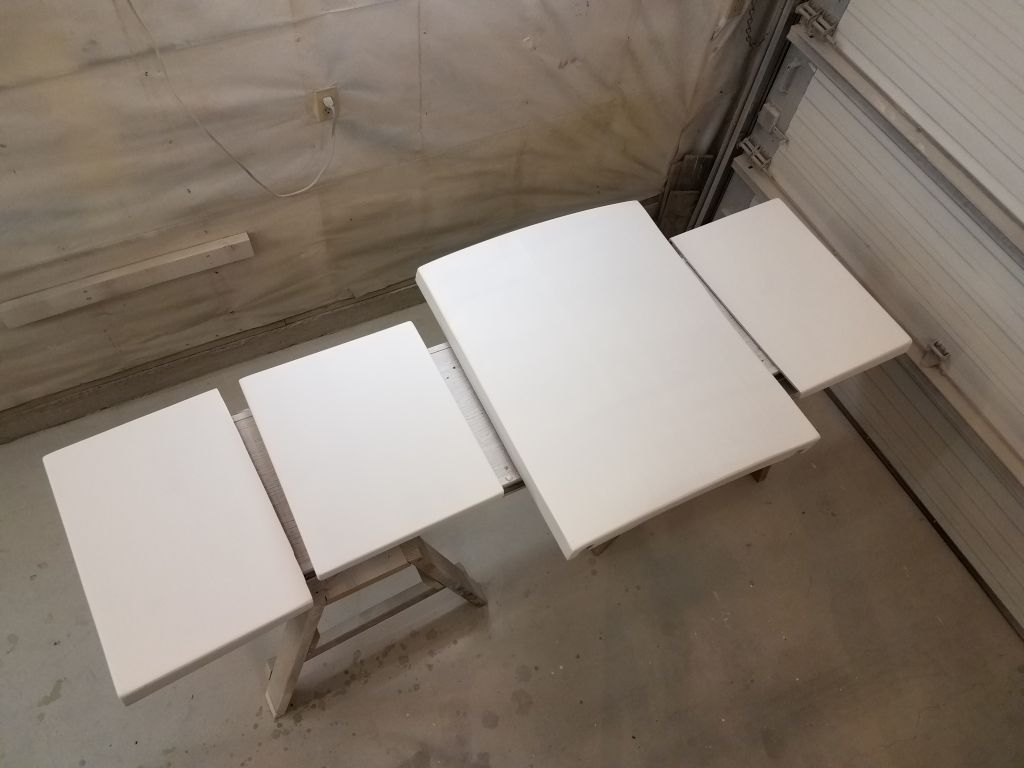
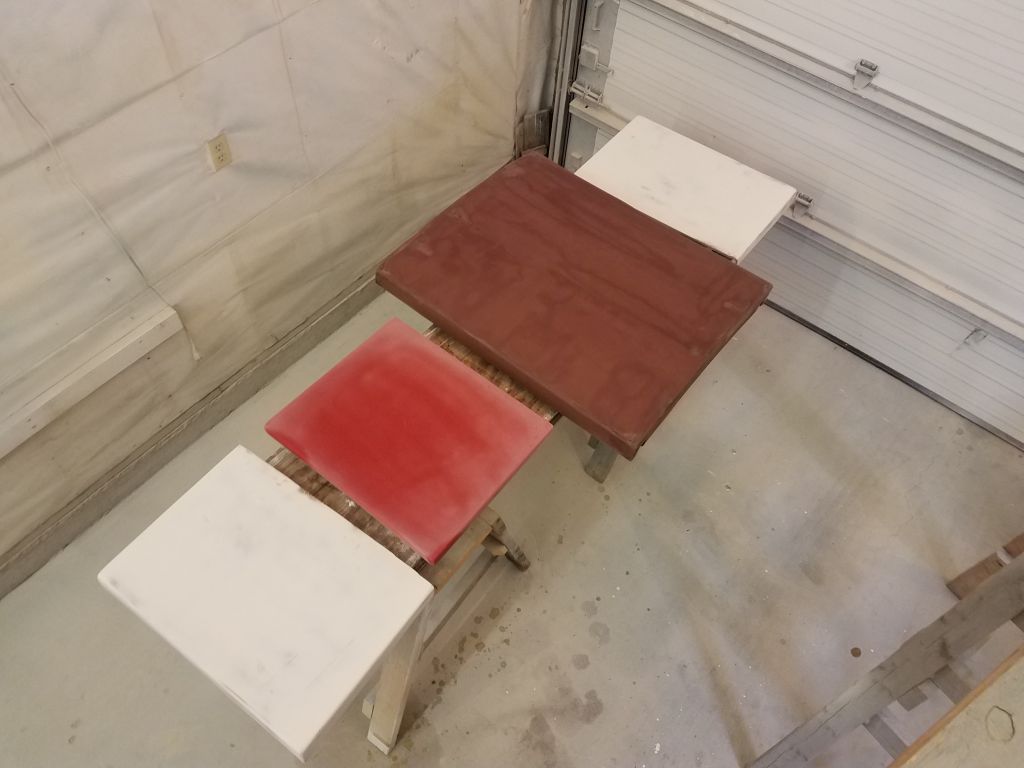
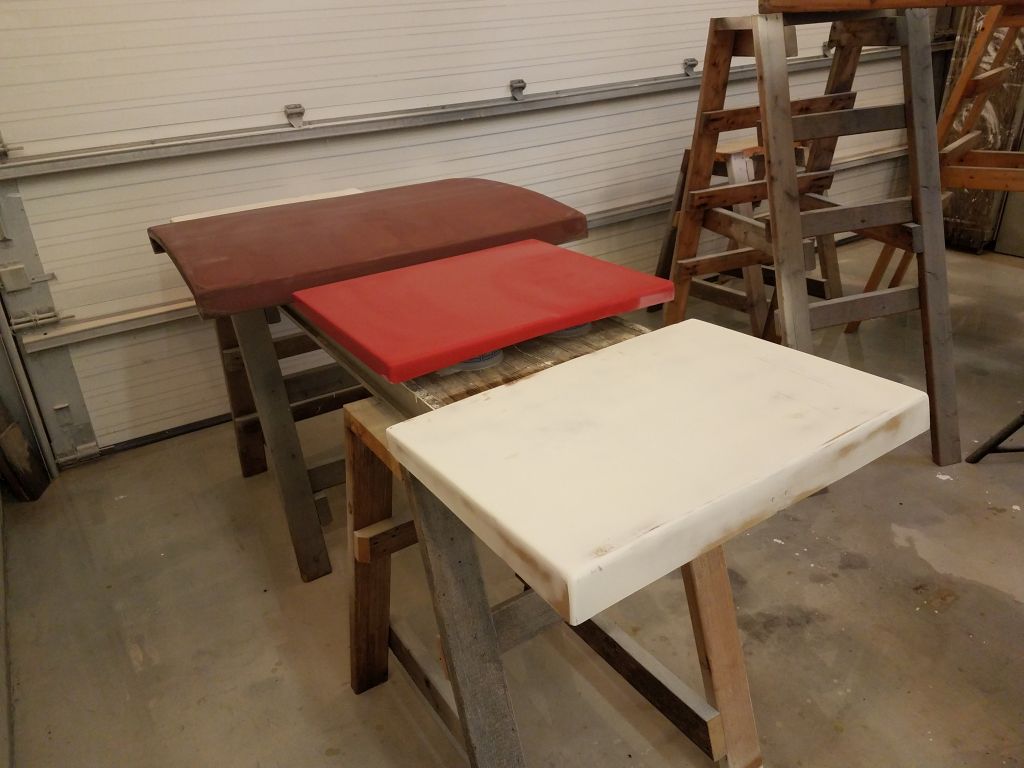
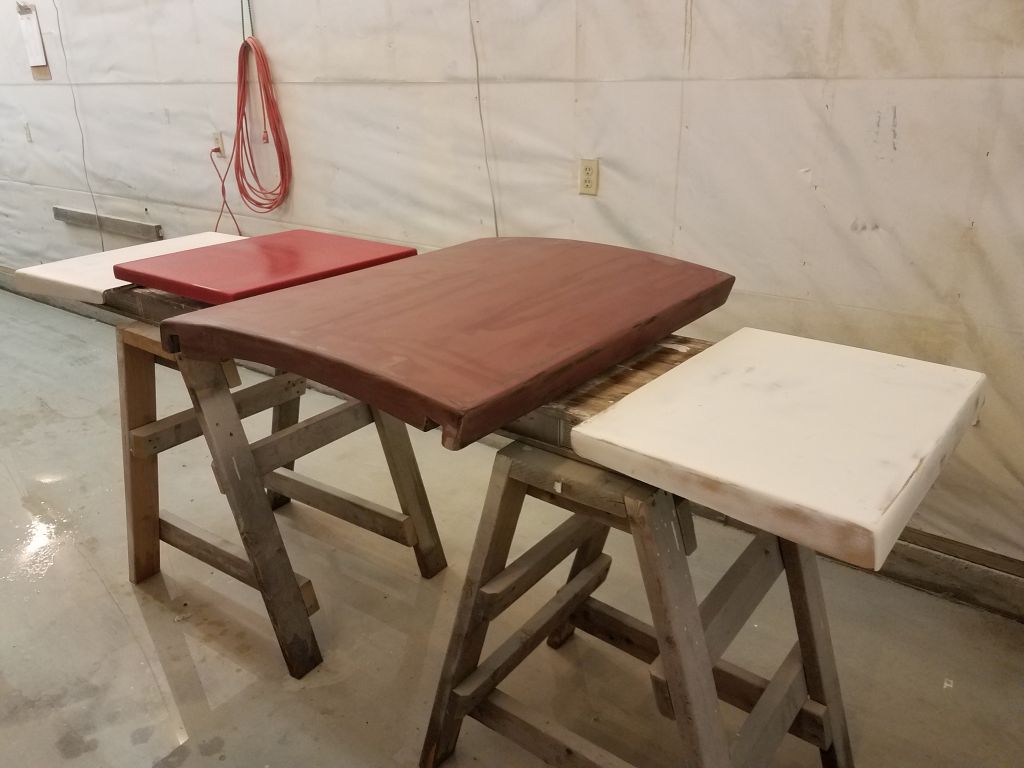
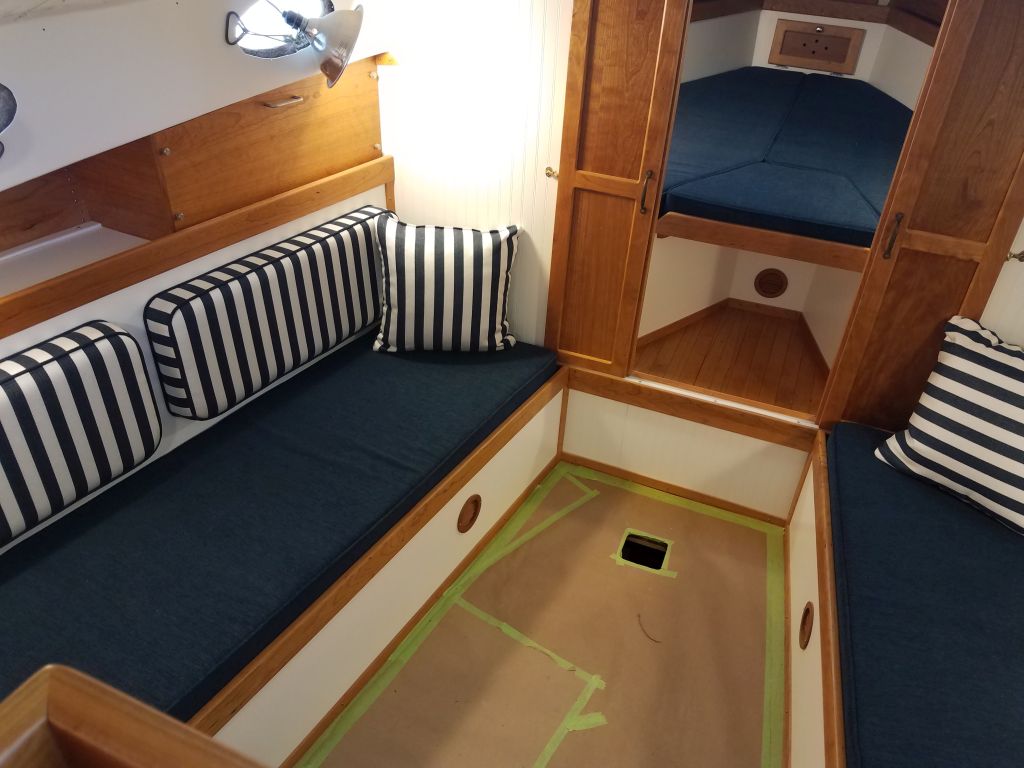
With the interior work and this phase of the project winding down, it was a good time to start work on the cabin table, which required refinishing.  The original table, which I removed early in the project, was heavily built of (I think) teak, and while it was in generally good condition, the finish wasn’t quite good enough to consider simply sanding and varnishing, with various nicks and scrapes that would have marred such an attempt.

To begin, I disassembled the table, removing the two drop leaves and their support systems, along with any hardware.  This left me with a series of manageable pieces.

I stripped the old varnish with a heat gun and scraper in the usual way and set the pieces aside for later sanding, cleanup, and eventual varnish.

Total time billed on this job today:   3.5 hours

0600 Weather Observation:  60°, foggy.  Forecast for the day:  Fog, then becoming sunny, 71°
Scupper 158

Tuesday

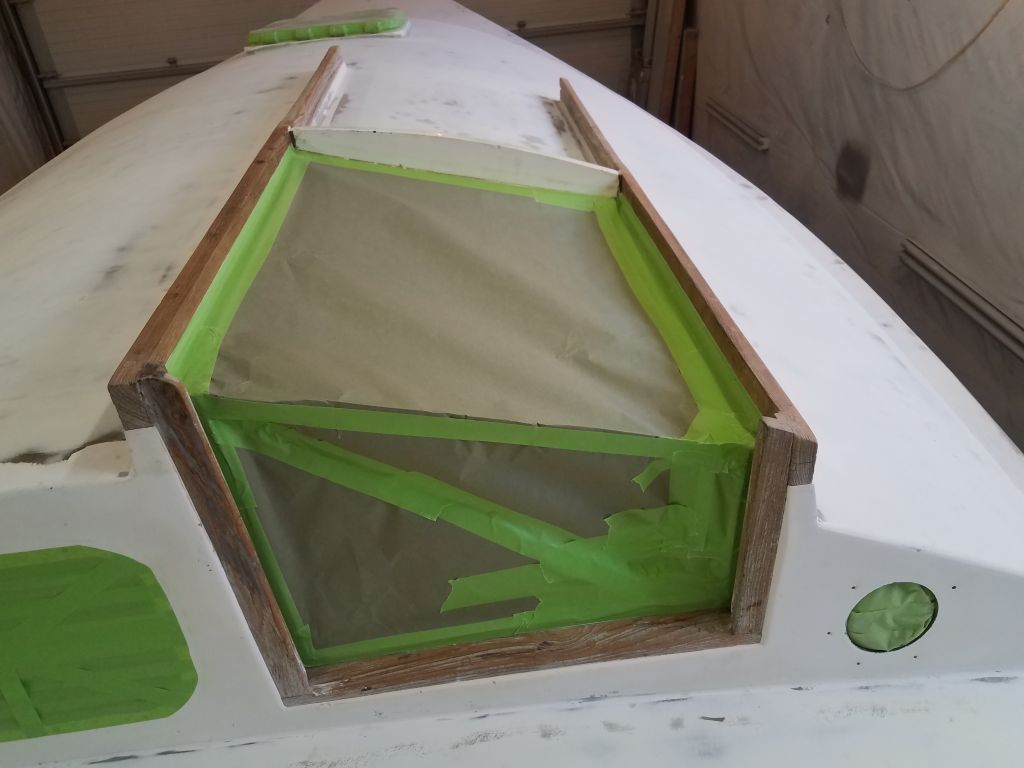
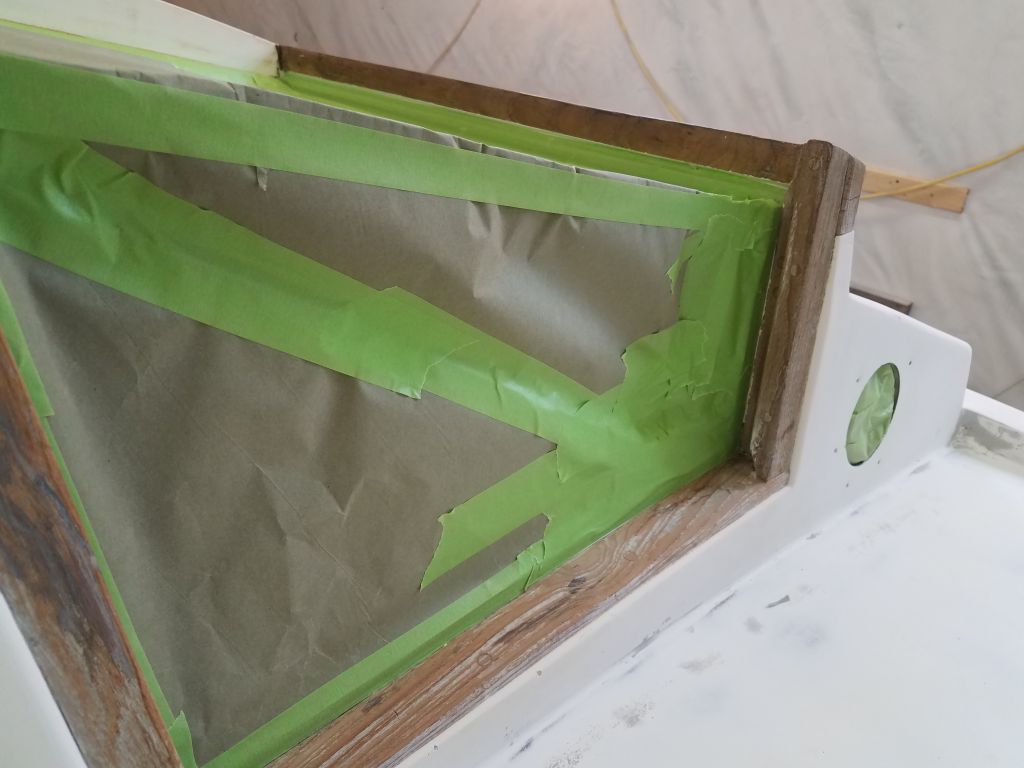
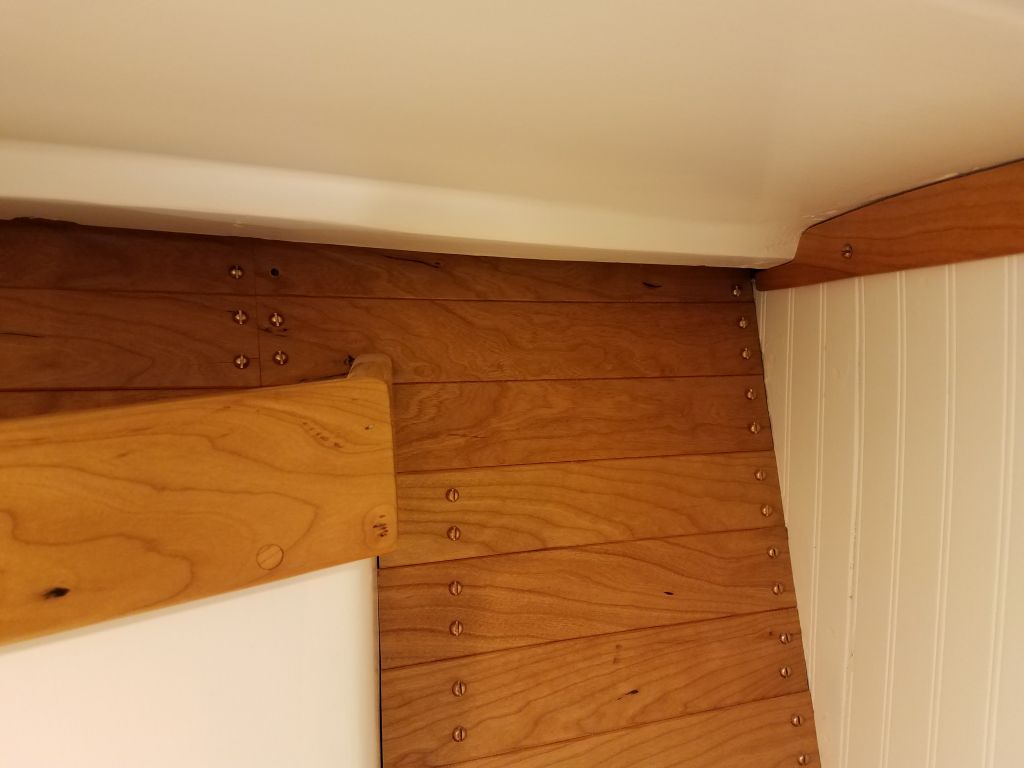
Now that the paint work at the companionway was complete, I could unmask the area and make up one final piece of trim to cover the exposed edge at the outboard side of the opening inside.  I made the “L”-shaped piece to cover the seams in this area, and once I’d test-fit the trim I removed it once more for final sanding and shaping, and then off to the varnish room.  Later, the unpainted exterior areas of the companionway trim would receive primer and paint to match the decks themselves.

After getting unintentionally sidetracked by another, unrelated, project, I got back to things in the late afternoon with the galley. Now that the countertop was complete, I could start to do the final installations and truly complete the space, which I looked forward to.

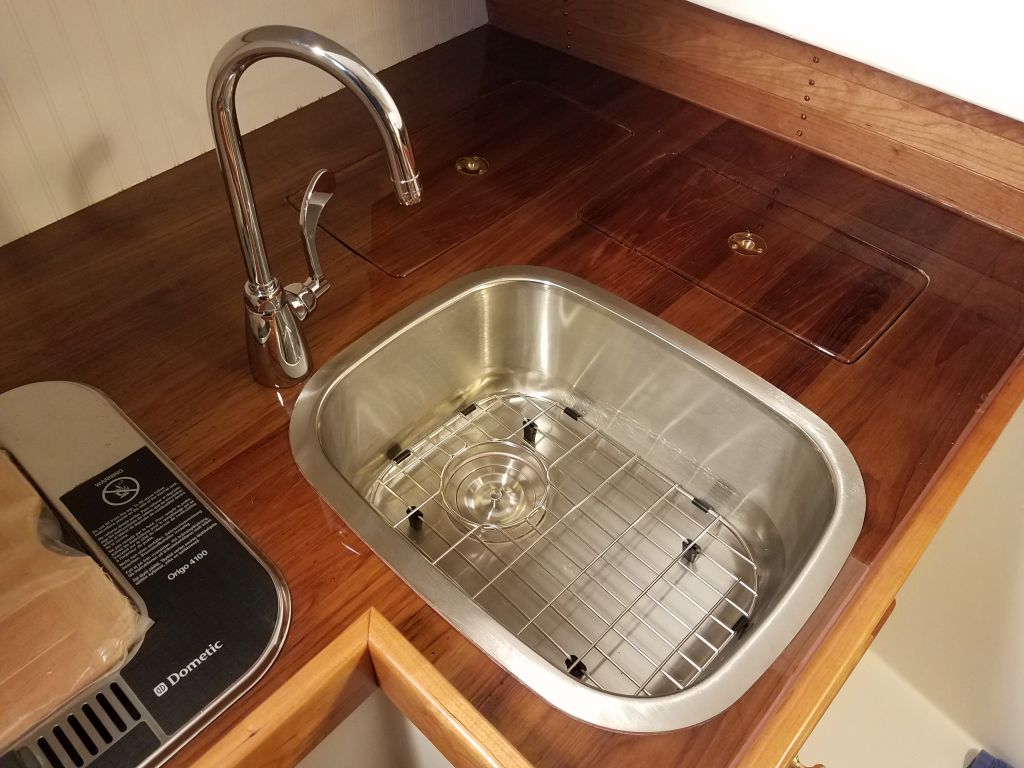
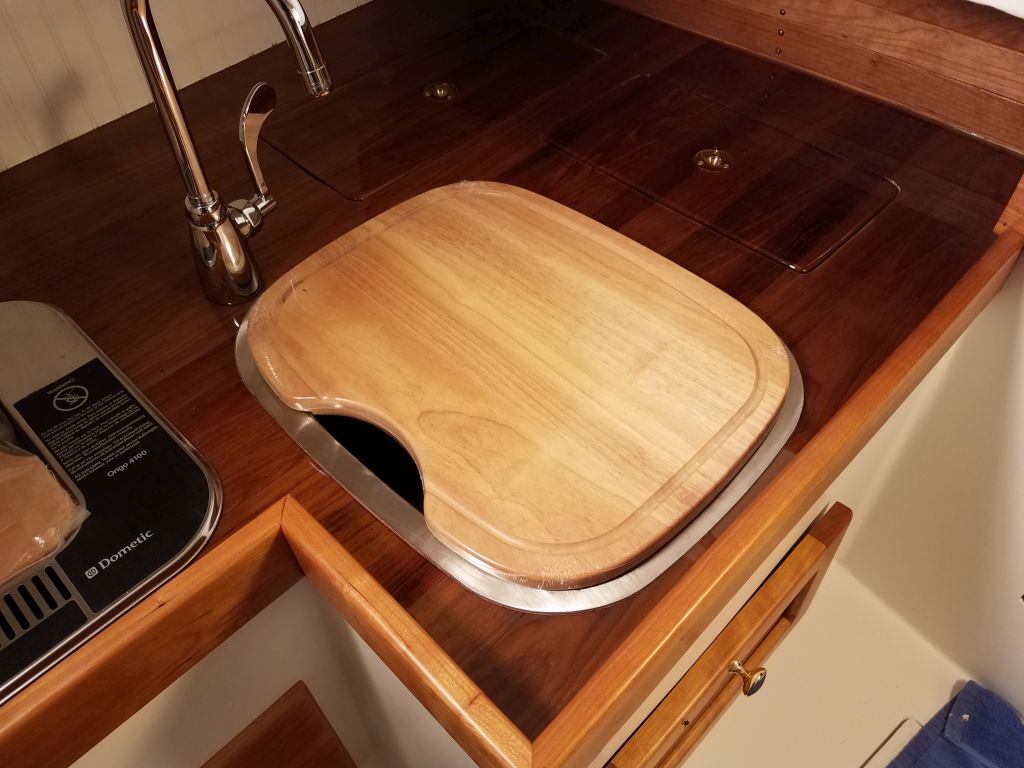
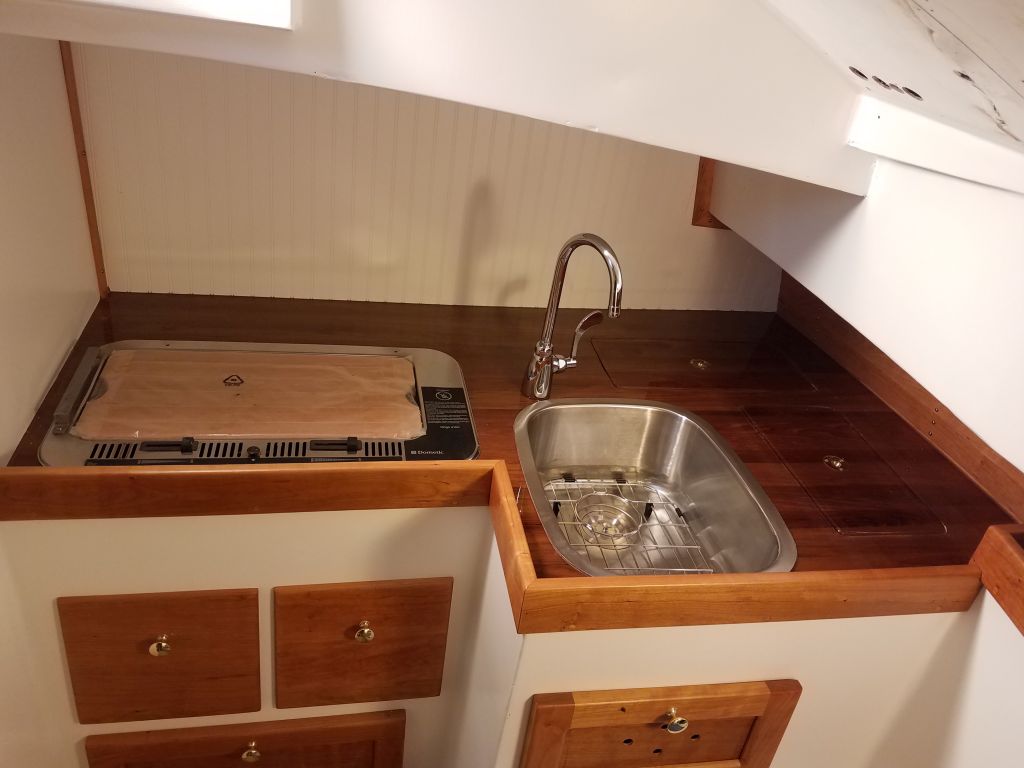
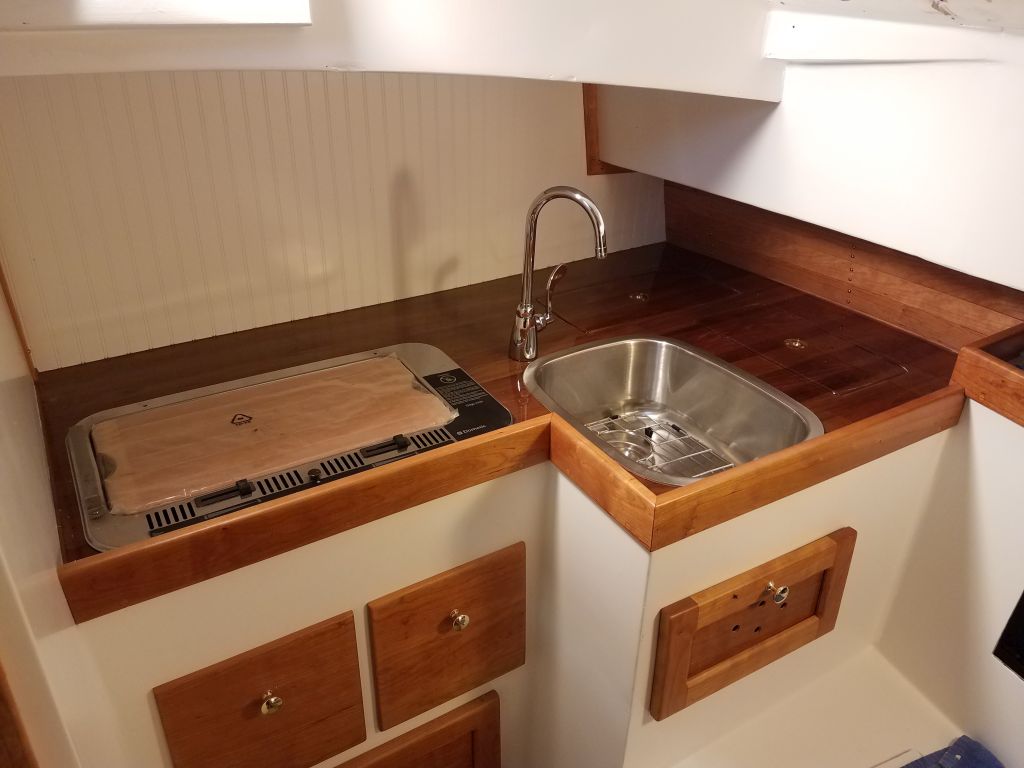
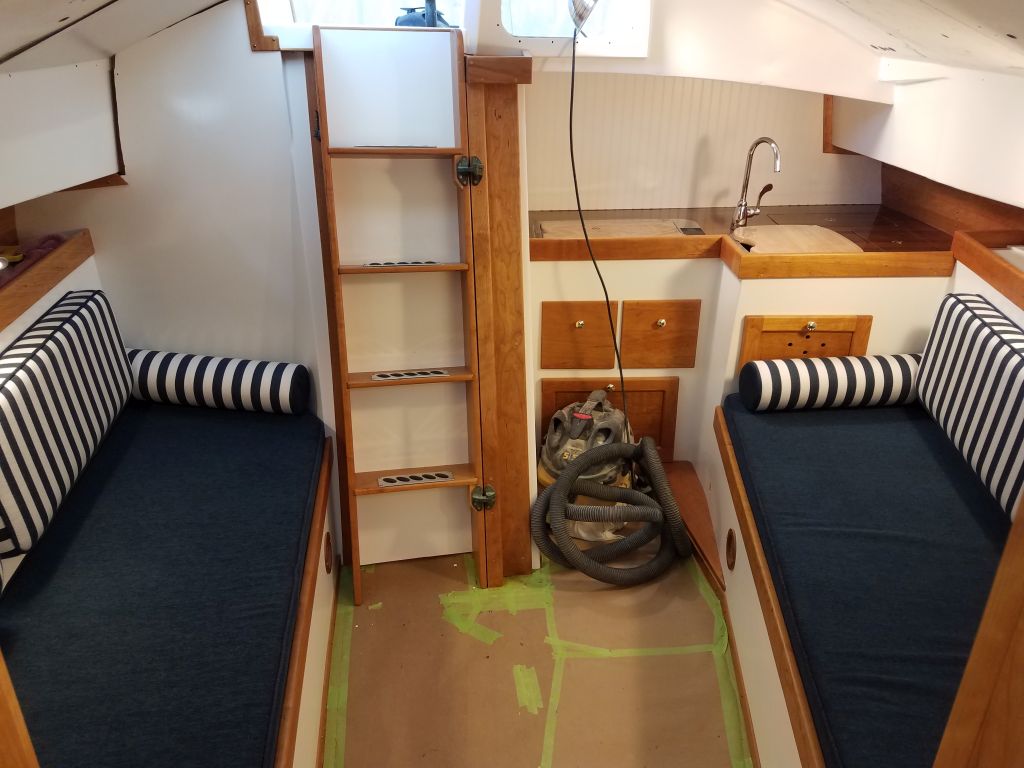
I began with the stovetop, which I’d removed from the galley early in the project.  It was a new-condition (and apparently never-used) two-burner alcohol drop-in.  Earlier, in a slack moment, I’d cleaned up some minor water staining that had marred the otherwise perfect stove; the cutting board was still in its plastic wrapping.  I found that I needed to enlarge the existing opening a bit in order to fit the stove, even though I’d patterned the new countertop around the original opening, but after a while I got the stove to fit back in and secured it with screws through the mounting flange.

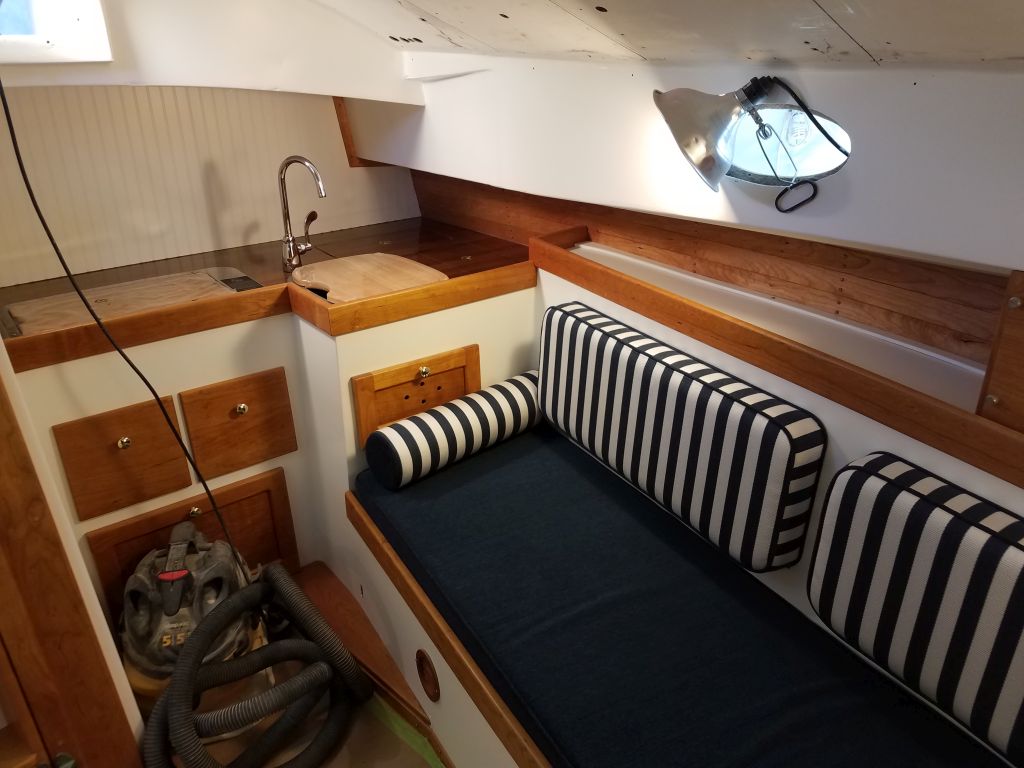
I installed the drain fitting in the sink, using sealant to secure and bed the fitting in place, and added a bronze tailpiece for easy and effective drain hose connection.  The sink fit back in its opening without an issue, but for now I left it dry-fit until I could install the faucet that was due to arrive in another day.  The sink also came with a wooden cover and cutting board which is visible in some of the photos further down the page.

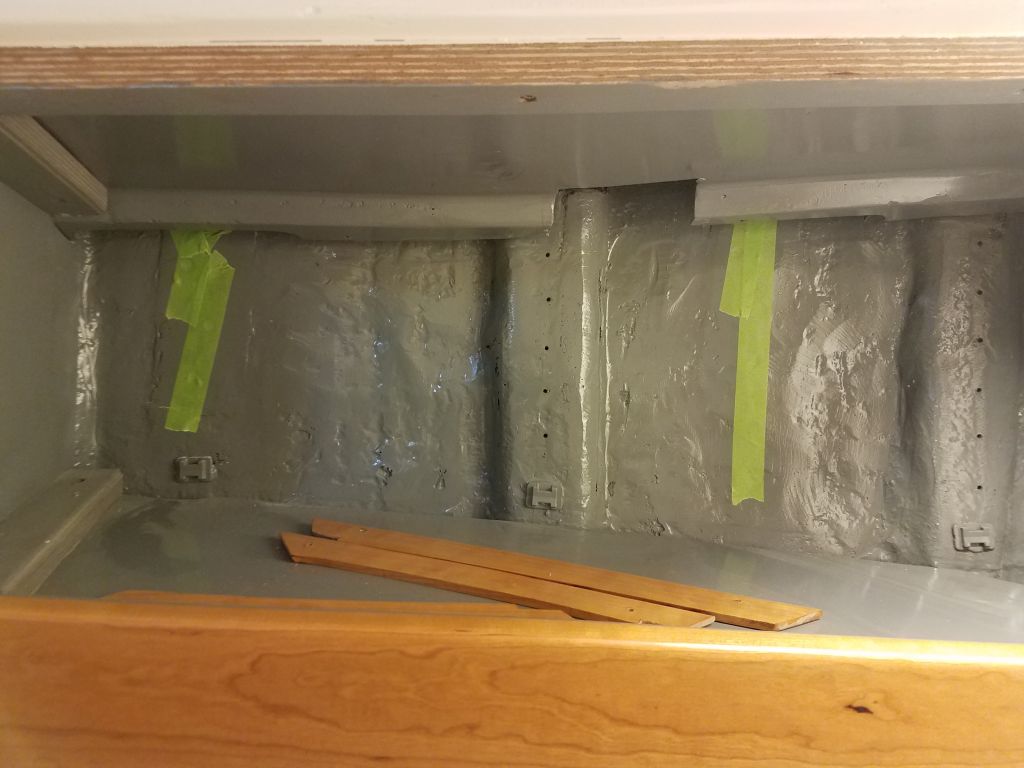
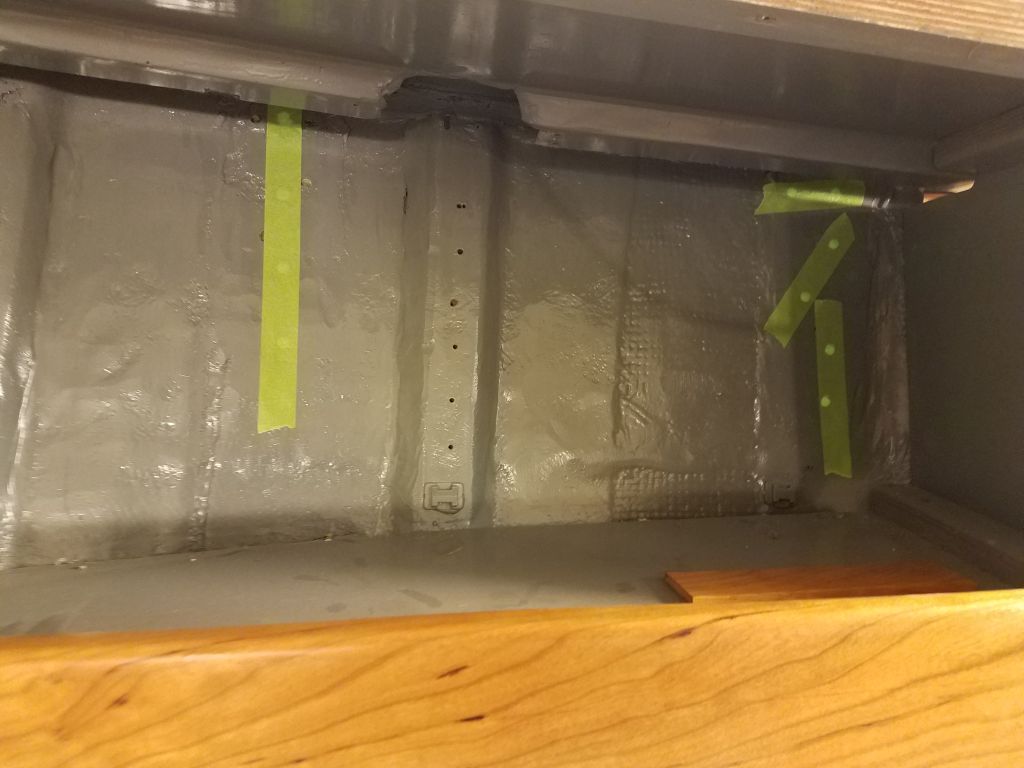
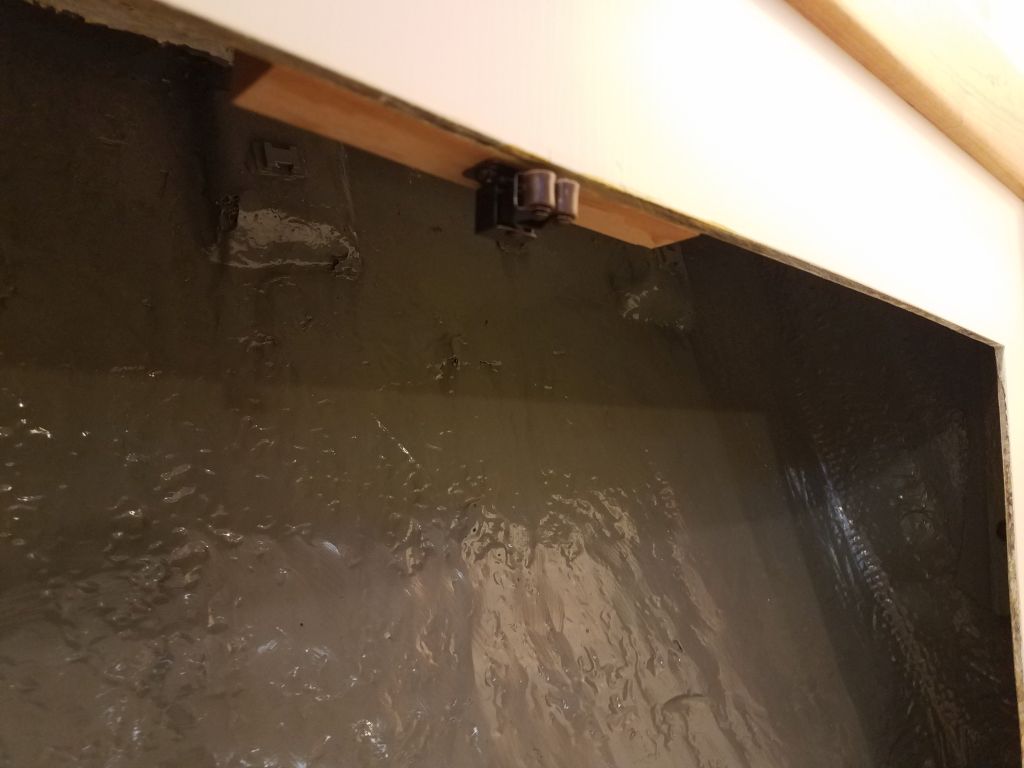
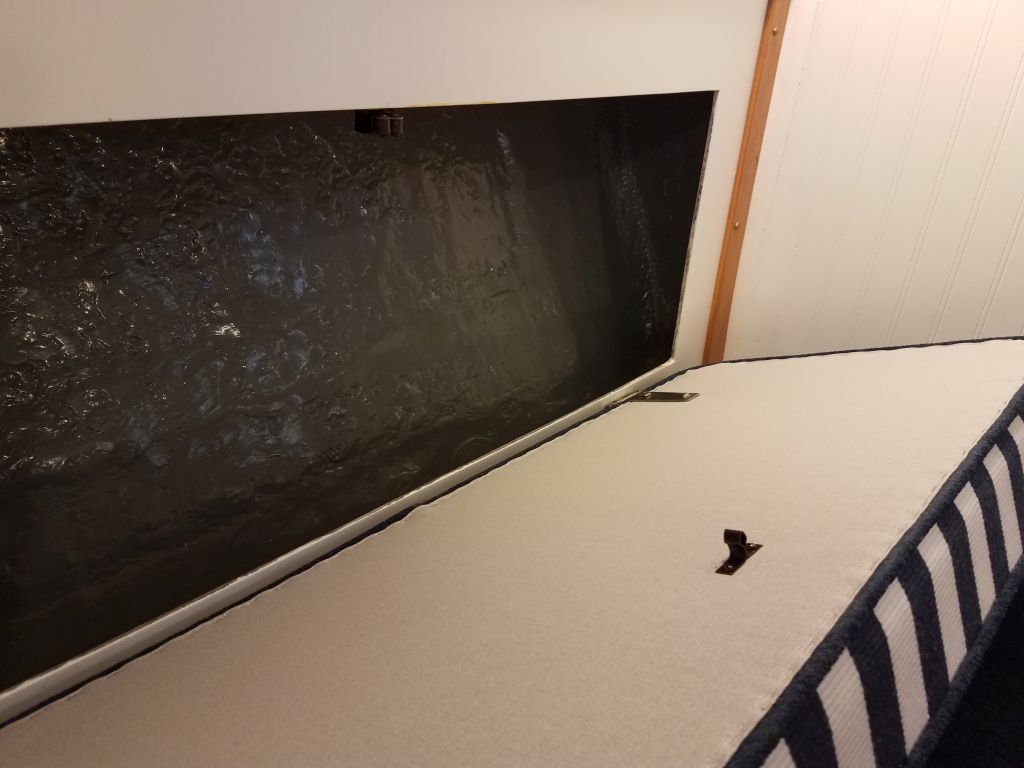
To fit the locker lids in the outboard countertop required that I clean up the openings a bit, as some of the epoxy coating had gotten into the corners, but after a bit the lids fit back in properly.  Later I planned to paint the insides of the openings and the edges of the lids since they looked a little raw as is.

Total time billed on this job today:  3 hours

0600 Weather Observation:  60°, mostly clear. Forecast for the day:  Partly sunny, 75°
Scupper 157

Monday

To finish off the doors to the forward cabin, I installed a slim piece of slippery plastic on the bottom trim, which slightly raised the doors to their final position and improved operation.  I installed the trim with screws in countersunk holes.

To secure the doors when opened, I installed brass latches at each end.

The companionway ladder and door required a latch to hold it closed on one side, plus another grab handle on the inside to help operate the door from within.  I salvaged these bronze pieces from the original doorway.

Continuing work on the galley countertop, I carefully sanded off the raised edges around the four openings, much as I’d done earlier on the loose hatches.

Afterwards, I applied some of the tabletop epoxy to the sanded and cleaned edges on the two locker openings.  I didn’t need to apply the epoxy to the stove and sink openings since the edges would be hidden by the installations.

With the countertop hatches on the bench, I installed the brass ring pulls.

After a light sanding and cleanup, I applied a second coat of semi-gloss white paint to the companionway and trim rings.

Total time billed on this job today:  4.75 hours

0600 Weather Observation:  55°, clear.  Forecast for the day:  Sunny, 80°

Scupper 156

Wednesday

In a short work day, I continued with the companionway.  After lightly sanding the primer and cleaning up afterwards, I applied the first of at least two coats of the same semi-gloss white enamel I used elsewhere throughout the interior.

I repeated the steps on the six port trim rings.

Total time billed on this job today: 1.5 hours

0600 Weather Observation:  45°, clear.  Forecast for the day:  Sunny, 76°

Scupper 155

Tuesday

With the countertop cured sufficiently (though full cure would take a few days), I removed all the duct tape and masking tape from the countertop and hatches. Though the epoxy coating was below the level of the masking tape along the edges of the countertop, the application process had spread some epoxy up and over the tape in several areas, which only meant it took some fine work to remove all the tape.  Without a full cure, I was wary of doing any damage to the fresh and highly glossy surface, so worked with extra care.

Removing the duct tape that had formed the dams revealed an unforeseen small problem:  the epoxy, though surface tension, had slightly climbed the duct tape dams at the countertop openings and around the hatch perimeters, leaving a raised edge when the tape was removed.

This wasn’t a problem on the stove and sink openings, where the edges would be covered by the installation flanges, but for the countertop storage lockers and lids, where the edges were the finished surface, I’d have to remove the raised part carefully.  I found I could use a sharp knife to pare away some of the excess now, but decided to leave the final resolution till later when I’d had some time to consider options.

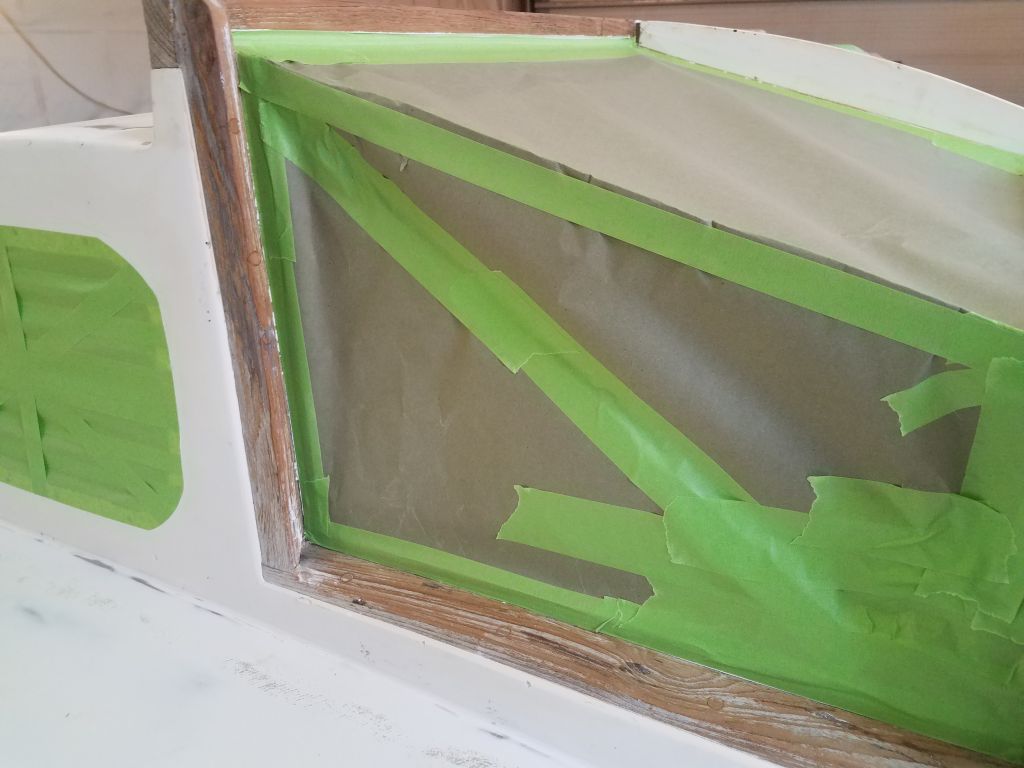
Meanwhile, I masked off the areas to be primed and painted around the companionway, then, after final preparations, applied a coat of white primer.  At the same time, I primed the interior port trim rings.

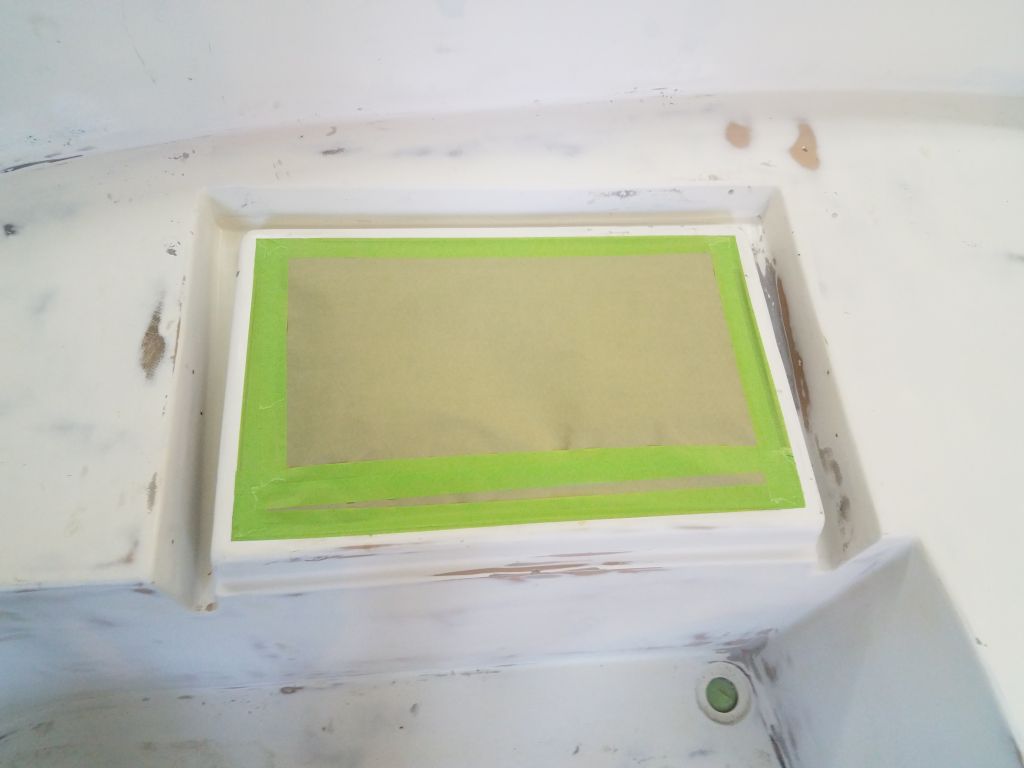
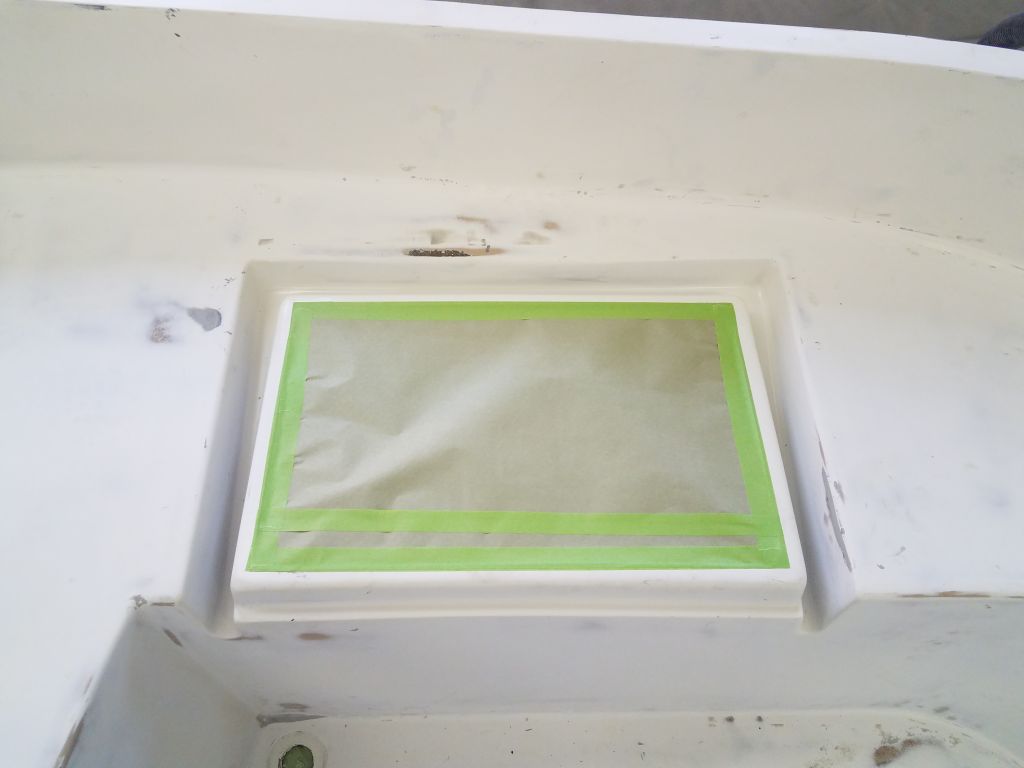
Later, working with the two loose hatches on the bench, I sanded the edges to remove the unwanted raised epoxy, staying away from the glossy field by keeping the sandpaper angled just to remove the edge.  I worked through several grits in this process, ending at 220, with a smooth and clean edge.  To finish off the edge, I mixed a small batch of the tabletop epoxy and applied it just to the sanded edges with a brush, which worked quite well.  I’d do the same treatment to the countertop openings a little later.

Total time billed on this job today:  4 hours

0600 Weather Observation:  60°, clouds and showers.  Forecast for the day:  Showers, 65°

Scupper 154

Monday

With a near-ideal 80° weather forecast for the clear epoxy countertop work still in place, I got started right away with the final preparations for the pour.  While it would get warm later, at the start of the day it was still on the cool side, so I bumped up the heat in the shop to help (and to ensure that the temperature remained constant in the overnight to come as well), and placed my containers of epoxy in a warm water bath to help the epoxy flow.  While I’d never used the table top coating before (like everyone else, I’d seen plenty of it on restaurant tables or bars throughout the years), all the information suggested that proper (i.e. warm) temperature was the key to success.

While the containers soaked for a while, I finished up final preparations.  In the galley, I installed some plastic sheeting inside the cabinets to protect them from drips, and spruced up some of the tape around the openings that I’d installed earlier.  The sink opening proved to be the most difficult, surprisingly, and I ended up installing all-new tape.  I also installed a tape dam around the outside perimeter of the two flush hatches.  Afterwards, I washed the bare wood with acetone.

The first coat required was to be a basic thin seal coat to absorb into the wood grain and provide a better substrate for the final flood coat.  I chose to start on the small loose hatches for practice before doing the main countertop, so I mixed up a small batch of the epoxy and mixed it according to the instructions.  I found it impossible not to create air bubbles–another instruction admonition–in the pot during mixing, but a little rest time before application helped disperse some of the mixed-in air.  I spread the epoxy with a squeegee and brush for the corners, basically getting the surface wet with no intentional excess.  The epoxy at this point was thick and dense despite its bath and ambient shop temperatures in the 60s or better, and this was instructive, but not harmful to the seal coat at this stage.  Still, it reinforced the need for warmth to allow the epoxy to flow properly on its own.

Afterwards, I repeated the process on the main countertop.  Here, perhaps because it was warmer in the boat (unconfirmed), I found the epoxy behaved a little better, and other than the irritation of avoiding all the raised tape dams to prevent damage as I leaned over the deep countertop, the seal coat went well, and was even smooth and glossy enough to provide tantalizing insight of things to come.

I had to babysit the fresh epoxy for some minutes to see if there were air bubbles forming that I’d need to remove, and I did end up using a heat gun over the surfaces to help raise and pop air bubbles as a practice for the flood coat, if not strictly necessary now.

I couldn’t risk doing any real work in the boat while the epoxy work was going on, lest I contaminate it one way or another, so while this put on hold my original plans for the week (priming and painting the companionway), I was quite pleased to be taking care of the countertop, since this final step had been pending for some time, so the minor delay in the intended work was of no matter.

Whiling away the time while the seal coat tacked up, I installed bronze handles (salvaged from the originals) on the now-complete forward cabin doors, and test-fit the doors in place.  I ordered some hooks to secure the doors open, as well as some slim slippery material to install along the bottom edge to slightly raise the doors and improve operation, and I’d complete those steps as soon as the new materials arrived.

Meanwhile, I worked on other things unrelated to the boat while I waited a few hours till I could apply the flood coat of epoxy.

By early afternoon, the shop temperature was an indicated 82° (and probably warmer up in the boat), which seemed perfect for the countertop epoxy work.  Again, I chose to begin the pour with the small hatches to learn and test the process, and it was immediately obvious that the epoxy flowed much better at this temperature.  Whereas in the morning the epoxy had been a lot like honey in texture, now it was substantially less viscous–but not runny nor watery, just a lot looser and prone to actual flowing/leveling, rather than sort of sitting in a blob and barely oozing from its original position, which was how it had acted when temperatures were in the 60s.

The pours for the hatches resulted in substantial bubbleage (a well-documented and expected condition) but the heat gun worked well to remove them all, leaving behind an almost ridiculously clear and shiny surface about 1/8″ in thickness.  The epoxy had leveled itself well and was easy to work at these temperatures.

Moving the operation back to the galley, I poured the flood coat on the main countertop.  Again, the process seemed to go well, and the epoxy was loose enough not only to flow, but to easily re-level whenever I had to squeegee or brush it into a tight corner or to fill a void in the coating.  For a while, I struggled to help along a section in the after outboard corner–hardest to see and reach–that didn’t seem to be leveling, till I realized I was actually seeing the reflection of the masking tape on the adjacent surface (the tape bulged over some ceiling fasteners, creating a rippled reflection in the super-glossy epoxy).

Babysitting the countertop, I carefully inspected it over and over for the formation of air bubbles, but there didn’t seem to be any at all–nice.  I did have a couple places (at that fussy sink opening, mainly) where epoxy found its way slowly through the dam and dripped onto the plastic within the locker, but I carefully added some extra tape from beneath to help stop the drip.  The good (and interesting) thing was that despite the leak, there appeared to be no worry that the coating would actually all drain away; it was thick enough to stay in place at its prescribed 1/8″ thickness, so stemming the drip was more a matter of keeping the mess to a minimum than anything else.

Lighting wasn’t great for highlighting the gloss and reflection in the new epoxy, and I wasn’t about to move a lamp or do anything else that might contaminate the surface (or worse), but I tried to photograph the surface from various angles to show the depth of gloss and reflection.  Pretty neat stuff, this.

Now I left the countertop alone to cure overnight.  I left the heat set at 75° for the night to maintain the shop temperature once the currently-warmer temps dropped with the night.

In total, I used about one mixed gallon (1:1 mix) of the epoxy coating for this work over both coats.

Total time billed on this job today:  5 hours

0600 Weather Observation:  50°, mostly clear.  Forecast for the day:  Sunny, 80°

Scupper 153

Friday

The weather forecast suggested that I might have a chance the temperatures I needed to pour the epoxy countertop early in the week, so I continued some of the prep work towards that end, masking off lavishly around the countertop, and using duct tape to dam up the four openings in the countertop (stove, sink, and two storage openings).

With that complete, I sanded the companionway door trim and, after cleanup and all final preparations, applied a coat of the same rubbed-effect satin varnish used everywhere else in the cabin.  Much later, with the varnish cured, I removed the masking tape and rehung the laddor [sic].  Still ahead, I’d prime and paint the remainder of the companionway opening to complete the finishing work.

Total time billed on this job today:   3 hours

0600 Weather Observation:  45°, clear. Forecast for the day:  Sunny, 76°

Scupper 152

Thursday

Now that the first side of the forward cabin doors had had a couple days to cure, I could flip the door over and prepare the second side for the final coat of satin varnish, which I applied once preparations were complete.

In the cabin, I sanded and cleaned the companionway door trim and environs, then applied the 4th build coat of gloss varnish to these surfaces.

The port trim rings required some light sanding to finish up with the minor fairing repairs I’d completed.

Unclamping the mast compression post assembly, I used the table saw to true one glued edge, then planed the blank clean and smooth on all sides, ending up with a square blank about 2-7/8″ on a side.  I trimmed the ends and set the post aside for now.

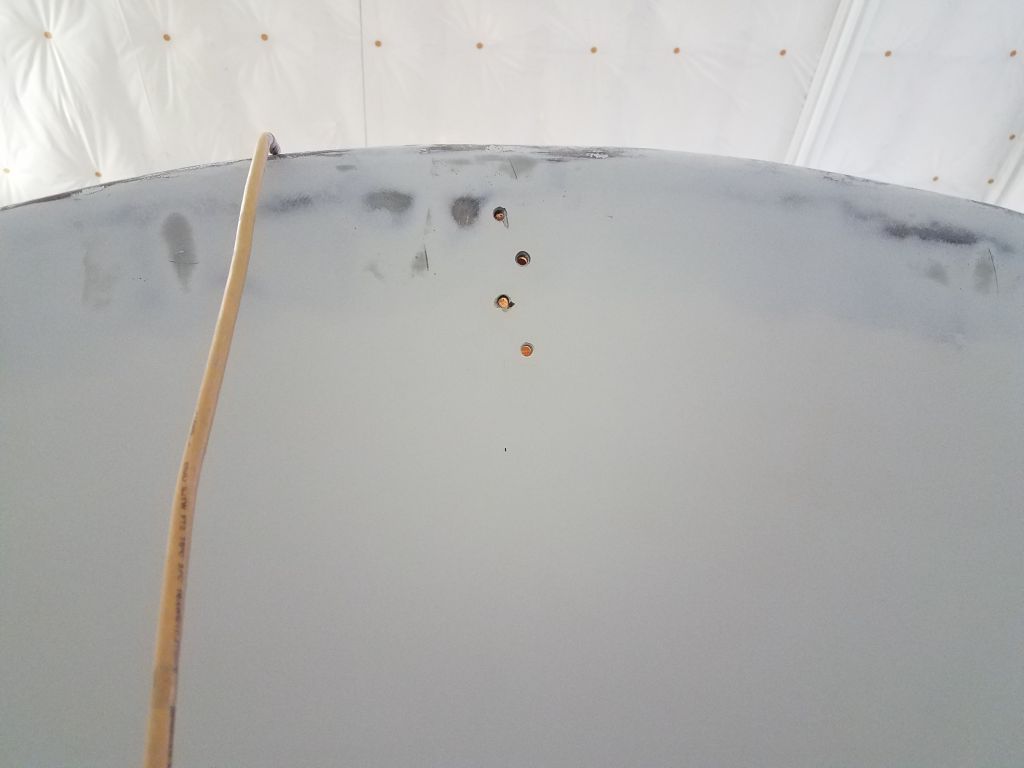
To finish up my simple rudder stop system, which would prevent the rudder from turning too far and hitting the hull (this had caused the damage to the top of the blade that I repaired earlier), I installed a pair of stainless steel cables running between the bronze arm I’d installed on the rudder shaft and the bulkheads on either side of the engine room.  To prepare for this, from outside the boat I turned the rudder as far as it should go to one side, and used a little wedge to hold it in place at that position (i.e. the maximum turning angle).  Then, working in the after steering room, I installed the cable between new eyebolts on the steering arm and bulkhead, securing the cable as needed with simple U-clamps.  These aren’t the sleekest or strongest things out there, but in this instance they’d do the job well and easily and with sufficient strength for the job description.   They also allow easy length adjustment should it become necessary.

I finished up one side, then turned the rudder and held it in position on the other side and repeated the process.  I originally tried the eyebolts in one of the pre-existing holes near the tops of the bulkheads, but decided to move them to new holes near the bottoms of the bulkheads at the hull when I found that the cable might torque the unsupported tops of the thin bulkheads too much if someone at the tiller pushed too hard against the stops.  The attachment was much more secure at the lower, tabbed edges of the bulkheads.

Quite frankly, if someone was truly determined to push the tiller farther past the extent of the cables, I preferred that the cables slip than cause damage to some other more critical component or structure

Not that they would slip, necessarily–but the point is that ultimate cable strength here could be more harmful than not.

With the cables in place, the rudder stopped a comfortable but minimal distance from the corner of the hull on each side.

Total time billed on this job today:   5 hours

0600 Weather Observation:  58°, rain. Forecast for the day:  Rain and showers, maybe a thundershower, 71° 

Scupper 151

Wednesday

With some other commitments on the docket, it was a shorter day, some of which I spent on planning ahead for the upcoming electrical installation on the boat (both propulsion and house sides), and in the meantime I continued work on the salient ongoing chores on the boat.  With summer break approaching, the current phase of the project was winding down at this point, and the important-to-finish varnish work in the cabin was a bit of a crimp on my style in terms of switching focus to either systems or final exterior preparations, so for now I satisfied myself with short days that checked all the critical boxes on my immediate list.

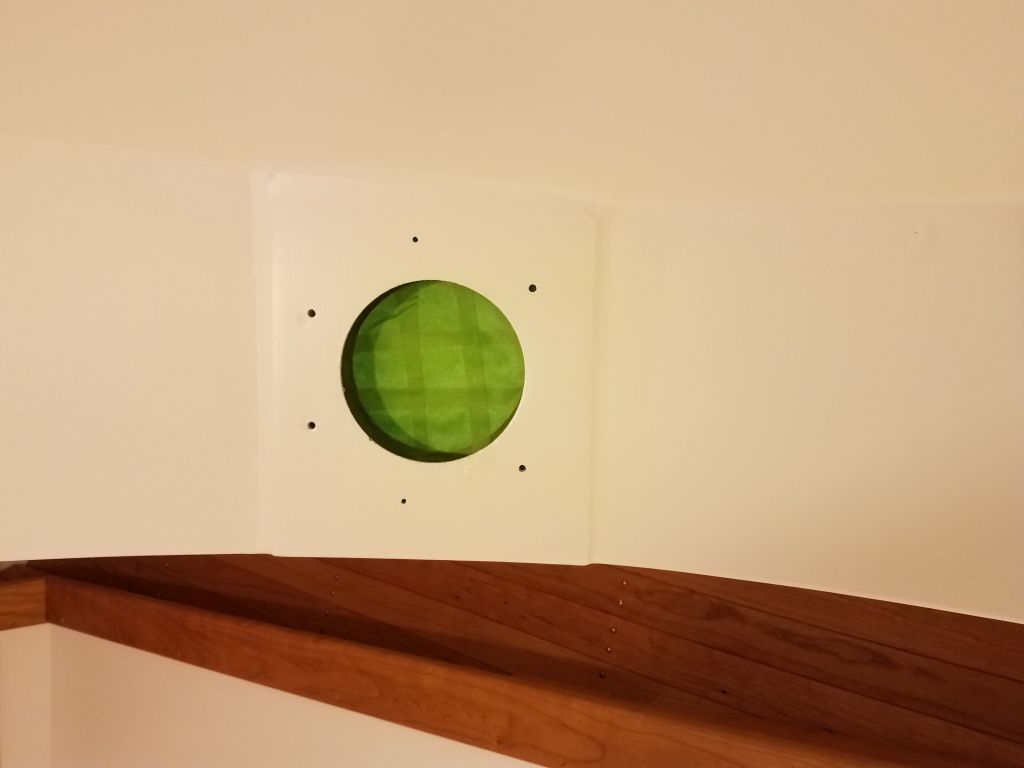
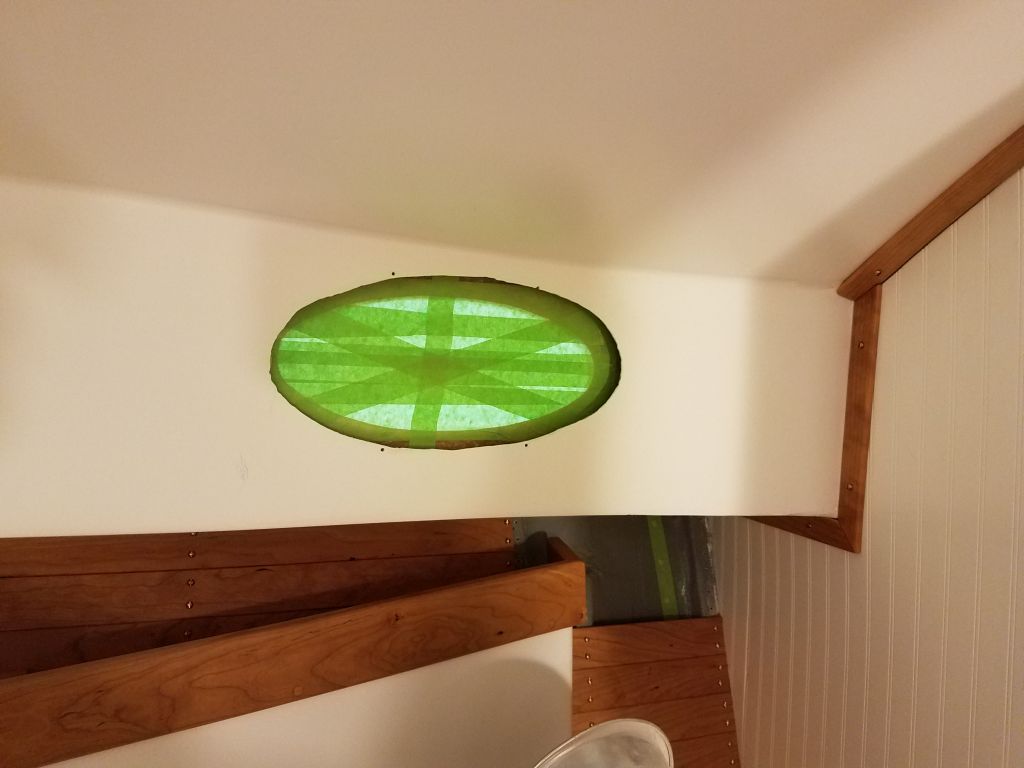
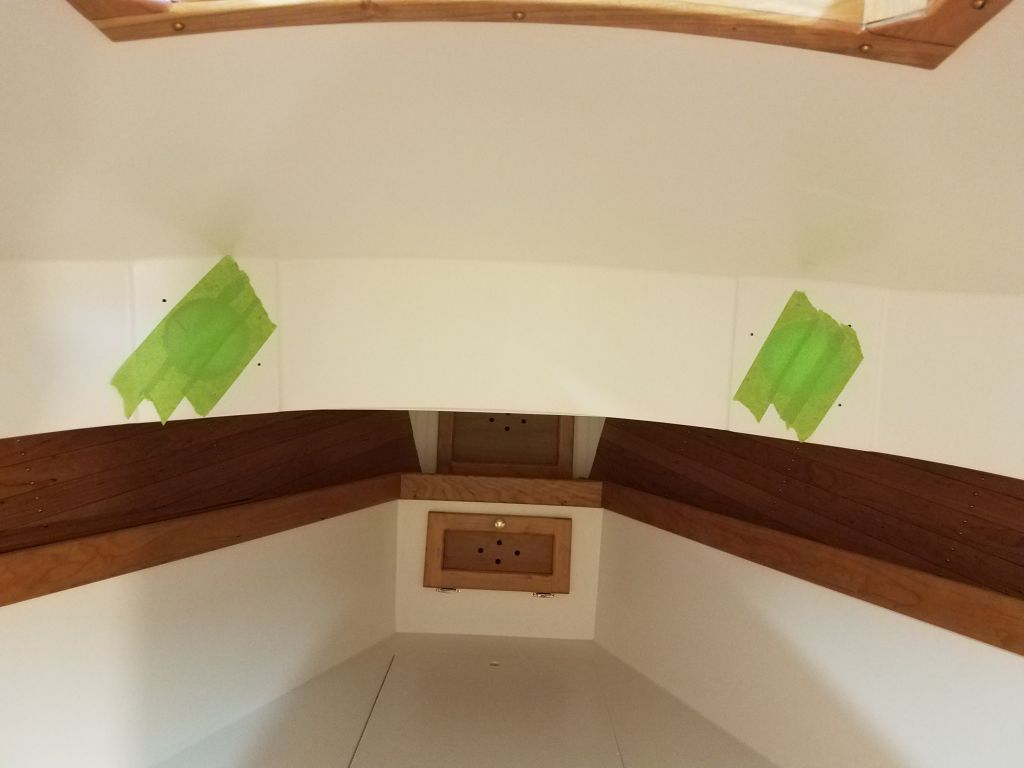
One of these little boxes was the interior port trim rings, several of which required some minor cosmetic-level repair to fix some minor areas of damaged gelcoat inside the rings, and a larger area on one ring where the edge had chipped away in an unsightly manner.  I applied epoxy fairing compound as needed to these small places, and set the trim rings aside for curing.

After a session of engine (I can’t help calling it the engine just for convenience’s sake and long convention) and electrical planning and materials specifications, I moved ahead with the companionway trim work, lightly sanding, cleaning, and revarnishing (coat #3) the door trim and environs.

Perhaps the last real interior trim to deal with was the mast compression post, which fit between the deck and keel directly beneath the mast step.  As nice and open as the cabin was at the moment, the compression post was required for mast support and therefore I must build a replacement for the original one, which was in fine structural condition but cosmetically suspect and built of the wrong wood species now that the cabin was cherry-trimmed.

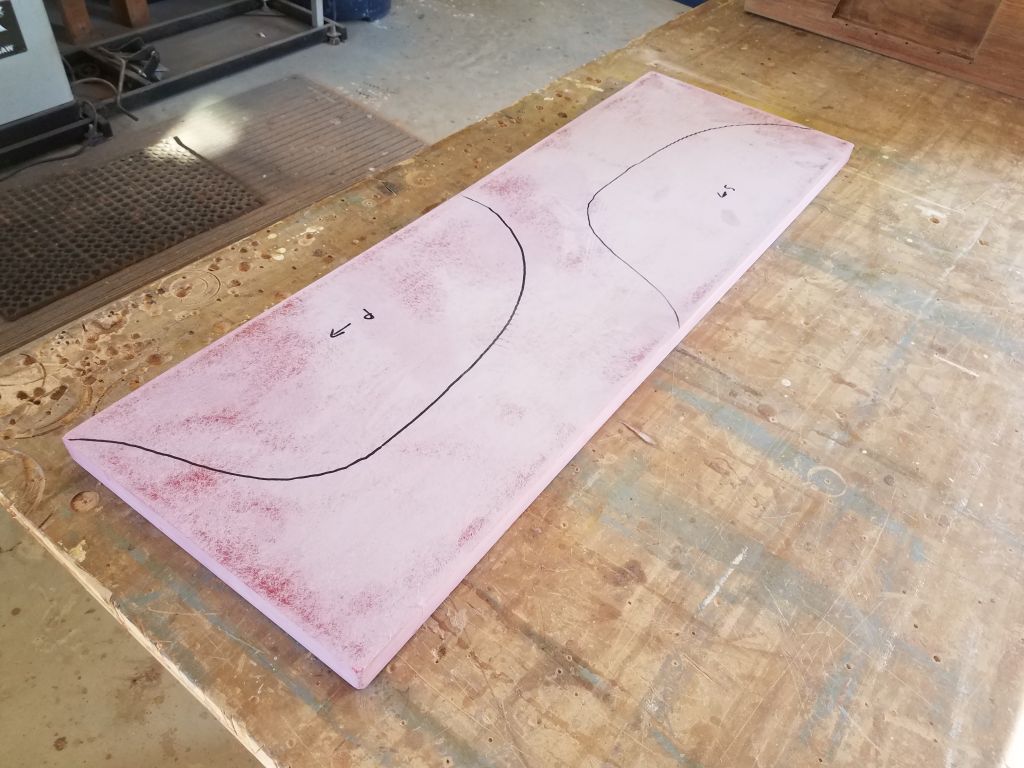
I had one long piece of rough cherry stock on hand, a piece left over from some long-ago order or another, and now I needed it in order to come up with enough cherry for the roughly 3″ square compression post assembly.  I began by cutting the 14′ long piece in half (the compression post was somewhere over 6′ in length), then planed it smooth on both sides, keeping the blank as thick as possible while removing all the rough milling marks.  I ended up with stock just under 1″ in finished thickness, and after straightening one edge of the rough boards I sawed three pieces 3″ wide from which to build the new post.  Finally, I laminated the three sections together with epoxy adhesive for strength, and clamped the assembly securely for curing.

Total time billed on this job today:    4.5 hours

0600 Weather Observation:  50°, light rain.  Forecast for the day:  Showers and cloudy, 65°

Scupper 150

Tuesday

With base coats complete on both sides of the forward cabin doors, I switched now to the rubbed-effect satin finish for the next coat on the main cabin side of the doors.

Working in the cabin, I lightly sanded the first coat of varnish on the companionway door trim, then cleaned up to prepare it for varnish later in the day.

In the meantime, I turned to the galley countertop.  Working with an anecdotal assumption, formed over 52 years of direct experience, that ambient temperatures in the area would someday during the coming months eventually rise back into the mid- or upper 70s or higher (an elusive benchmark thus far this season), making it feasible for me to pour the self-leveling epoxy coating for the countertop surface, I wanted to get some final preparatory steps completed now so that when the time came, there’d be nothing standing in the way of the temperature window and completion of this crucial part of the interior.  Sure, I could raise the heat in the shop to this level if needed (and I would if I had to), but I thought it seemed likely that Mother Nature could take care of the temperature if I maintained patience.  It wasn’t going to happen this week, but I’d be ready when it did.

Whether necessary or not, I wanted to seal around the edges of the countertop where it met the bulkheads, ceiling, and trim to ensure that the top surface would contain all the liquid epoxy when I installed it and to prevent any chance of leakage down some small gaps or cracks.  I’d never worked with the pourable epoxy coating before, and wasn’t about to take a chance of ruining an adjacent surface or compartment (not to mention the countertop) with seepage.  I removed the paper covering I’d had in place over the countertop for protection, then with a spacer masked off clean lines 1/8″ on either side of the seams along the edges on all sides.  I added another width of tape for extra protection.

Next, I applied a bead of brown sealant, pressing it tightly into the corners and gaps with a finger and removing most of the excess in the process.

A little later, once the sealant had tacked up, I removed the masking tape to leave clean lines on both sides.  I hoped and planned that this bead would provide the necessary damming at the countertop edges to prevent any epoxy loss through the gaps.

Afterwards, I finished up a small lingering task in the head, where I installed a pair of door catches on the engine room door to hold it securely closed.

This took care of my interior plans for the day, so I finished up with a second coat of varnish on all the companionway trim areas.

Total time billed on this job today:   5.5 hours

0600 Weather Observation:  45°, clear.  Forecast for the day: Sunny, 68°

Older posts Newer posts