
(page 109 of 165)

Scupper 48

< Back to Scupper

Wednesday

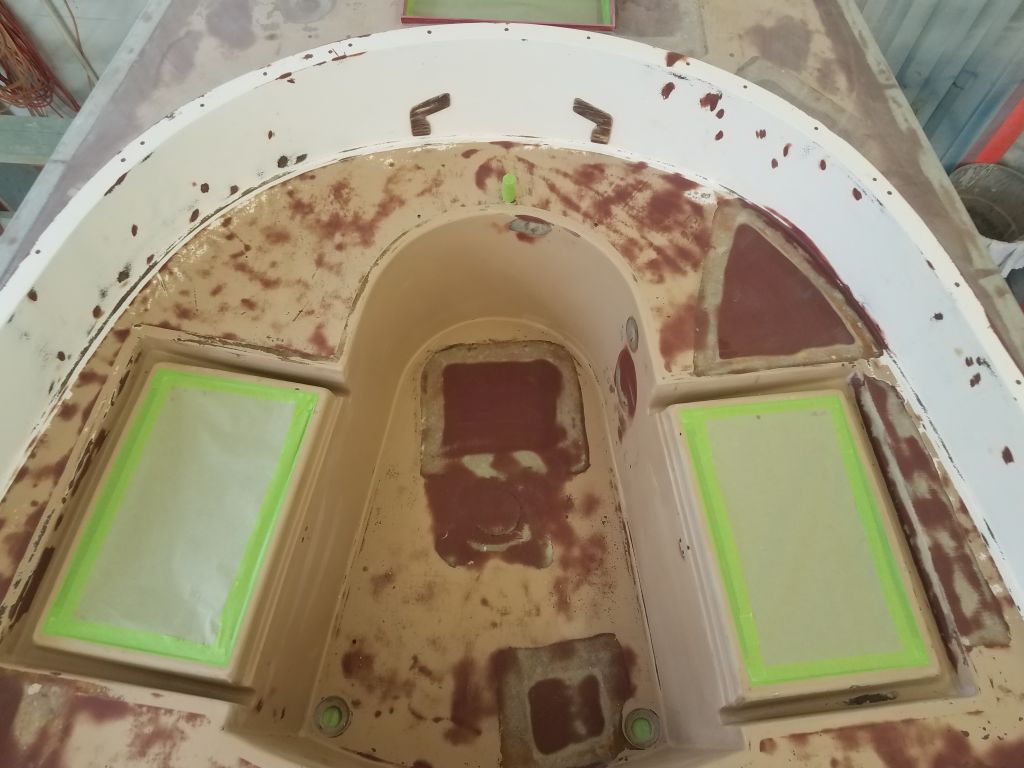
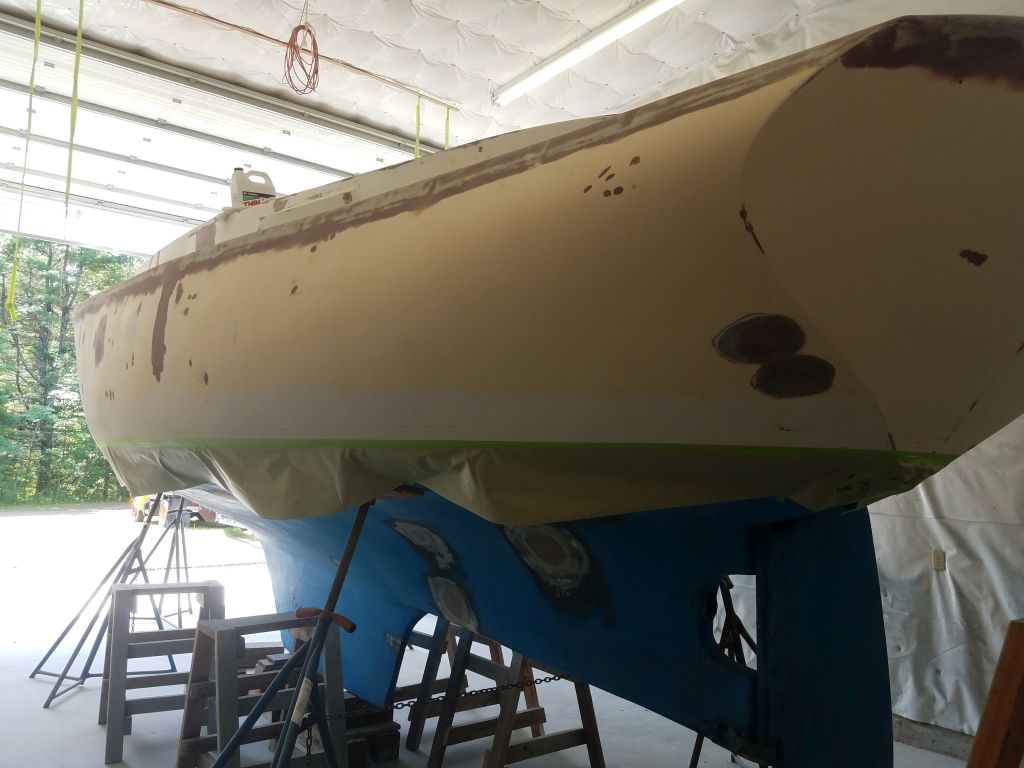
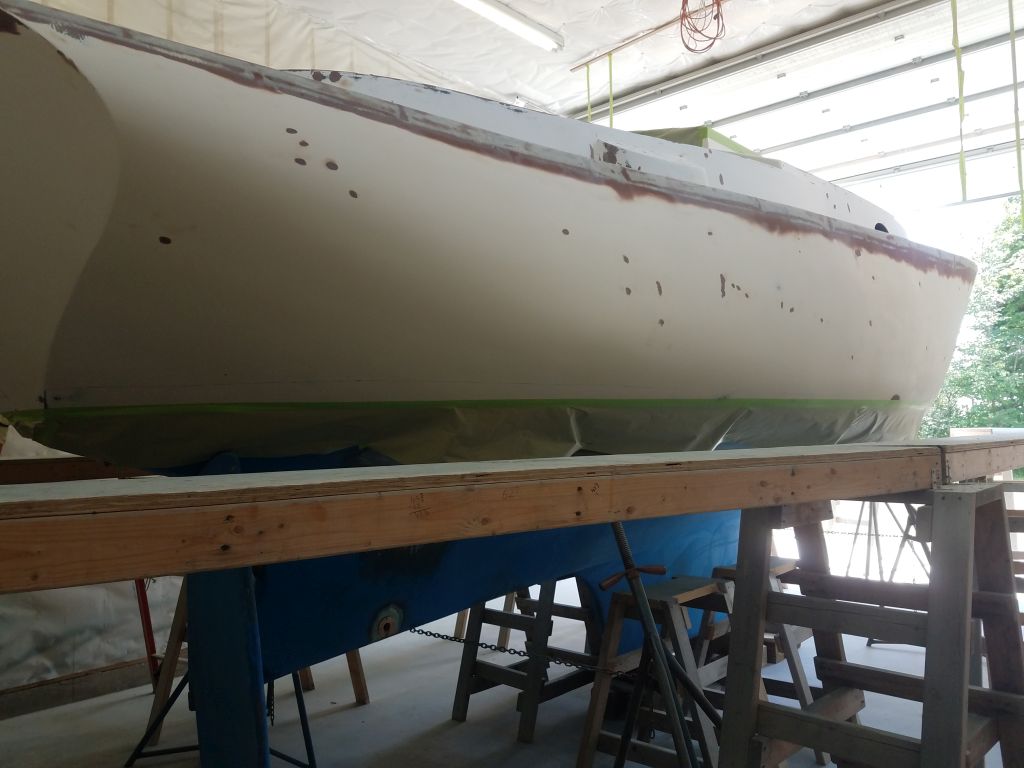
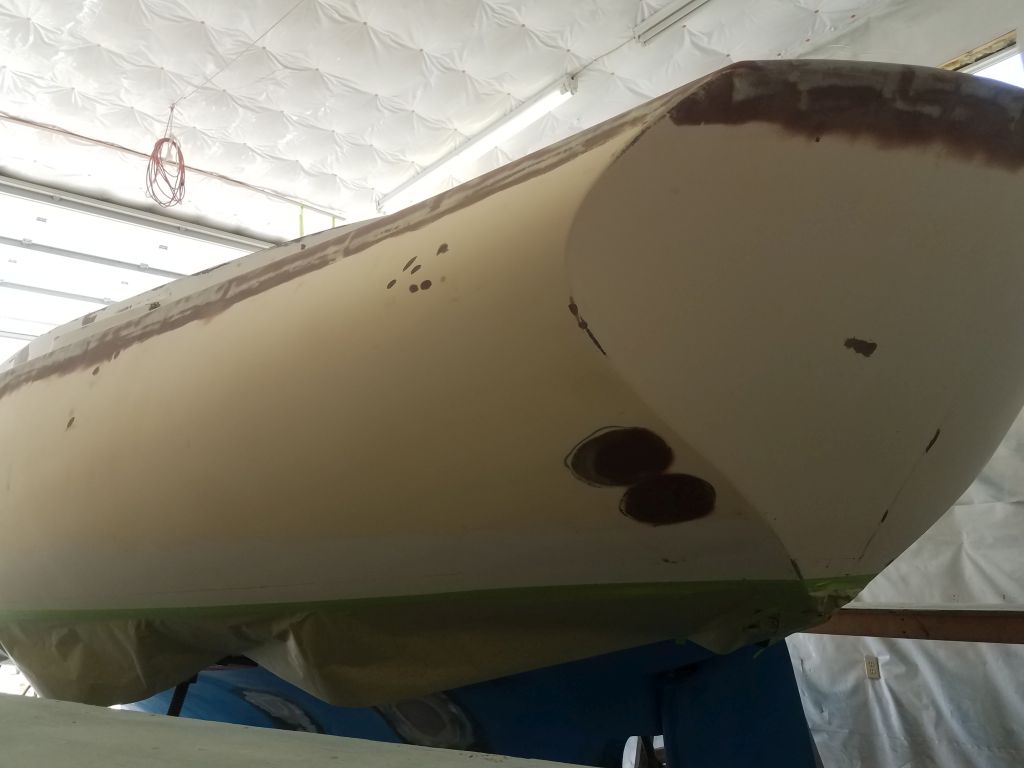
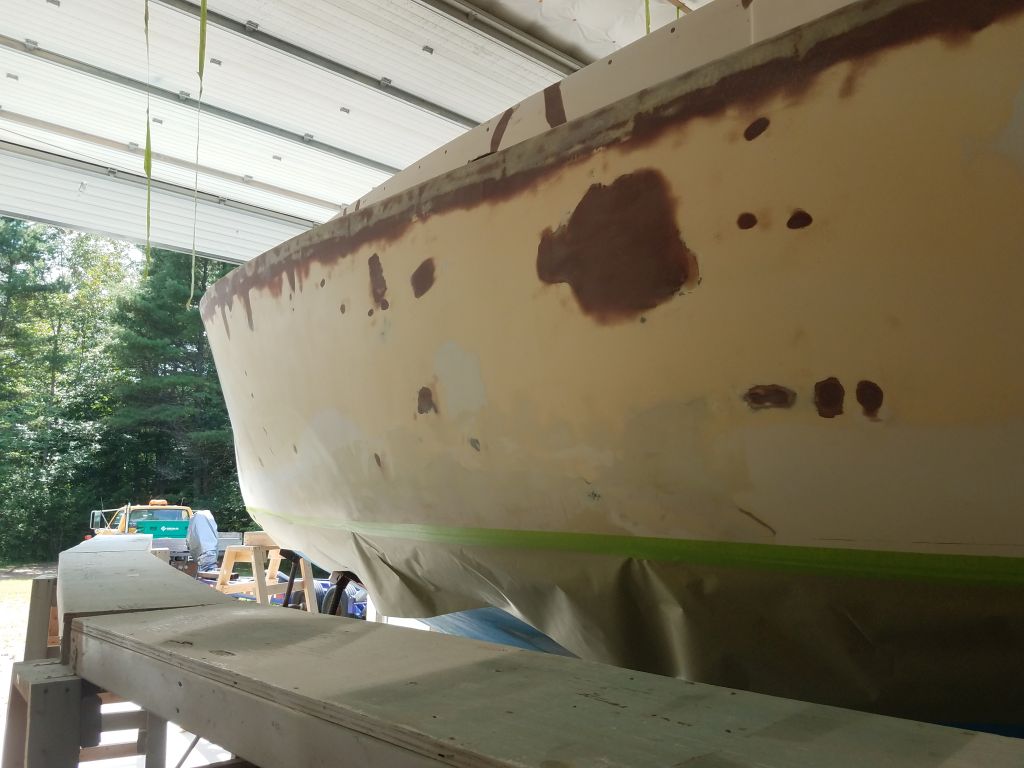
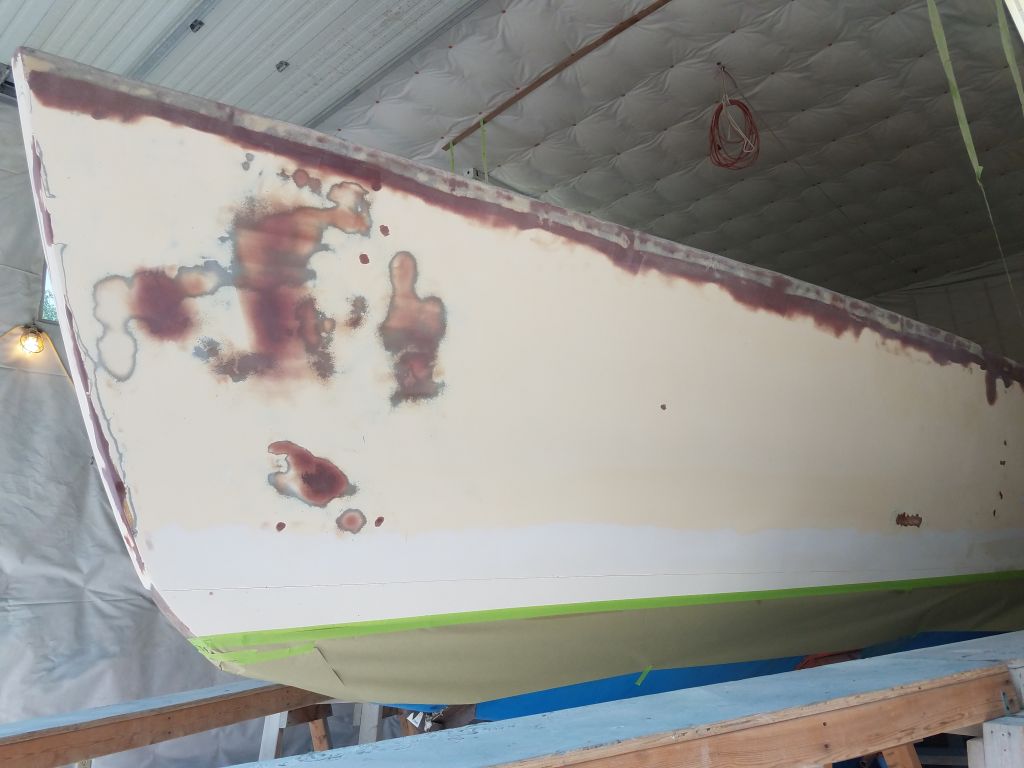
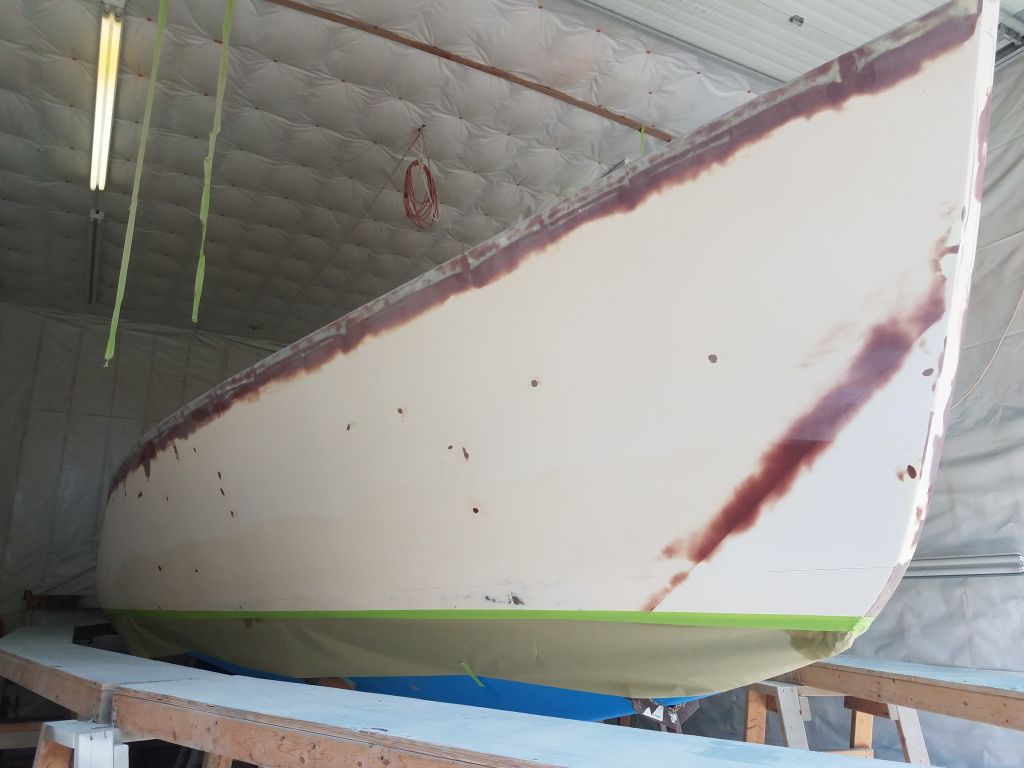
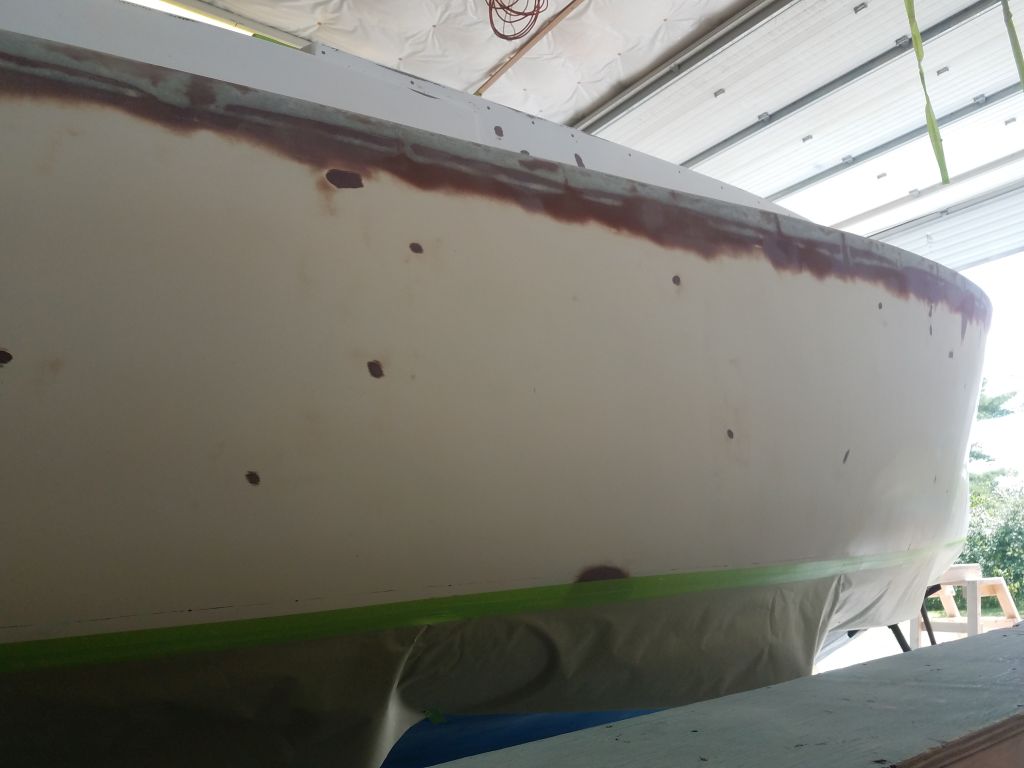
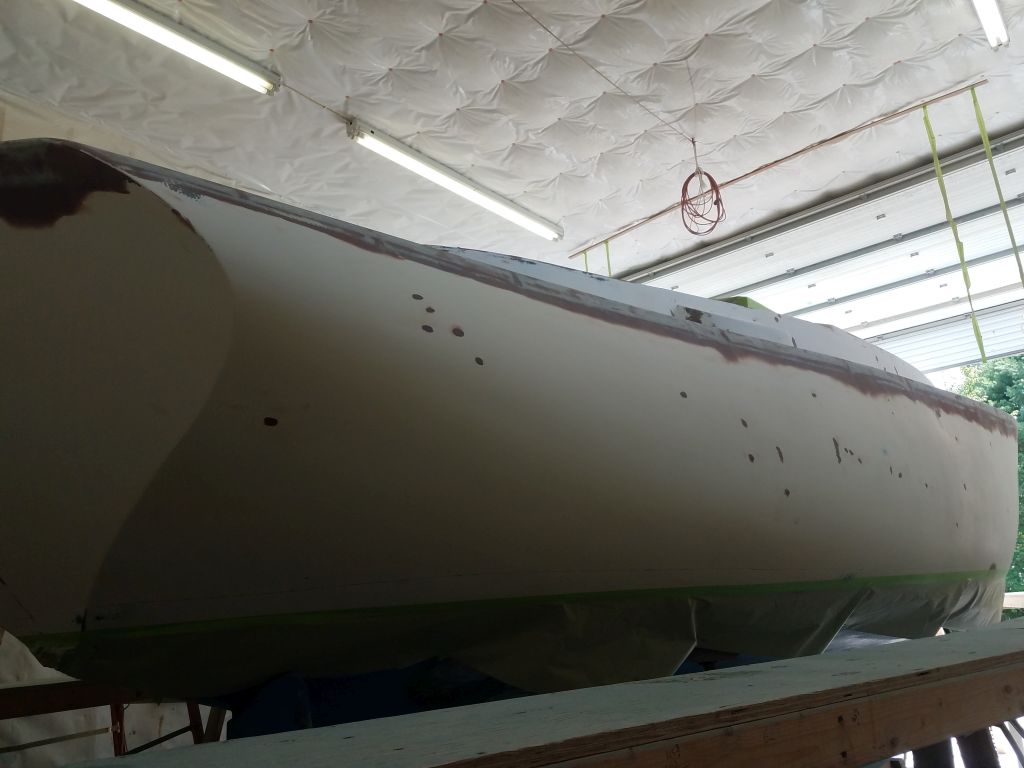
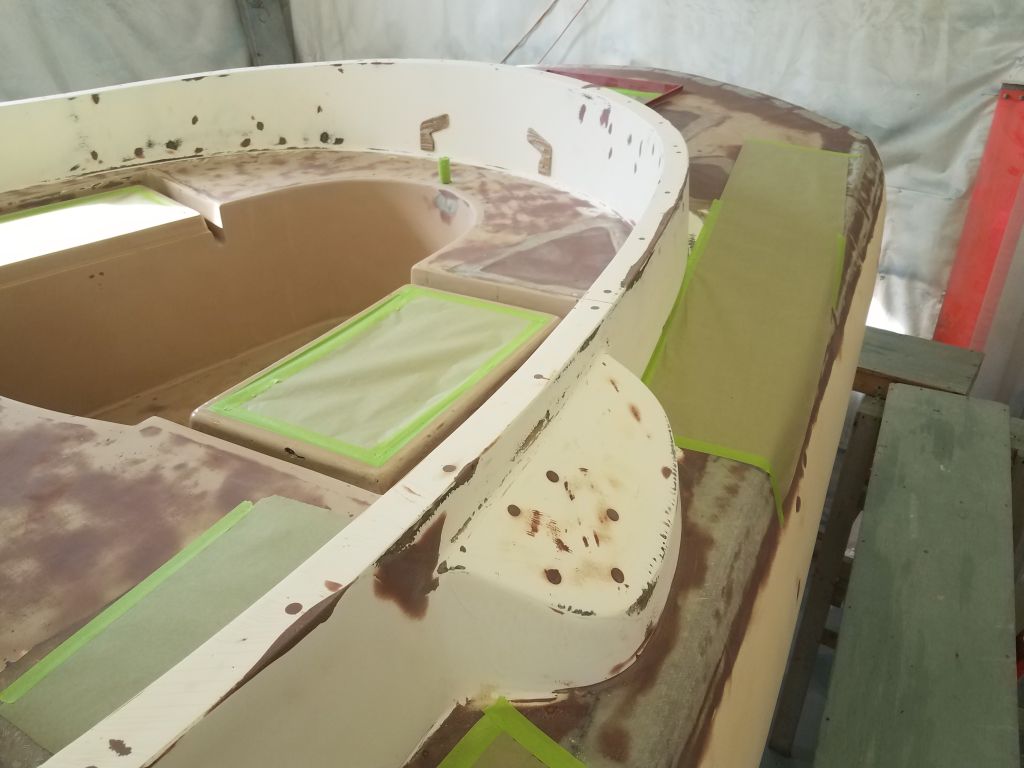
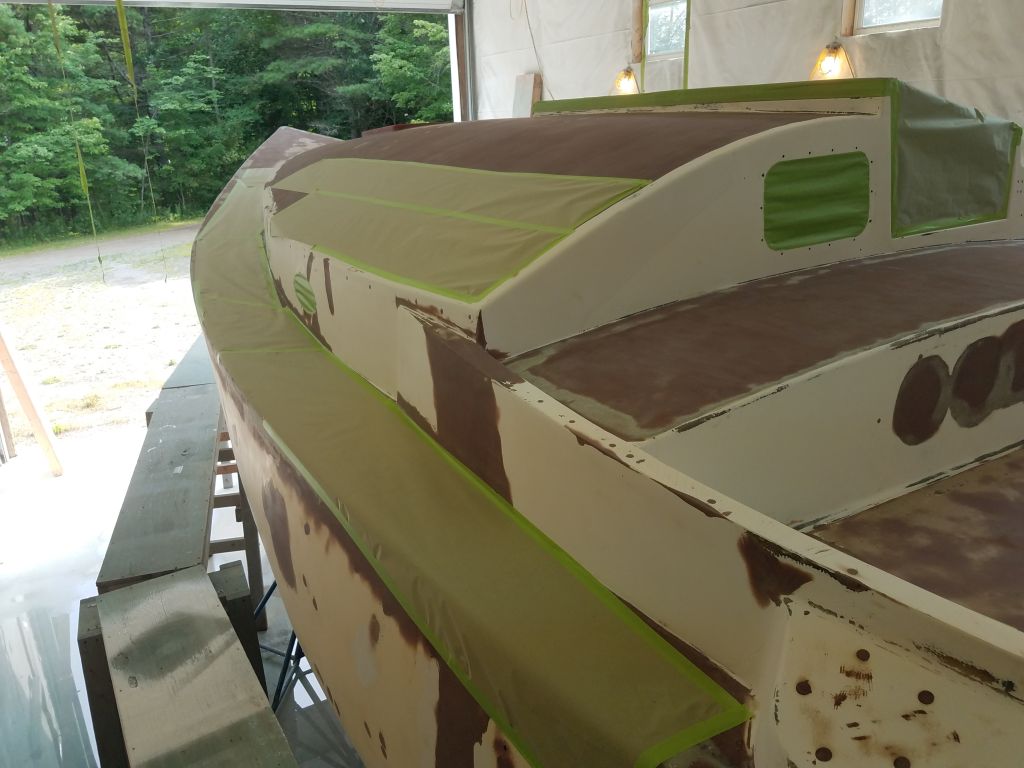
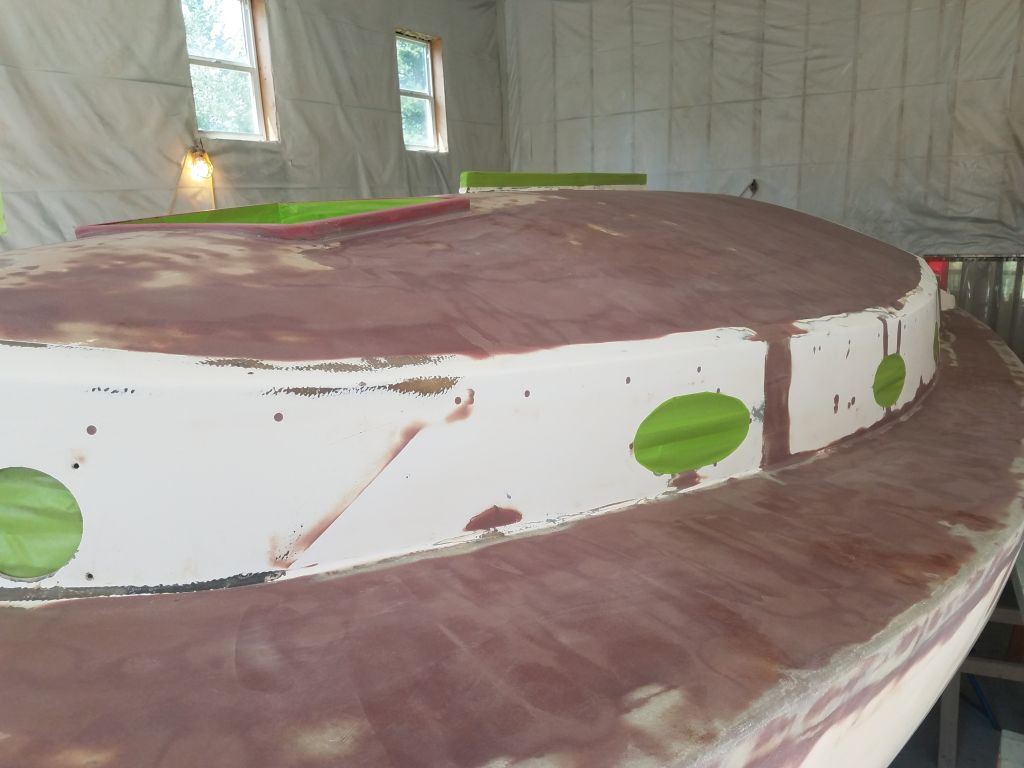
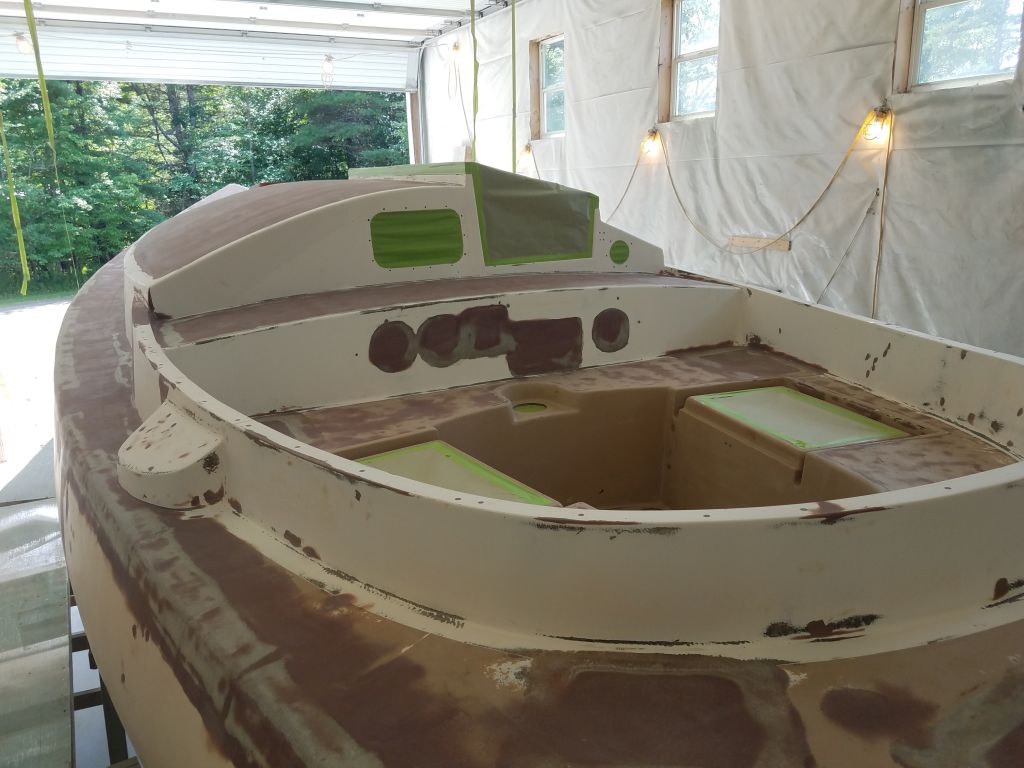
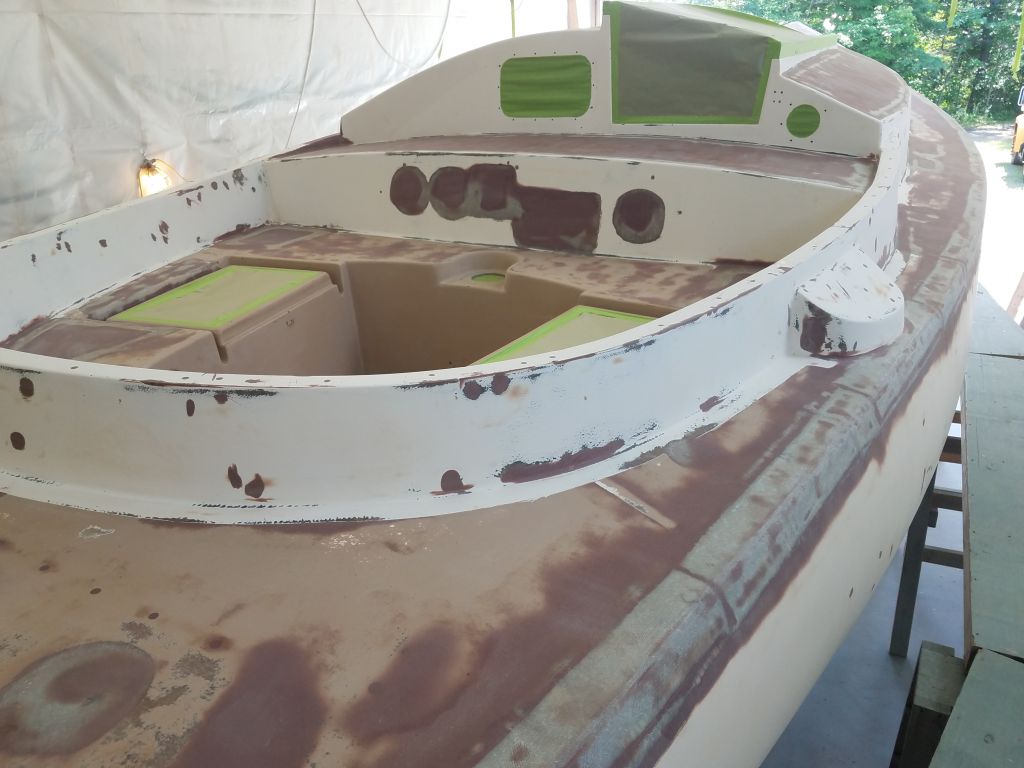
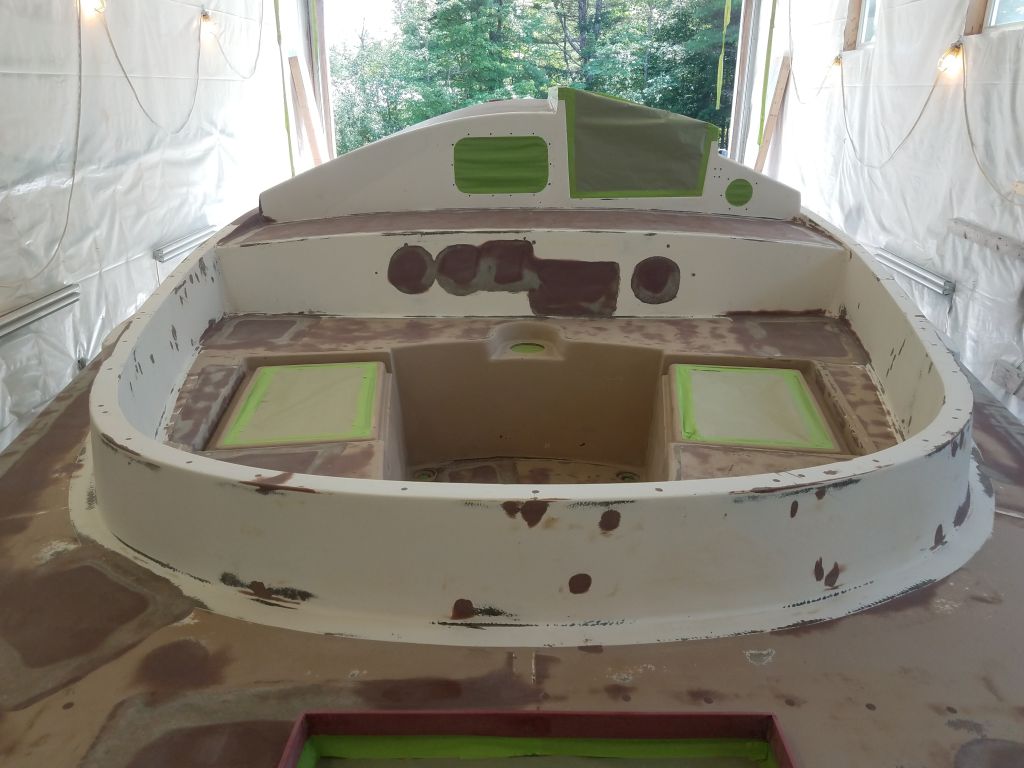
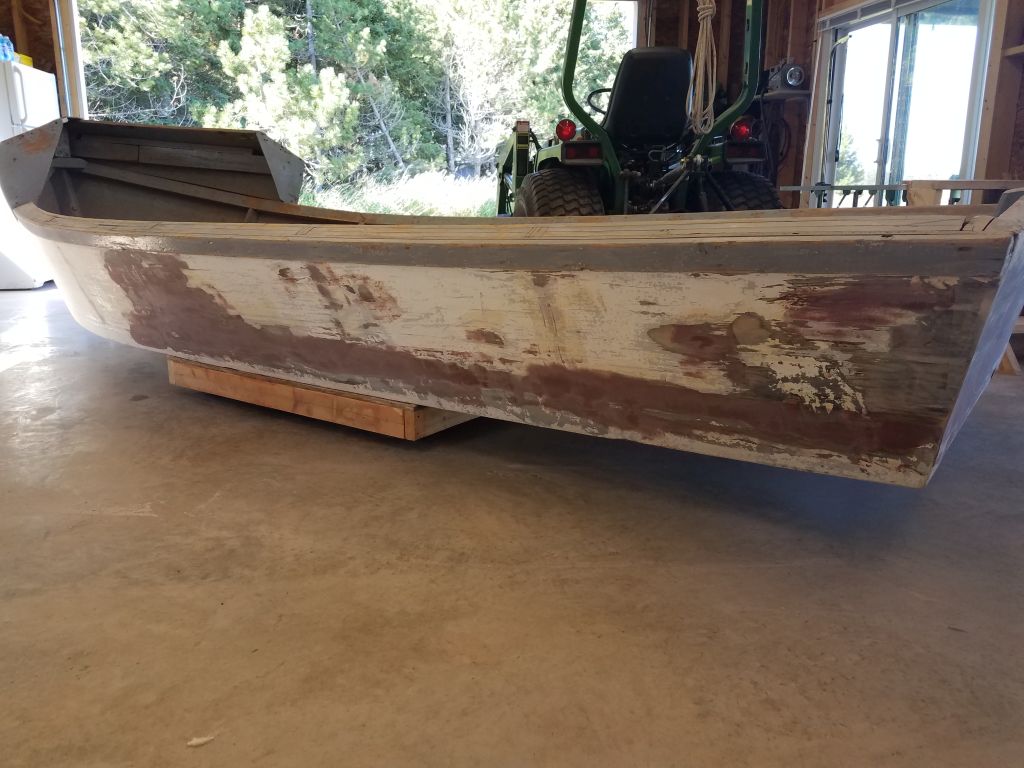
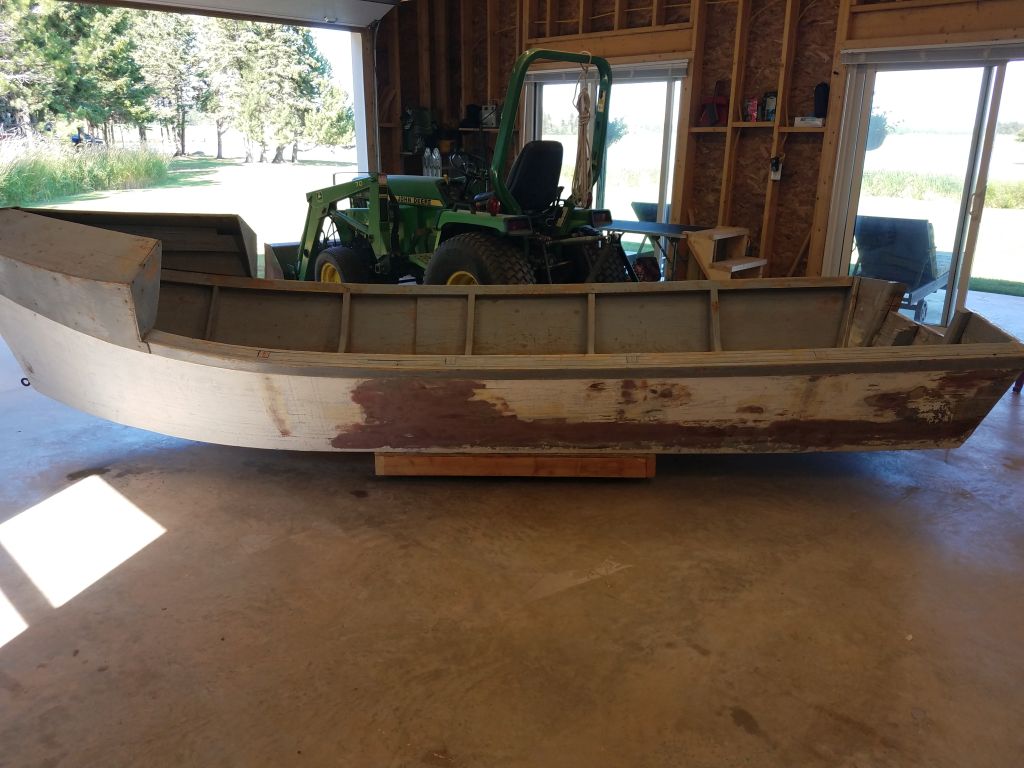
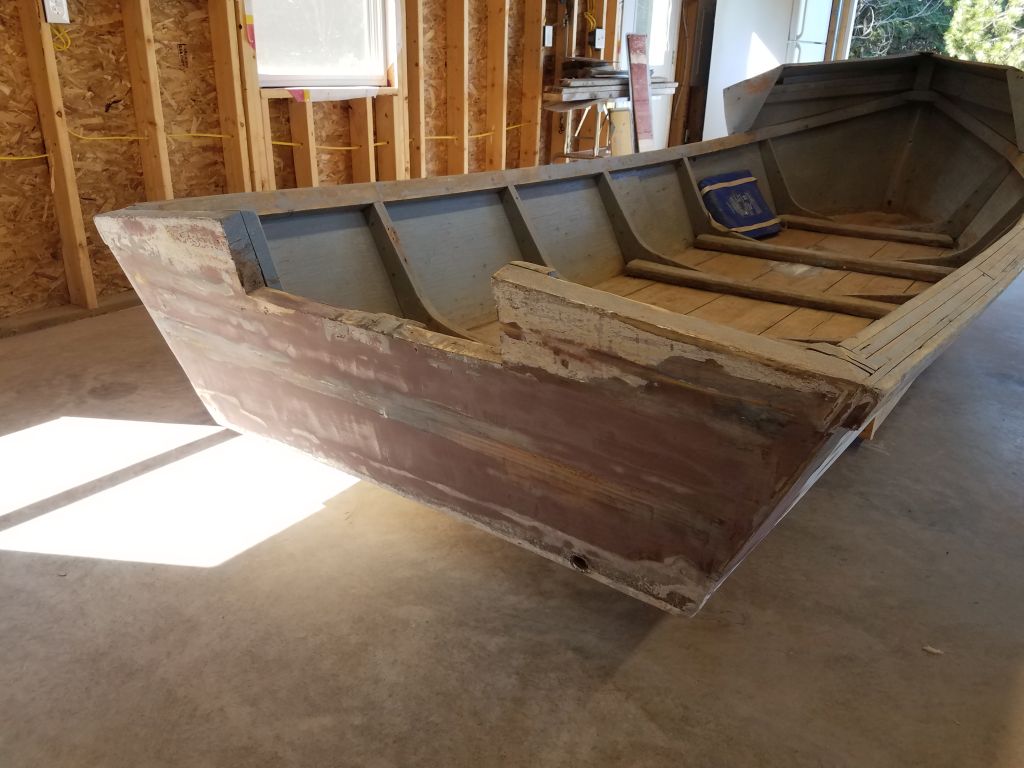
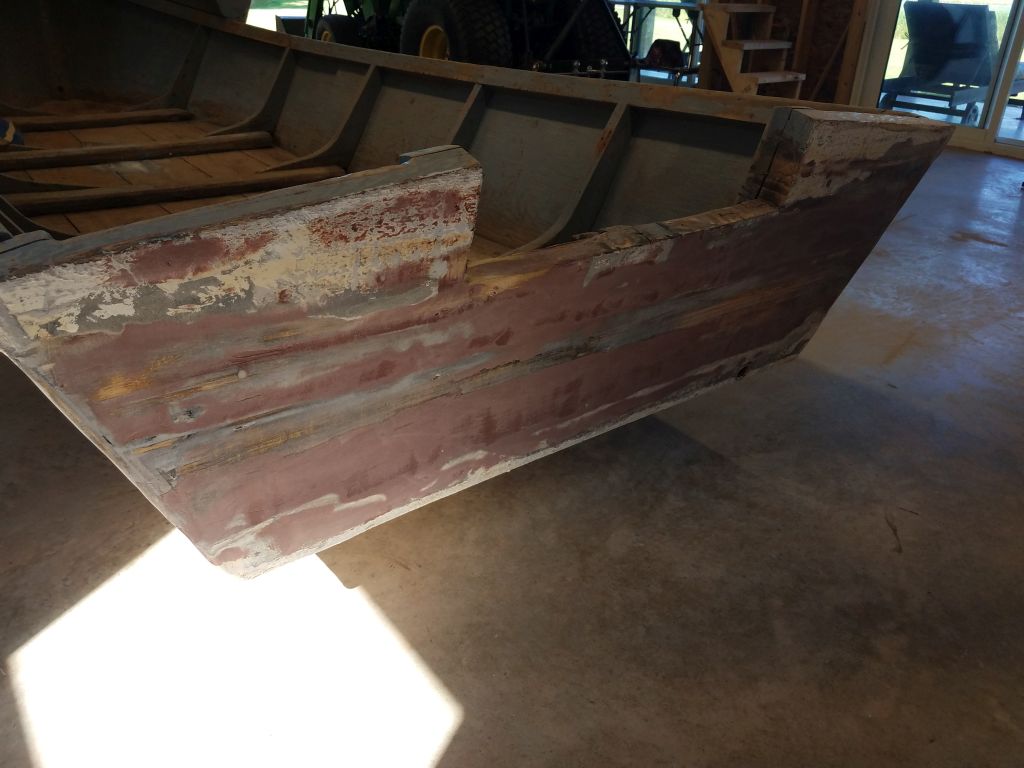
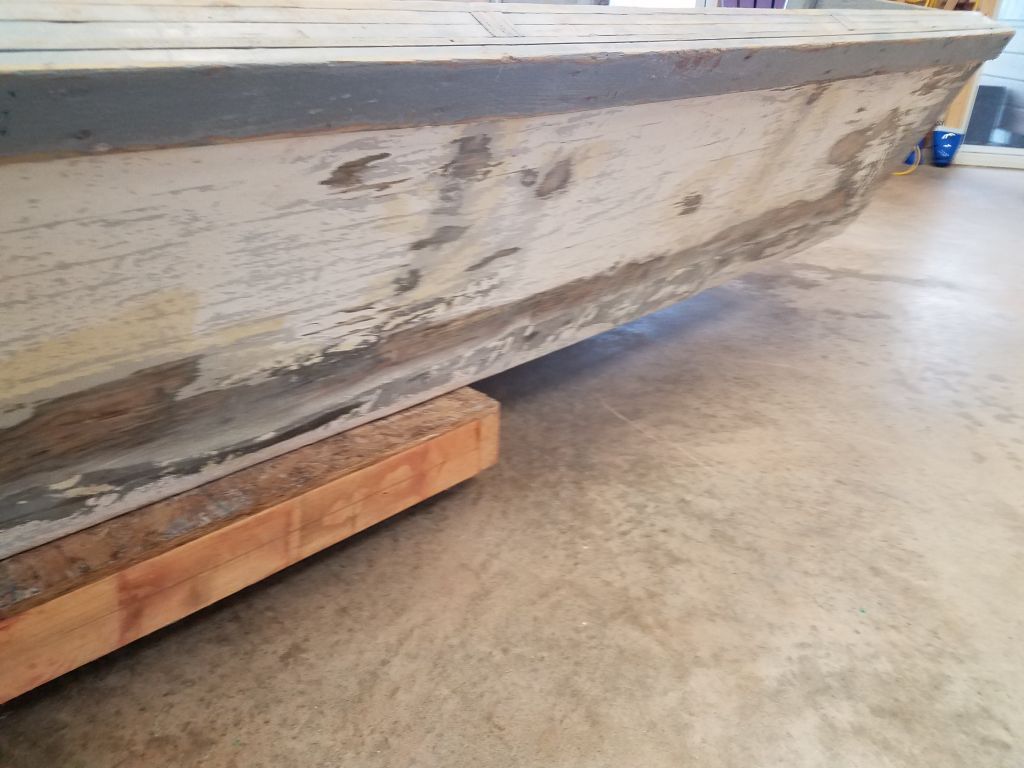
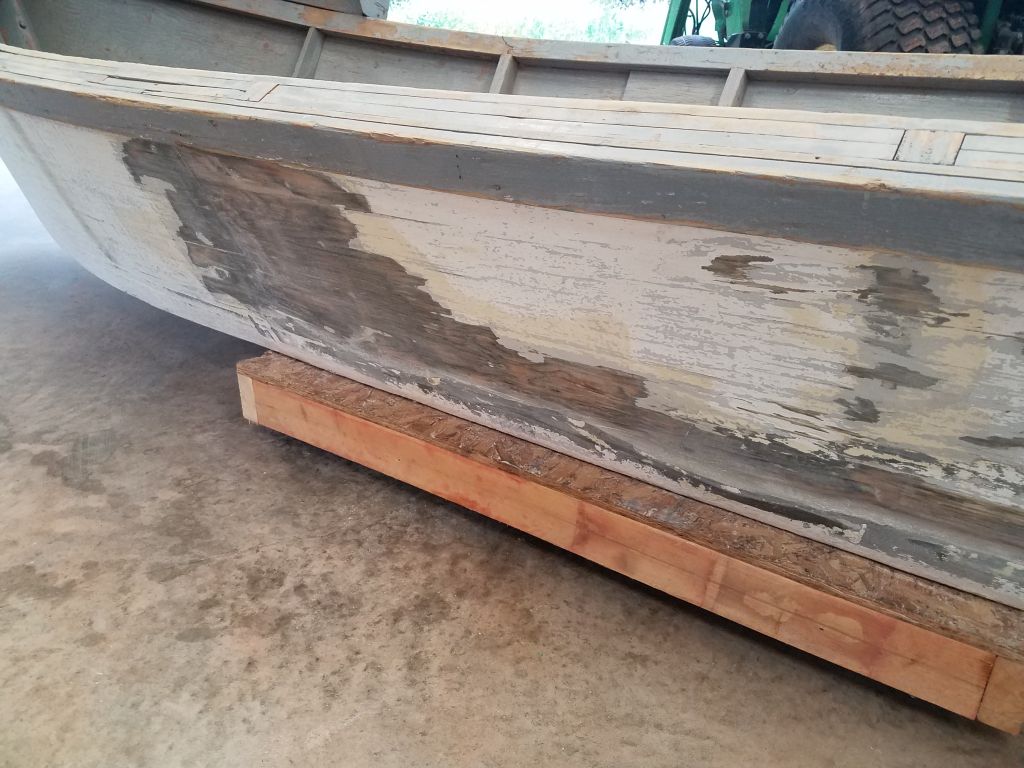
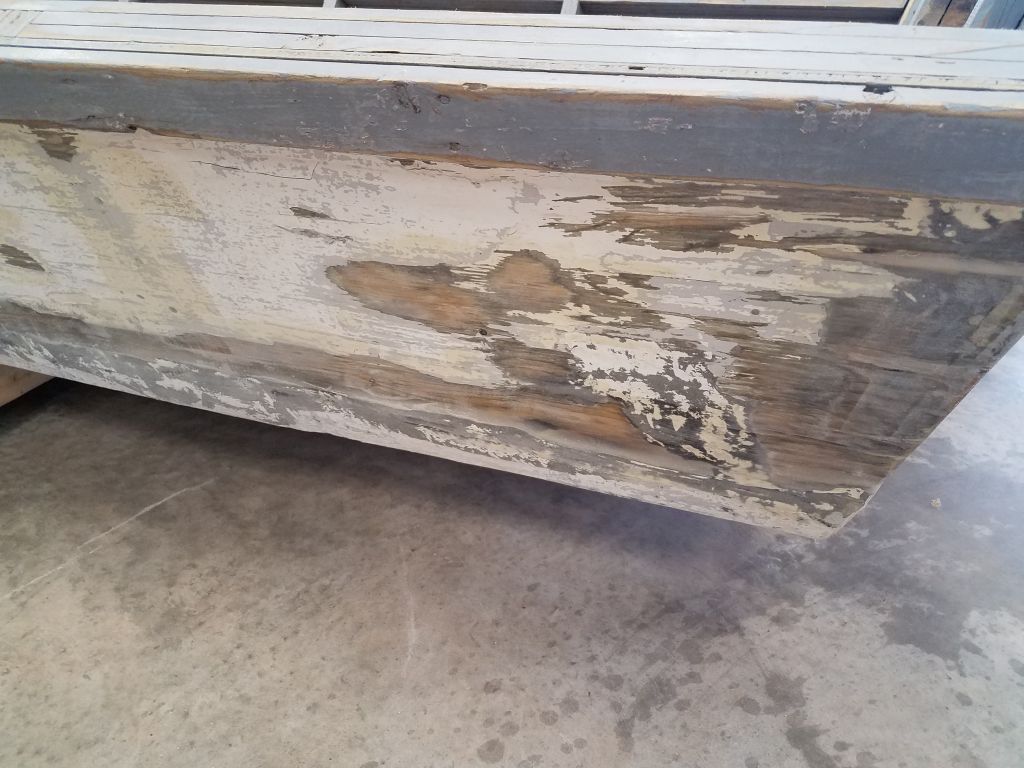
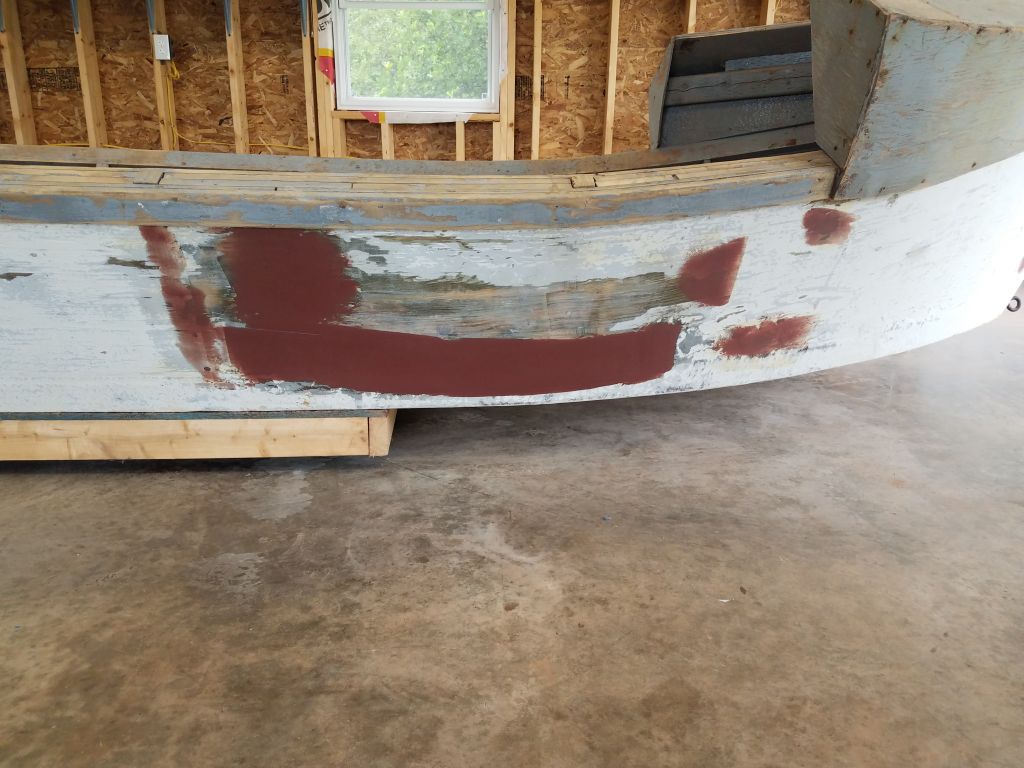
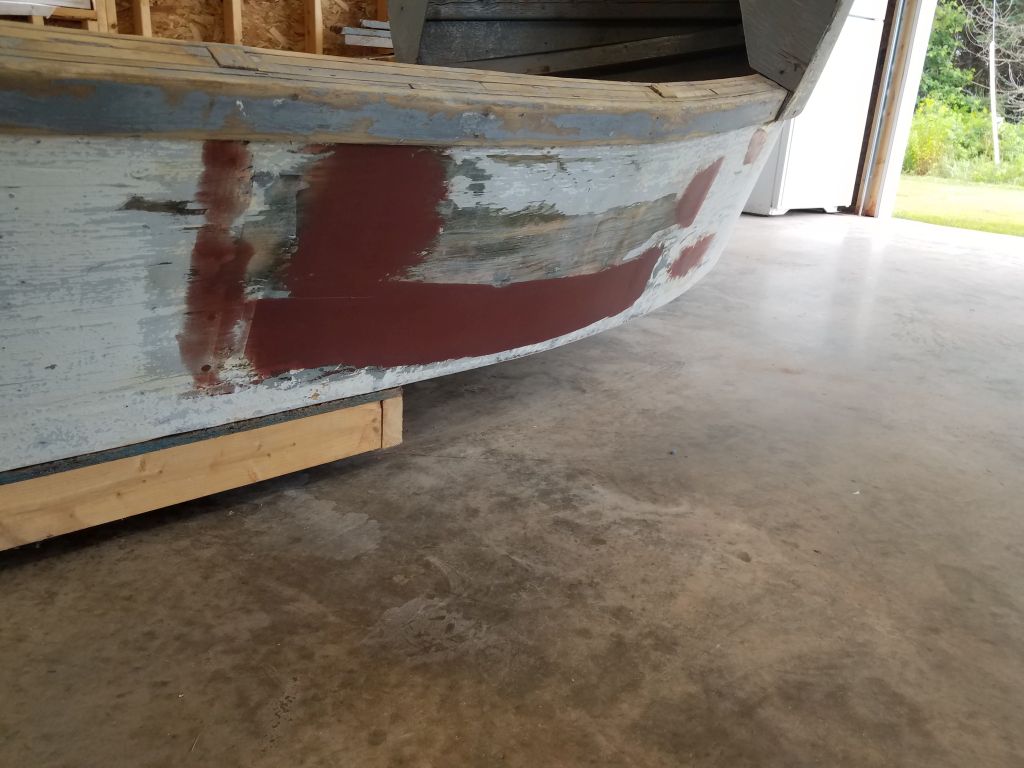
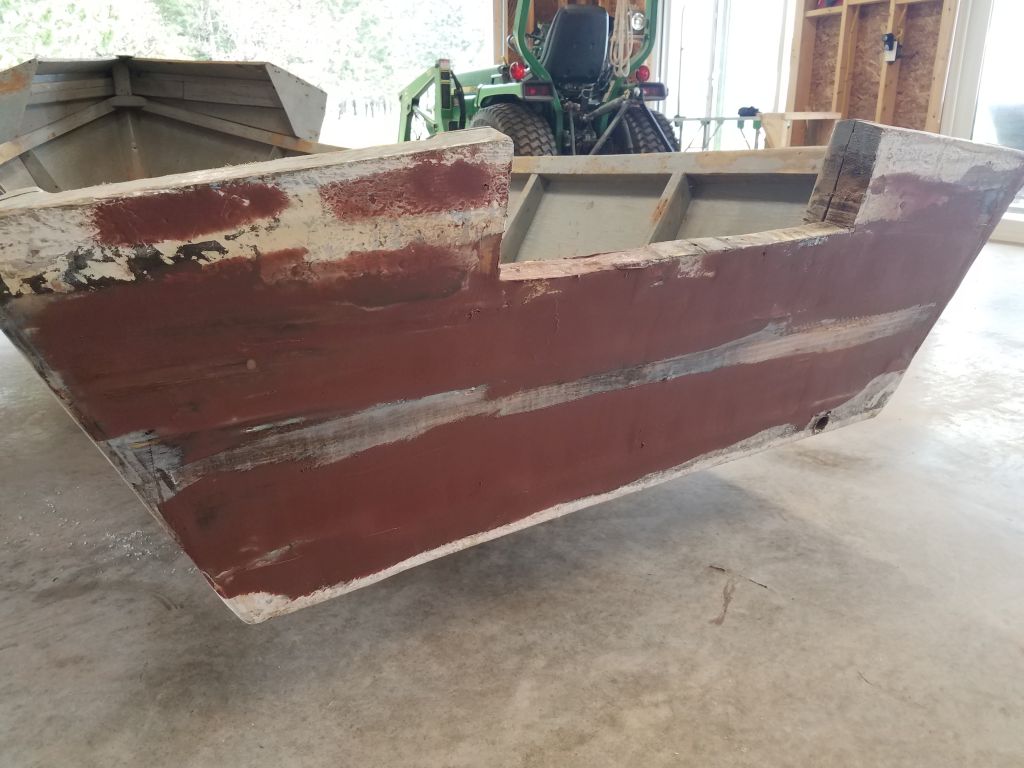
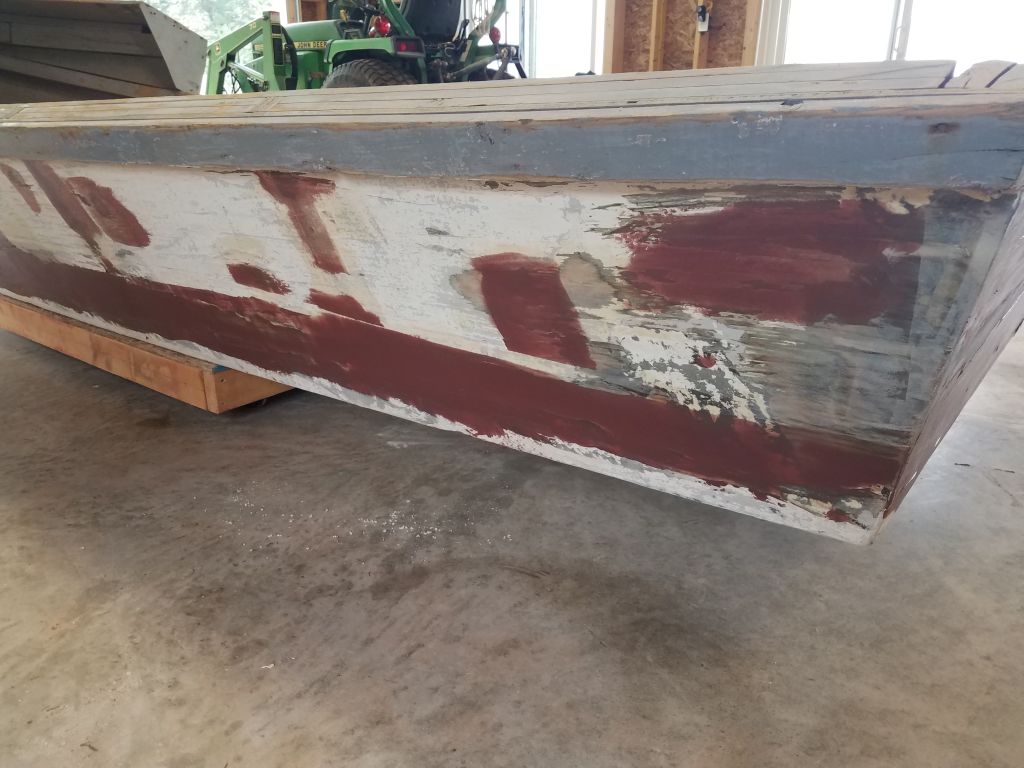
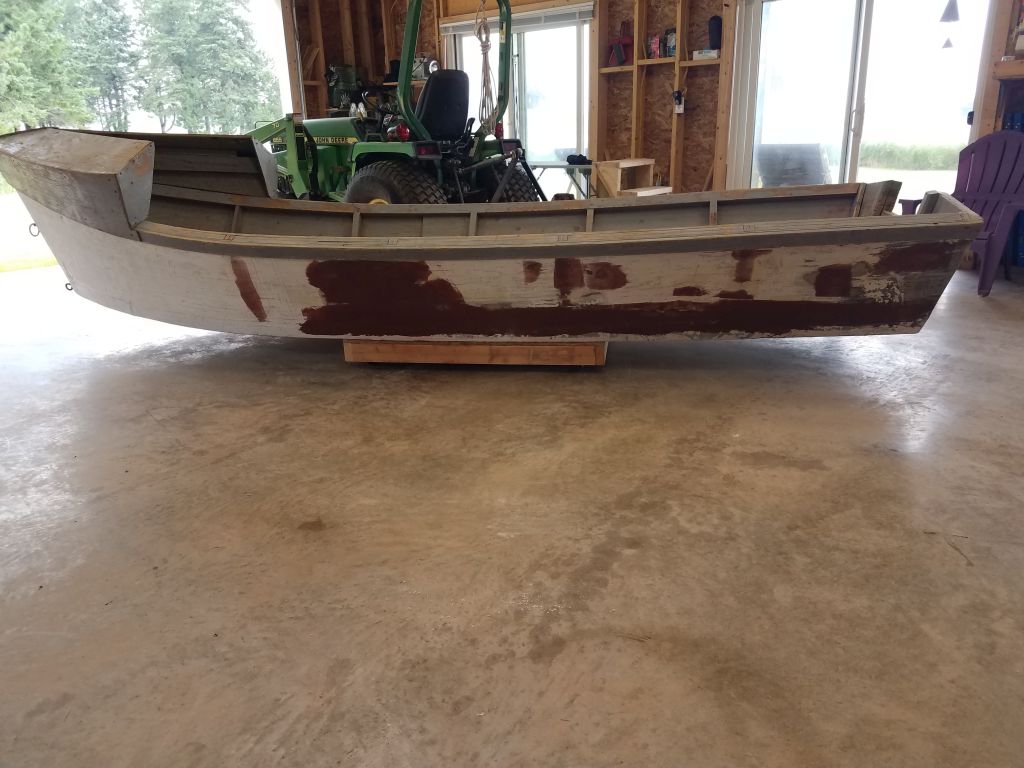
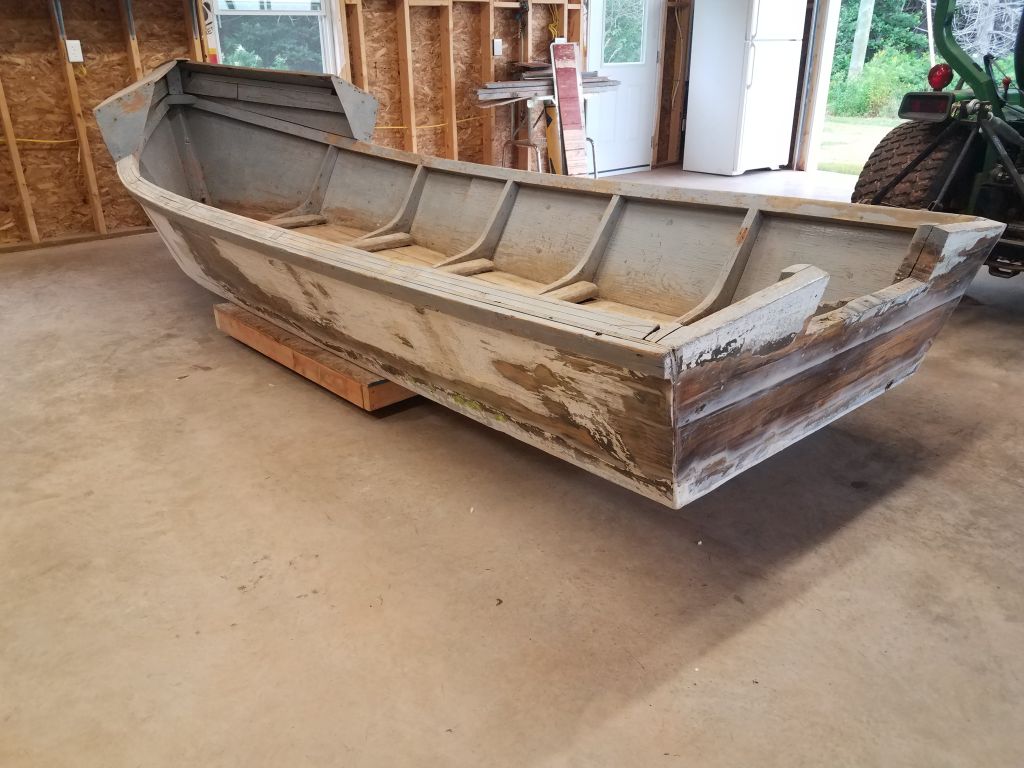
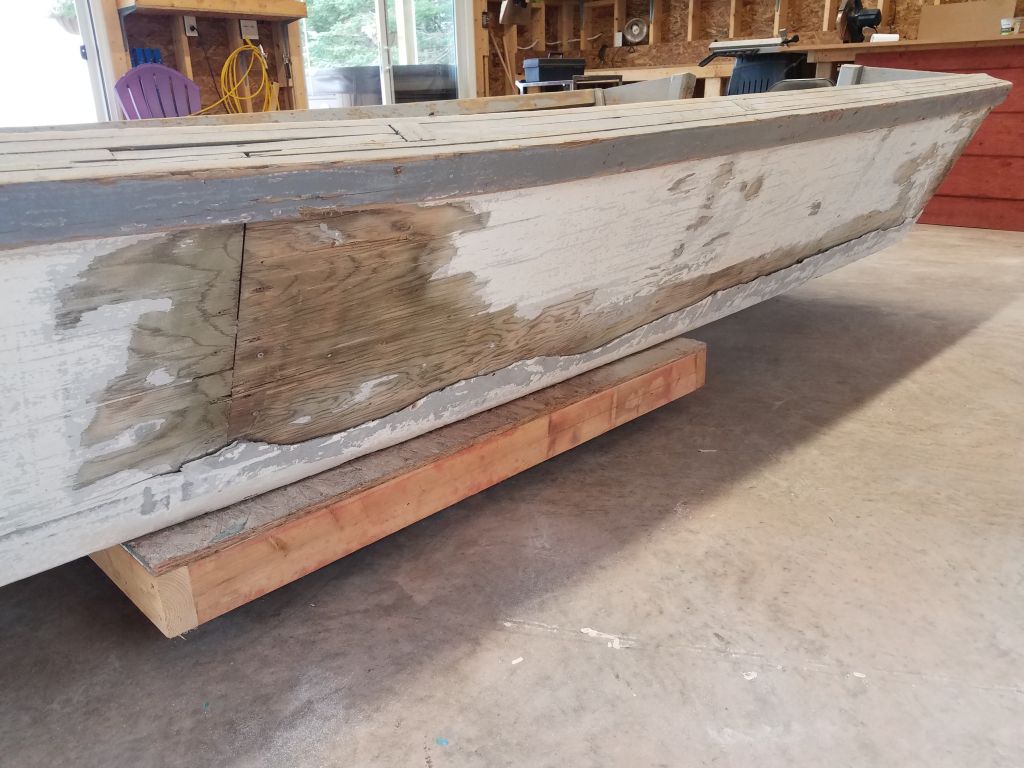
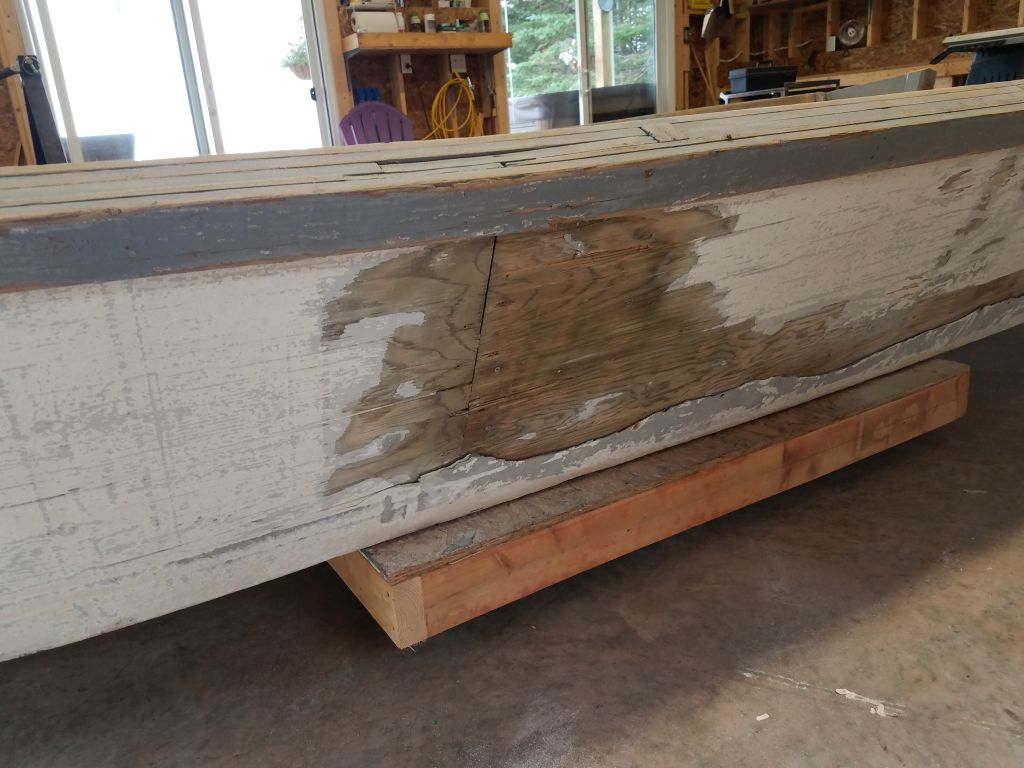
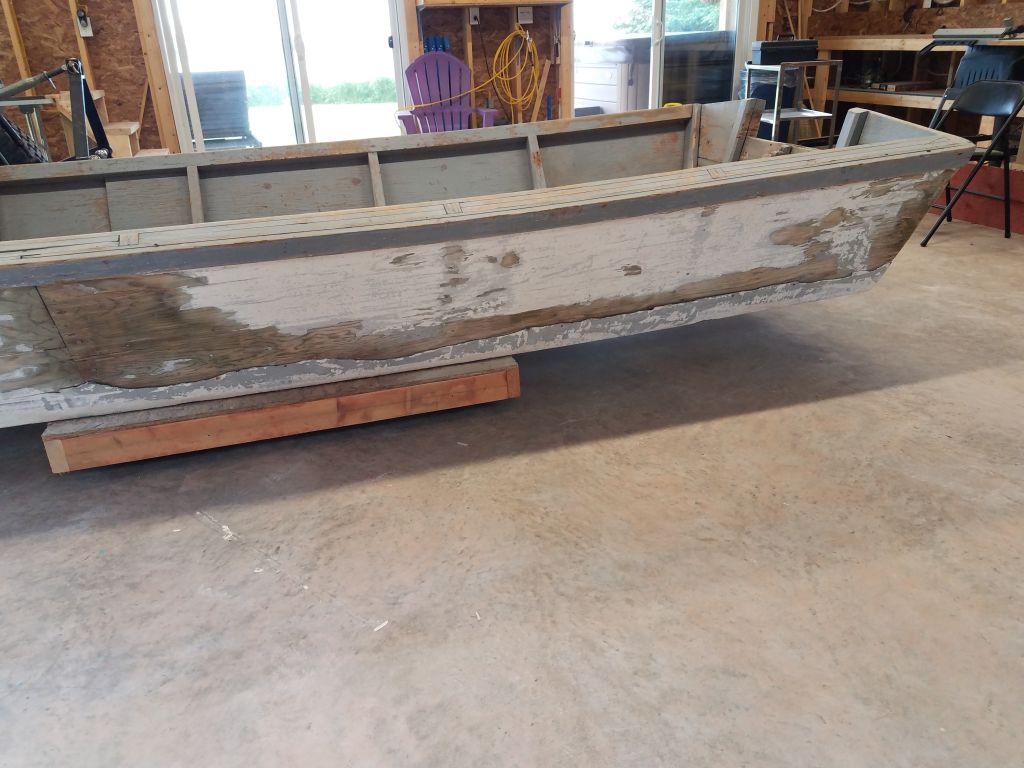
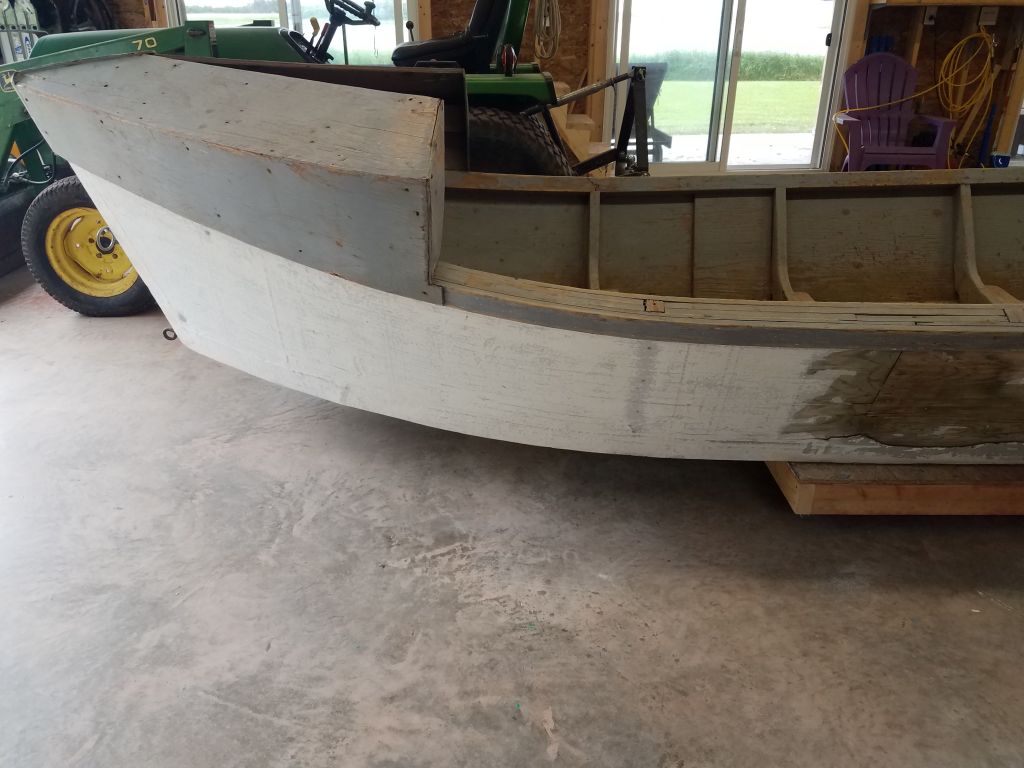
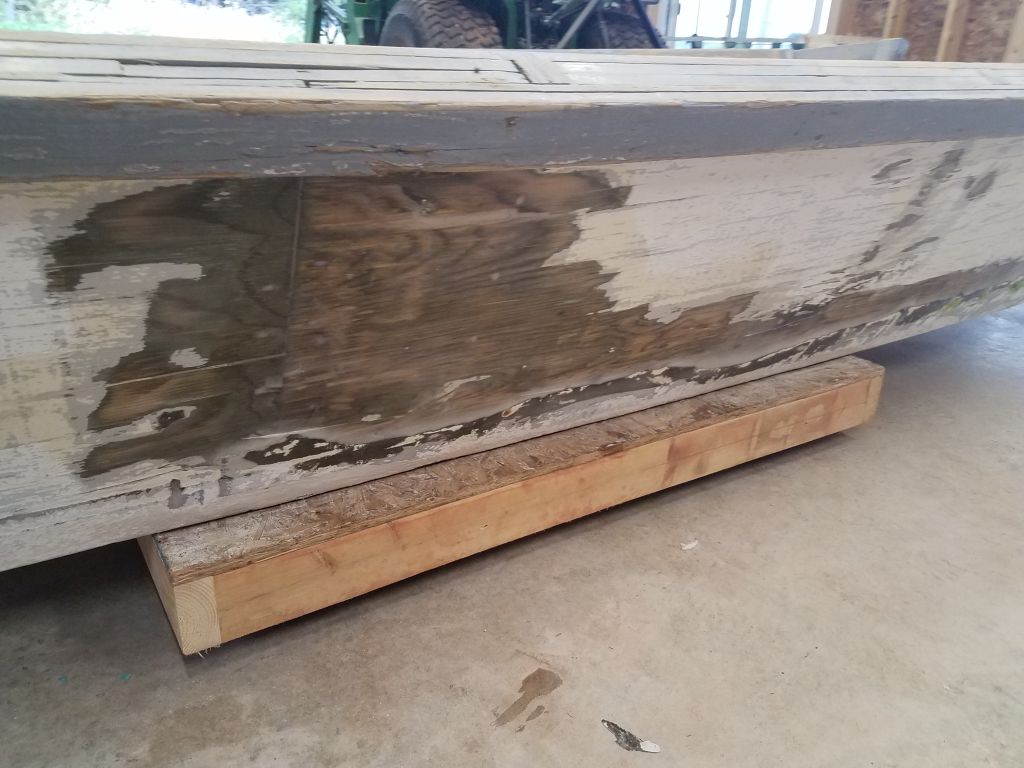
While I was away on a break, the various spots of epoxy fill on the hull had lots of time to cure, so I continued work on the hull with another round of sanding to smooth the latest epoxy application and generally complete the sanding for the hull.  I worked through 80-120 grits on a finishing sander, bringing the hull to its final readiness before high-build primer.  I’d actually expected to need another round of filler here or there, so completion now was a bonus.   I’d take care of any minor areas that remained after high-build, which would also inevitably reveal additional small flaws to correct.  But for now, I’d taken the hull as far as I could, or needed to.

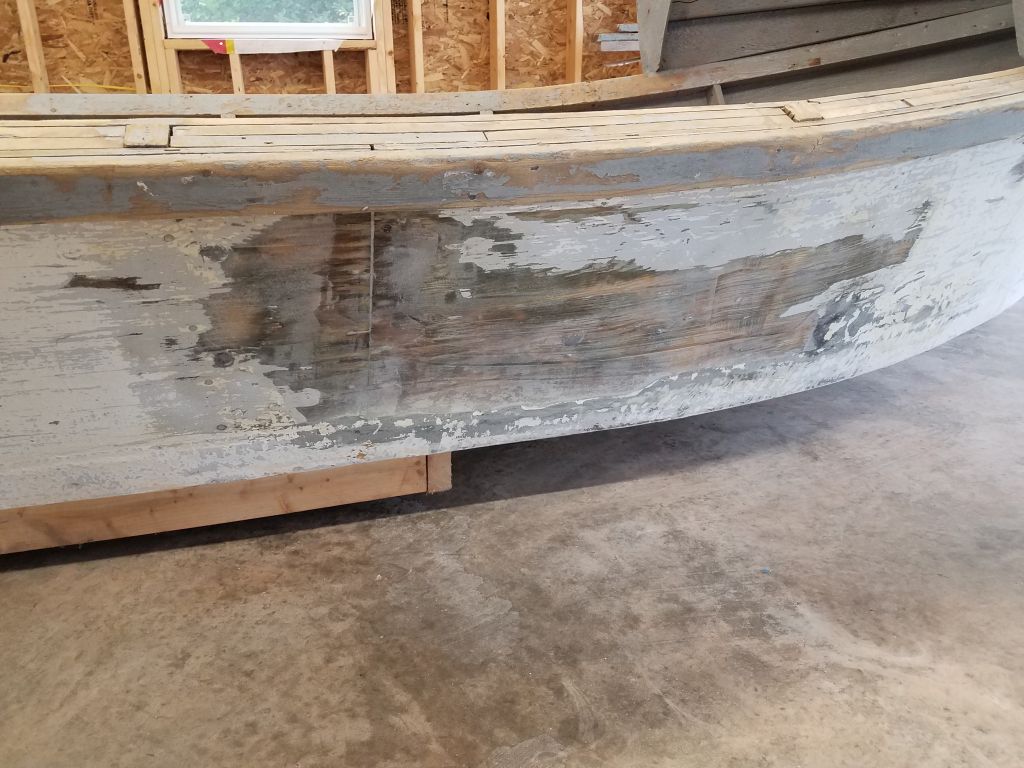
With the hull work done for now, I moved the staging aside for better access, and to await its further need later.  I decided to take advantage of the clear access at the moment and restrike the waterline (i.e. top edge of the bottom paint).  The original waterline was still visible, but the original lines were a bit wonky, and had clearly been too low (especially amidships), evidenced by the scum line and boottop paint failure I’d observed early in the project, and photos of this boat and sisterships found online, including this one.

I strove to correct the existing waterline (and, later, the boottop), as well as raise the waterline to improve appearance and help avoid paint damage that would occur if the new hull paint was submerged.

To begin, I first checked the boat for level.  When I moved her into the shop, I’d only leveled by eye, since it was winter and the boat happened to still be covered at the time.  The repair work hadn’t required the boat be perfectly level, but she was pretty close all along, leaning just a bit to starboard.

I spent a few minutes adjusting the stands to bring the boat level from side to side.

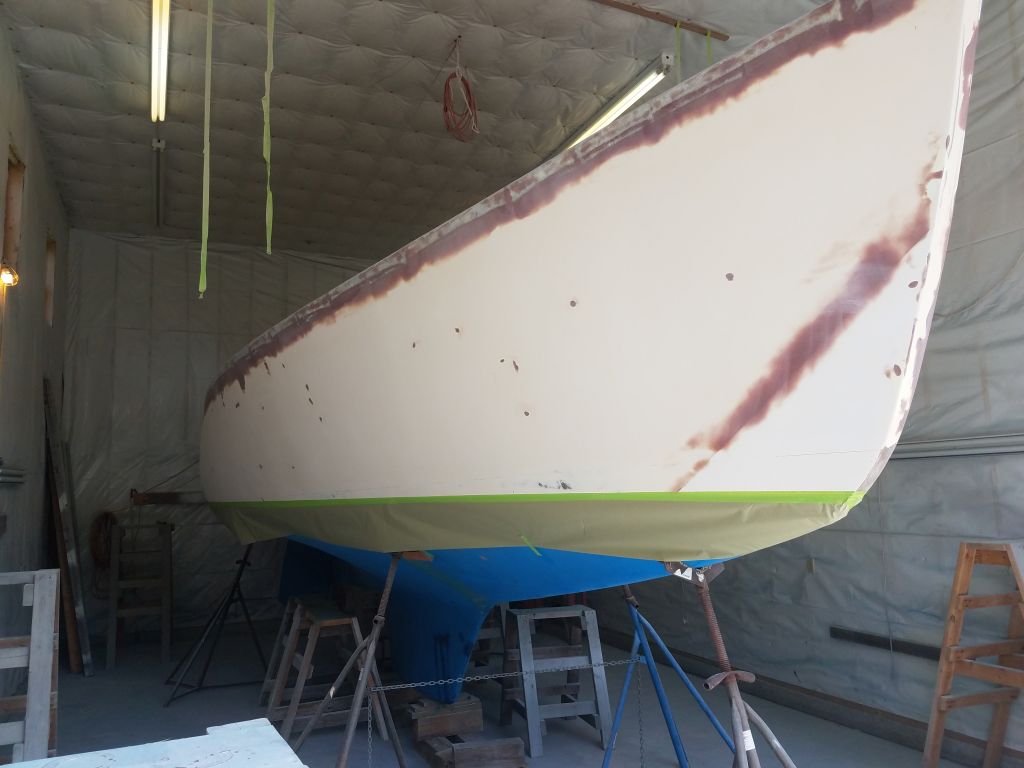
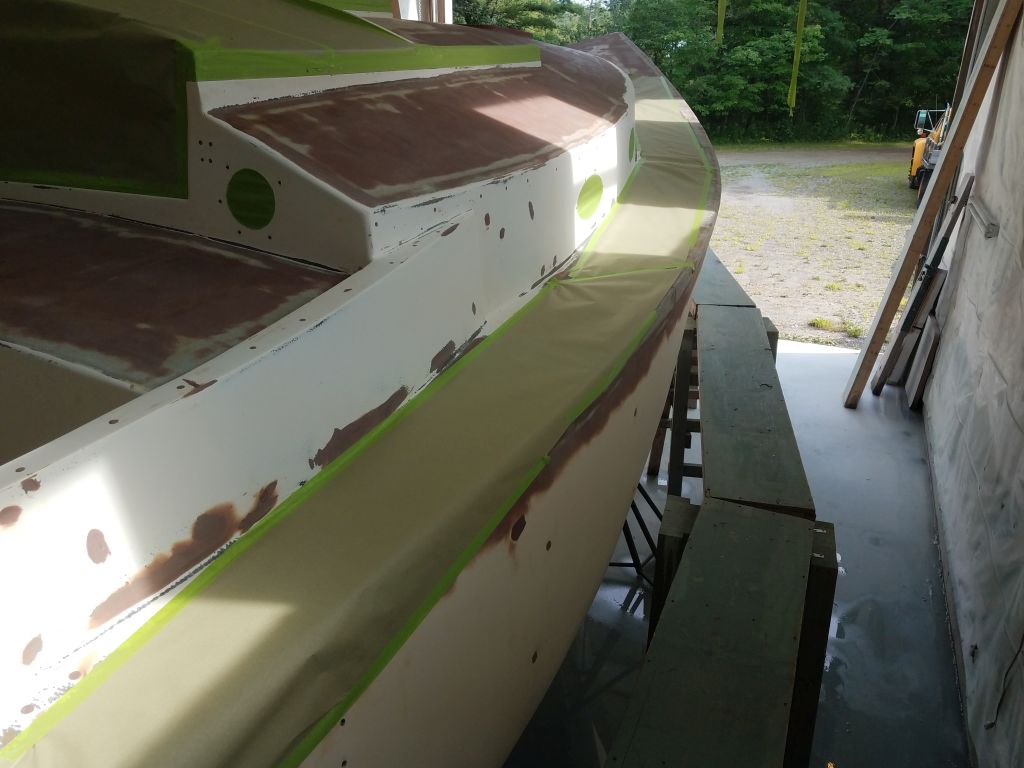
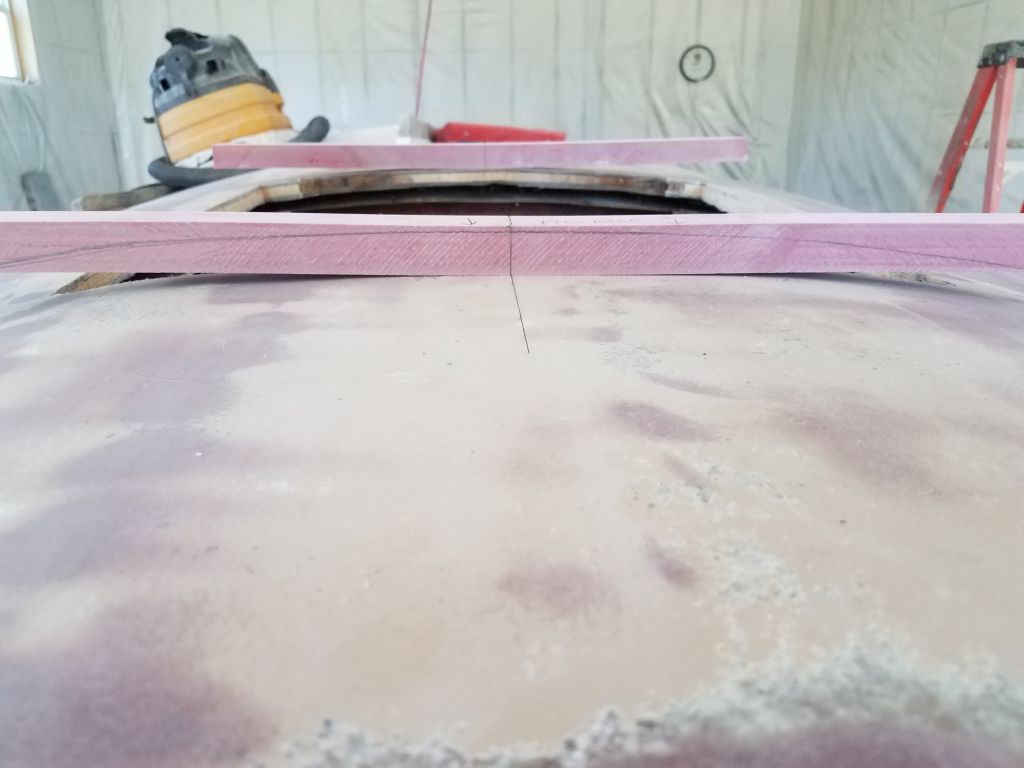
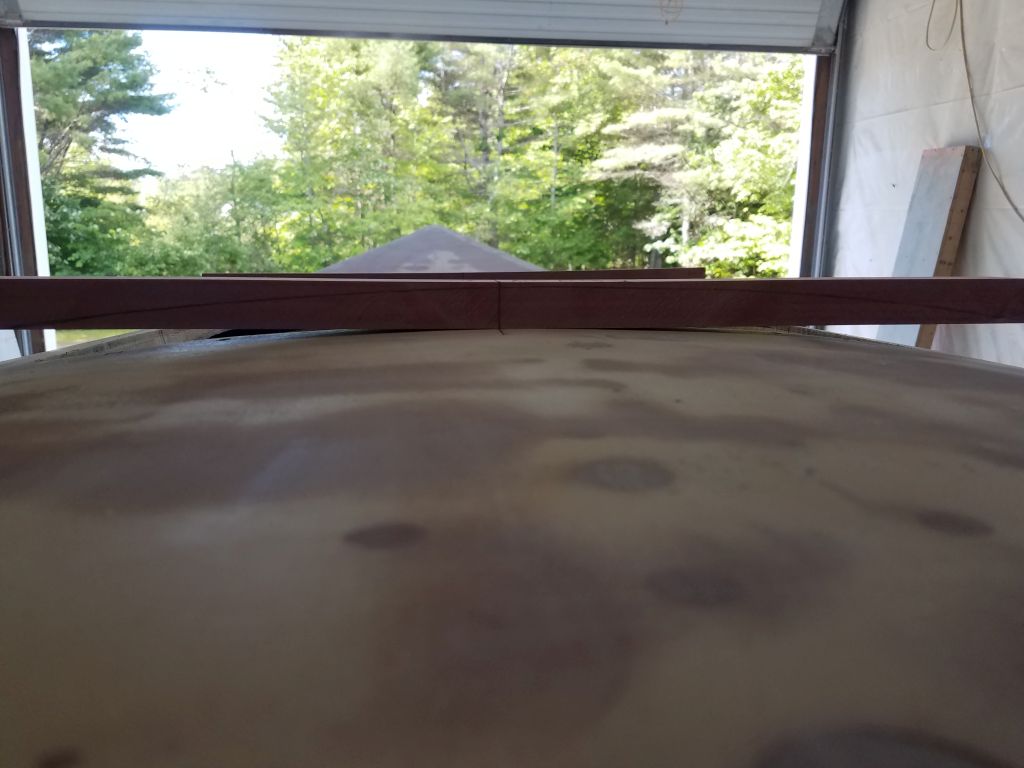
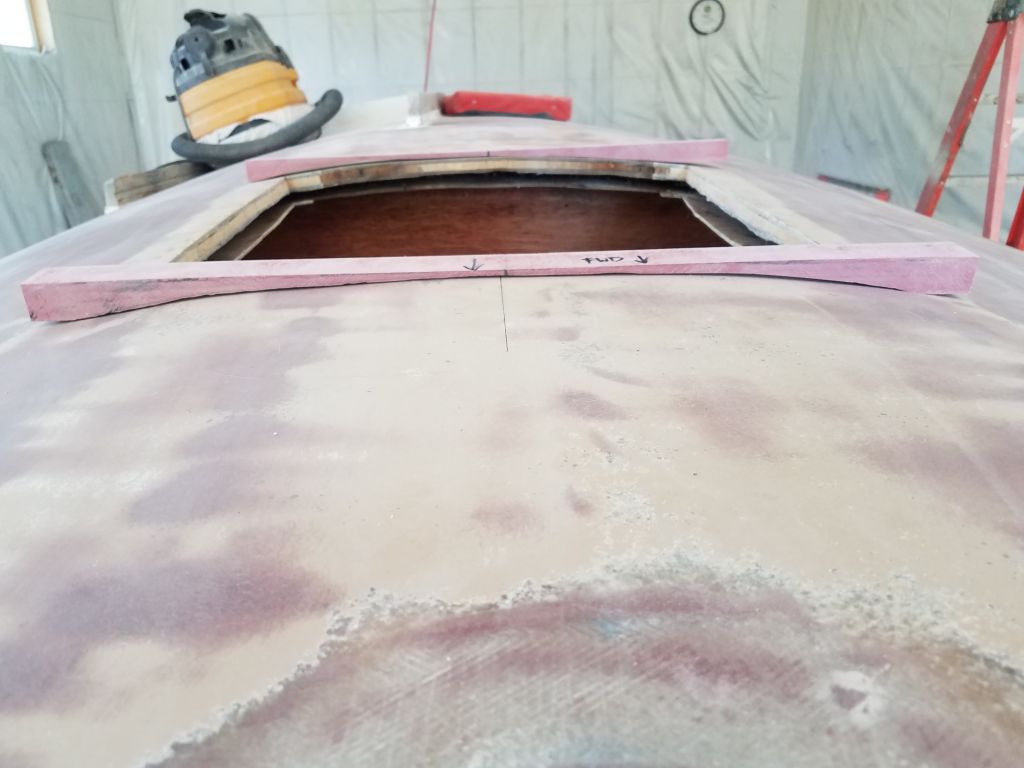
Based on my earlier observations, I decided to raise the waterline 2″, and used a level and steel rule at stem and stern to make reference marks above the existing line (still clearly defined by an original scribe mark and top edge of the bottom barrier coat).  Then, I set up horizontal beams at each end, leveled side to side and located at the new marks I’d just made at the bow and transom.

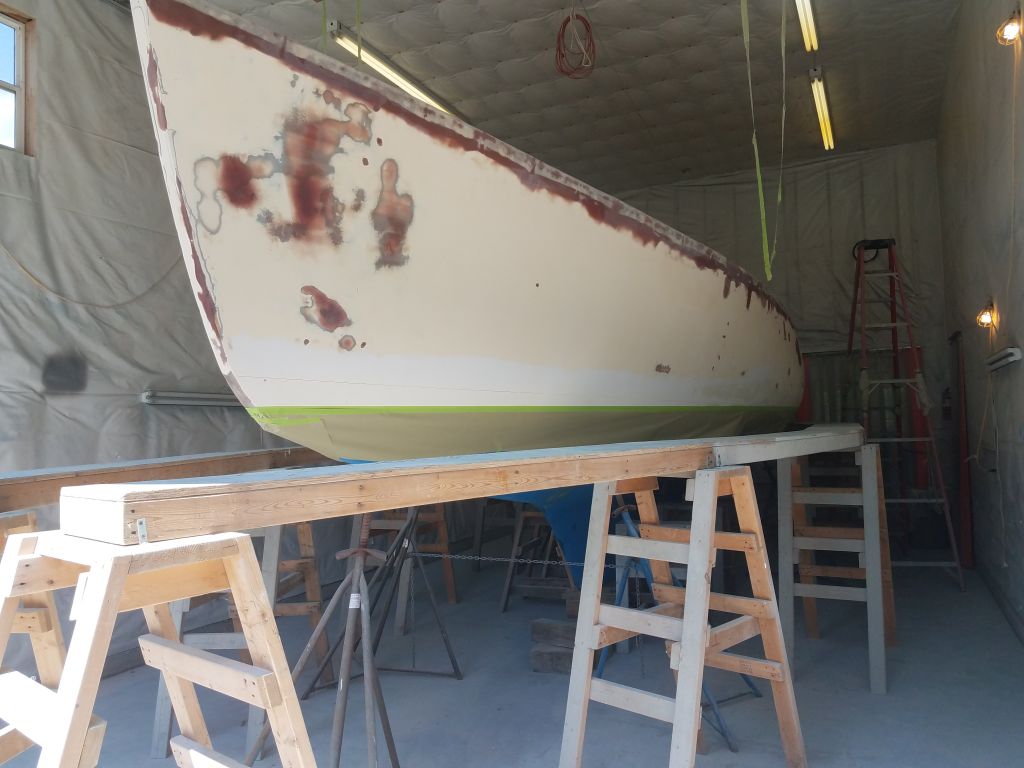
Next, one side at a time, I strung a taut line between the forward and after beams (essentially creating an planar analog for the water’s surface) and made a series of reference marks where it touched the hull, bringing it closer by increments and taping it in place as I went.  Faithful readers have seen this any number of times over the years.  I started with the after half of the boat on the port side, then the port forward side, then repeated the whole process on the starboard side.

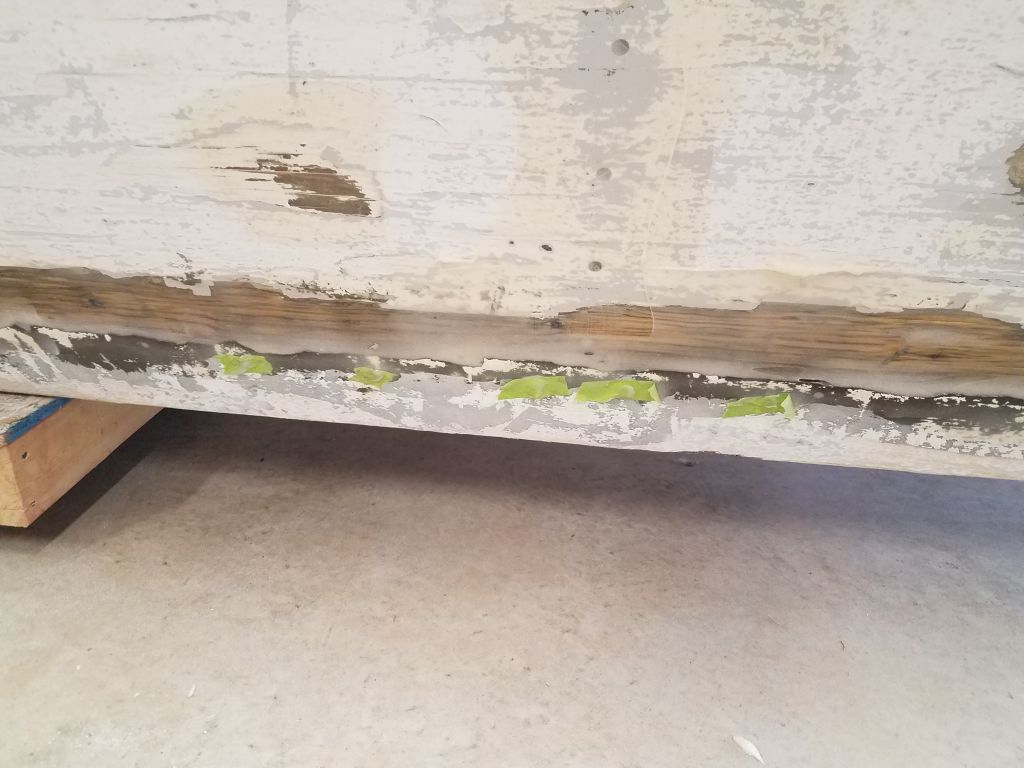
With the waterline marked, I applied masking tape just below the tick marks.  I’d apply primers and paint to the top of this line, and bottom paint below.

Total time billed on this job today:  6.25 hours

0600 Weather Observation:  60°, clear.  Forecast for the day:  Sunny, 80s

Handy Cat 6

< Back to Handy Cat

Thursday

With sailing season now beginning, it was time to put the new electric motor to the test in the real world.  To finish up the basic preparations, I purchased a small tractor-sized deep-cycle battery rated at 45 amp-hours–the largest one that would fit in my plastic control/battery box, and with the highest rating I could find.  The battery came without terminal screws, and it took some trial and error before I determined they were M6 thread.  What I really needed were cap screws, but for the moment I settled on what I could find locally, which worked fine but didn’t give much of a purchase for battery charging cables, which I expected to need frequently to keep the battery at full capacity.

The white hose I’d selected as a conduit for the motor wiring off the rudder was a bad choice (I don’t know why I think that white sanitation hose is ever satisfactory for any use), and turned out to be too inflexible to work as I’d hoped.  Instead of providing a clean, minimally-invasive wire conduit, the stiff hose, which retained a memory of its being coiled too tightly when I ordered it from the supplier, was bulky and awful, and would not be tenable for long.  For now, it’s what I had, but I planned to replace it as soon as I could.

Once I launched and rigged the boat, I took her out on a calm day for a real  trial.  I was really pleased with how well the little motor worked.  There was ample power, and I found that once I got the boat moving in whatever direction using one of the higher speeds (4 or 5 out of 5), I could turn the speed well down and the boat still moved well.  This should reduce battery drain, I hoped.  With no experience with trolling motors, I really didn’t know what to expect in terms of battery usage, though I knew the battery I’d selected was small–about half the capacity of even a basic car-sized starting battery.

Initially, I’d not had any markings on the control box to show which way to turn the knob, or where the graduations were.  This was highly confusing during my launching, when I used the motor briefly to dock the boat.  So I made some simple markings on the box, seen in the video below, and later (post-video) I used some white paint to make a tick mark on the knob itself to help register it in whatever position.  It wasn’t easy to take video in a way to give much of a sense of things, and I didn’t want to create one of those awful shaky videos that would have happened if I’d tried to manipulate the controls, or somehow get better angles, so this short video is what you get for now.

The worst-case scenario is that I end up needing a larger battery, which I’d then have to install somewhere at the aft end of the cockpit, and which might be less convenient overall.  I liked the idea of the control box/battery compartment all in one like I’d conceived it, so I hoped it would work.  Further testing in real use will determine whether the battery has the capacity I need.  Normal usage will include departing the dock and getting out a narrow channel, probably about 5 minutes’ use at the onset, and then the same thing on the way in.  (This all assumes that, as experience seems to have shown, I will be unable to easily sail in either direction.)  No harm will come if the battery dies before I’m ready, but it’ll just be inconvenient.  The water is mostly shallow, and worst-case is that I point the boat to the nearest shore and walk her home from there.  I shan’t be miles from home ever in this boat anyway.

Further updates later as things settle out.  The season is just (barely) starting.

< Back to Handy Cat

Scupper 47

< Back to Scupper

Thursday

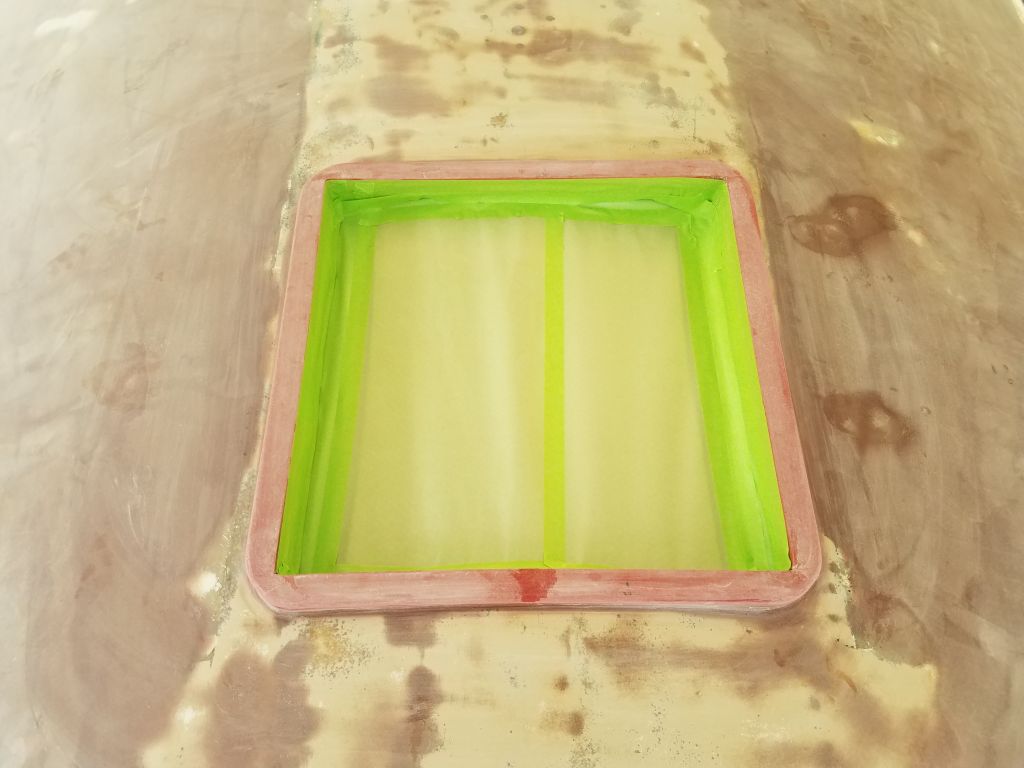
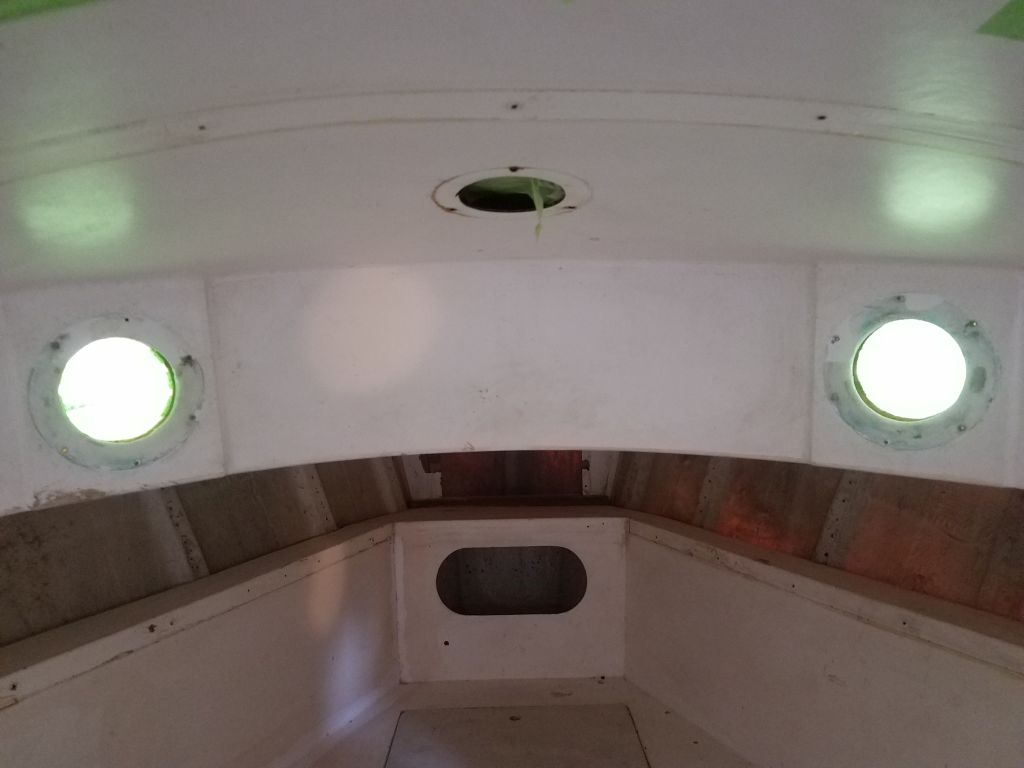
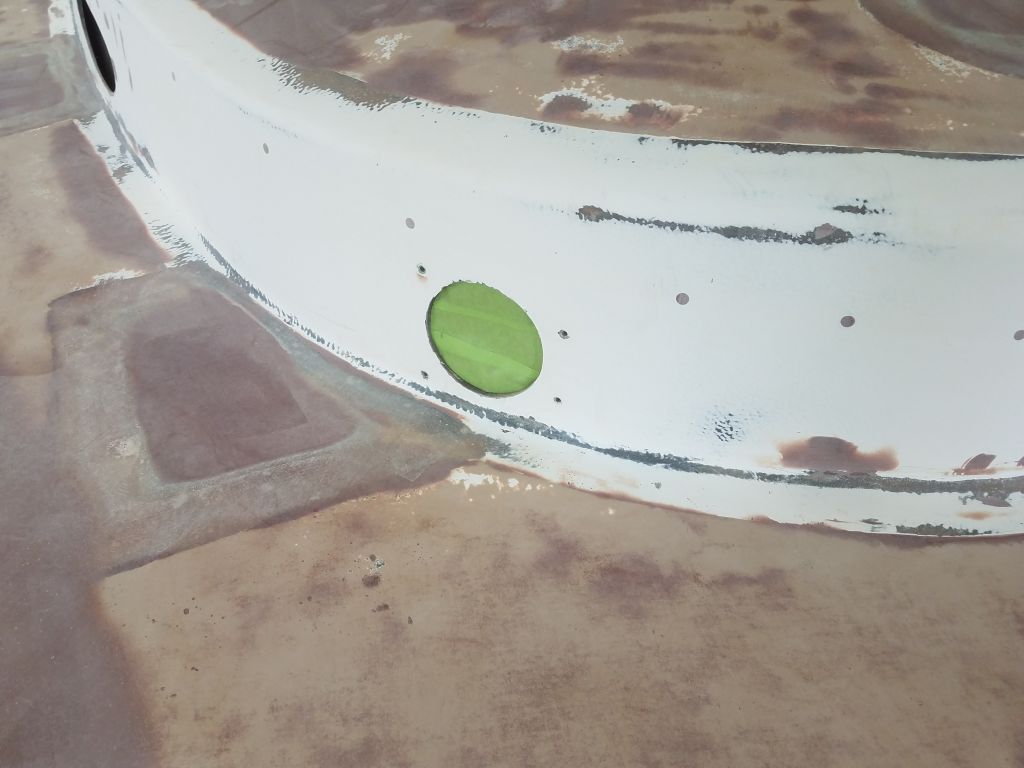
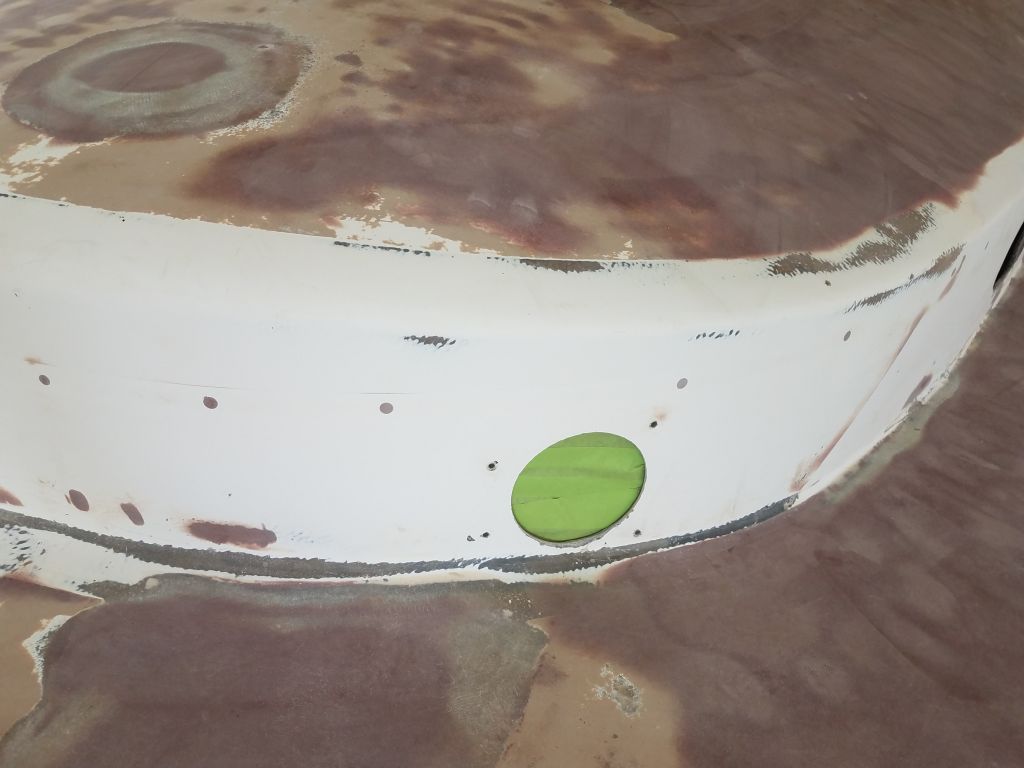
I finished up work on the porthole openings.  Fortunately, the three on the starboard side (which hadn’t ever been subject to whatever trauma had so greatly affected everything on the port side) were much less contaminated with silicone, so the job to finish the final four went more quickly than just doing the first two earlier.

I had one short round of final (final for now, anyway) sanding on deck to take care of a couple areas where I’d applied epoxy filler last time.

With that, I decided it was time to refocus on the hull, and also on the interior surface prep, so I spent some time resetting the staging down to a lower height to make working on the hull comfortable once again.

I’d already done a round of fairing filler and related sanding on the various small (and some larger) areas requiring it on the hull, but after a round in most areas I’d decided to wait till I had better access before continuing.  I’d lightly sanded all the spots after the first application, taking care not to go too far pending additional sanding to the entire hull that would be part of the process in the near future. The hull side of the new hull-deck joint fairing would also require final attention and finish sanding.

To prepare for another round of fairing filler where needed, I solvent-washed the entire hull, ensuring that I could spot-fill anything I found along the way that might need it.  Afterwards, I applied more epoxy fairing compound as needed.

Total time billed on this job today:  4 hours

0600 Weather Observation:  48°, mainly cloudy.  Forecast for the day:  Sun and clouds, 60s

Scupper 46

< Back to Scupper

Wednesday

Using a finish sander, I smoothed the last application of fairing compound on the coachroof, and continued sanding the coachroof through the grits to 120, completing the refairing work on this area.  One small spot, a remnant of a trowel mark, remained on the starboard side and would require some additional fairing compound.

Starting next in the cockpit, I used a palm sander and worked by hand as necessary to complete the final rounds of finish-sanding, taking care of tight corners, rounded edges, and the gutter areas around the cockpit lockers through 120 grit.

I continued on the sidedecks with minor final detail sanding as needed at corners and other spots, including lightly sanding the new deck edge.

I removed the temporary screws from the new lazarette hatch coaming, and after some light sanding and reaming out the screw holes, I applied some epoxy filler to seal up the holes.

On the coachroof, I cleaned up and applied a spot of fairing compound to the one small groove that remained, along with some touch-up on some mast step wiring holes that I’d only decided to fill at the last minute, as well as some additional screw holes in the cockpit locker hatches.

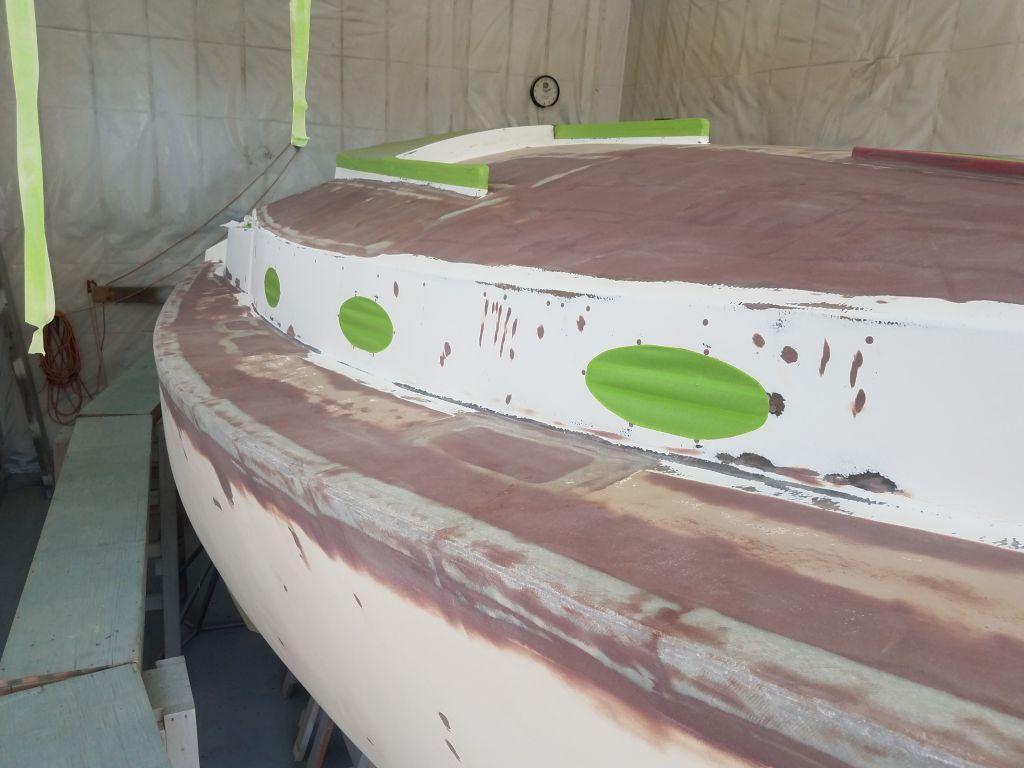
Later in the day, after a break to work on an unrelated project, I was contemplating the virtually-completed deck repair work and deciding whether to move the staging so I could continue the final work on the hull, when I realized I should clean up the port openings before continuing.  While I’d worked around the openings throughout the deck work, I’d basically ignored anything inside the deck’s outer skin, as my attention was on the significant repairs underway.

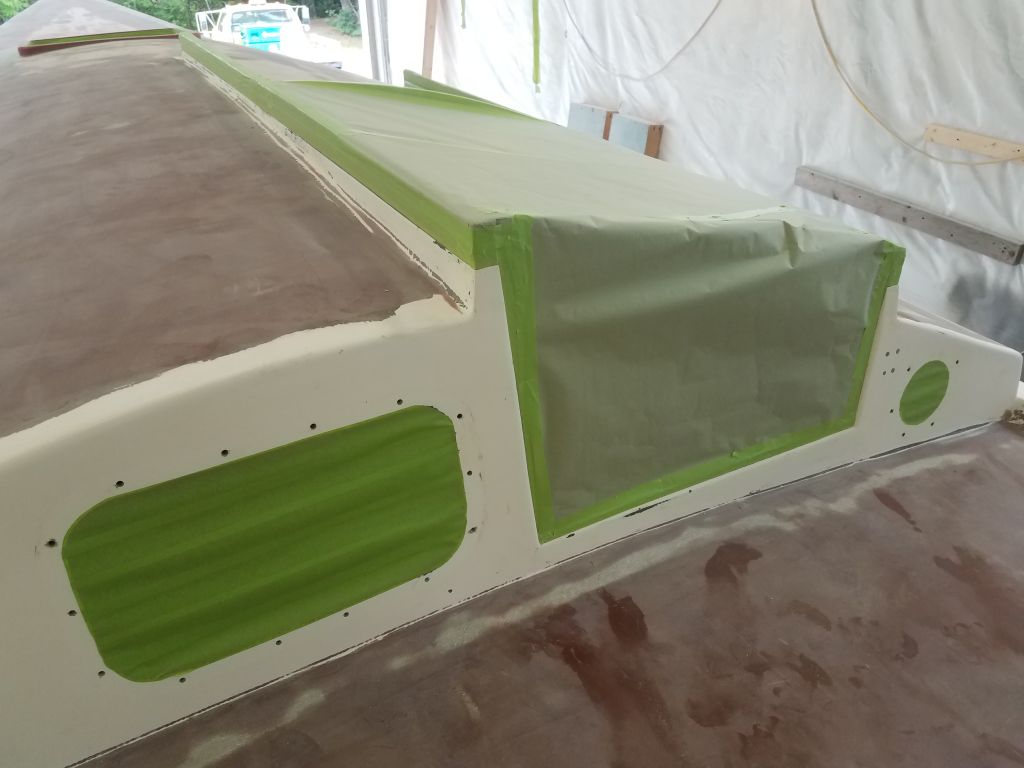
It was only after I got started on what I initially thought would be a simple, quick job that I discovered that much of what I’d thought was fiberglass inside the opening was in fact heavy dosages of The Hated silicone, leftover from the el-weirdo port lens installation that I’d removed early in the project.  So instead of quickly cleaning up the perimeters of the openings and moving on, I found myself laboriously attempting to scrape away the gobs of rubbery sealant from the tight space between the outer cabin trunk shell and the inner cabin liner, all the while trying to avoid damage to the outer surface that I’d only just finished preparing.  I worked my way through two of the openings on the port side before calling it a day, and looked forward to finishing up the remaining four next time.

Total time billed on this job today:  5.25 hours

0600 Weather Observation:  55°, partly cloudy.  Forecast for the day:  Sunny, chance of showers and thunderstorms, 75°
Scupper 45

< Back to Scupper

Monday

Continuing  the deck work, I once more sanded the coachroof fairing repairs, bringing the surface enticingly close to final contours with this round, other than several minor low spots and some pinholes that would require additional work.

I spent the rest of the morning sanding the other deck areas, including the bridgedeck, cockpit, and cockpit well, where I finish-sanded through 120 grit the skim coat over the existing nonskid to smooth those areas, as well as sanding the original gelcoat in the cockpit well, coamings,  my earlier repairs, and other areas to prepare everything for primer and any additional work beforehand.  I’d still need to come back and sand corners and tight areas by hand or with another machine later.

On the sidedecks and foredeck, as well as the cabin trunk sides and coamings, I finish-sanded all areas through 120 grit, removing the skim coat over the foredeck nonskid and portions of the starboard deck in the process and bringing these areas essentially into their final stage before primer, other than an additional round of detail and hand sanding as needed for those corners and tight areas.

The twelve through hull patches on the bottom (including three in the topsides) were looking pretty good after sanding the light second coat of fairing compound,  and I deemed the work complete, though the patches on the topsides would receive a bit of extra attention when I turned to the final preparations for the hull in the near future.

After cleaning up, I spot-applied additional fairing material to the coachroof as needed, focusing mainly on a few low spots (mostly trowel marks) and some obvious pinholes in some of the previously-faired areas.  The instrument panel patches below the bridgedeck required a bit of additional fairing as well.

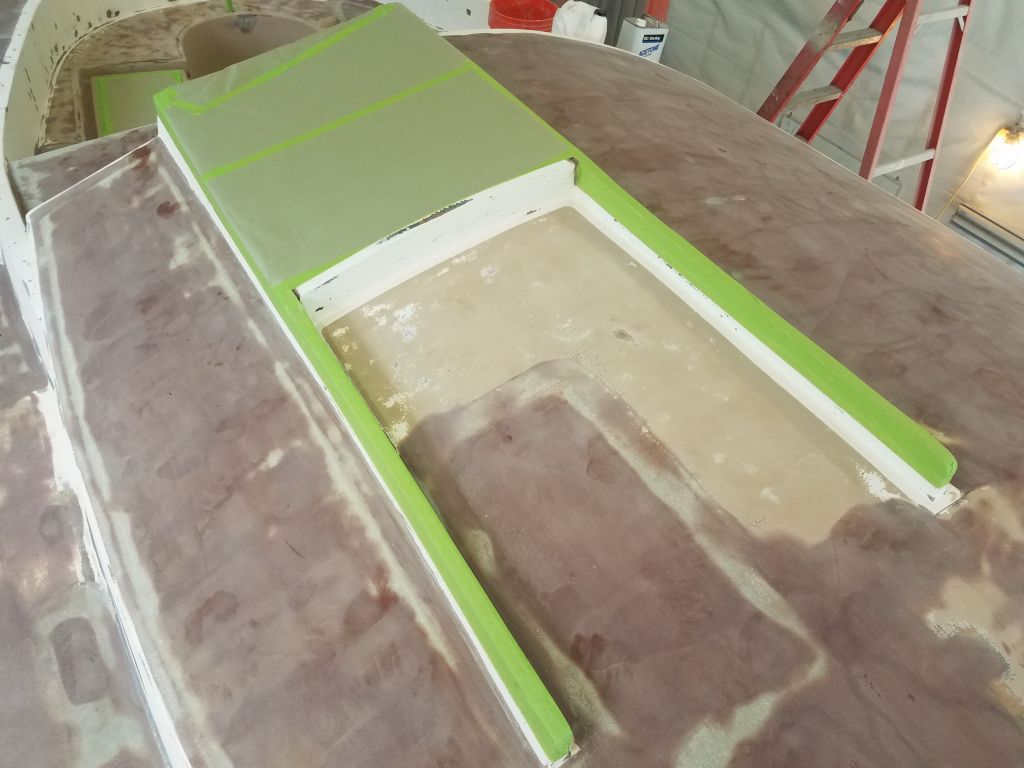
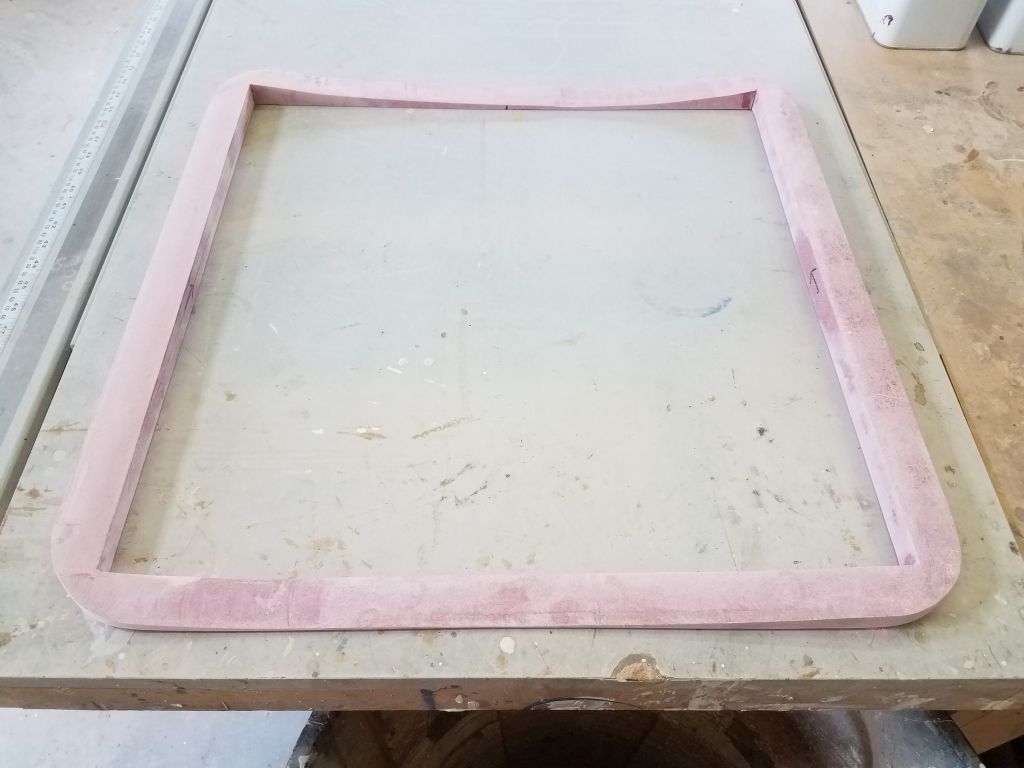
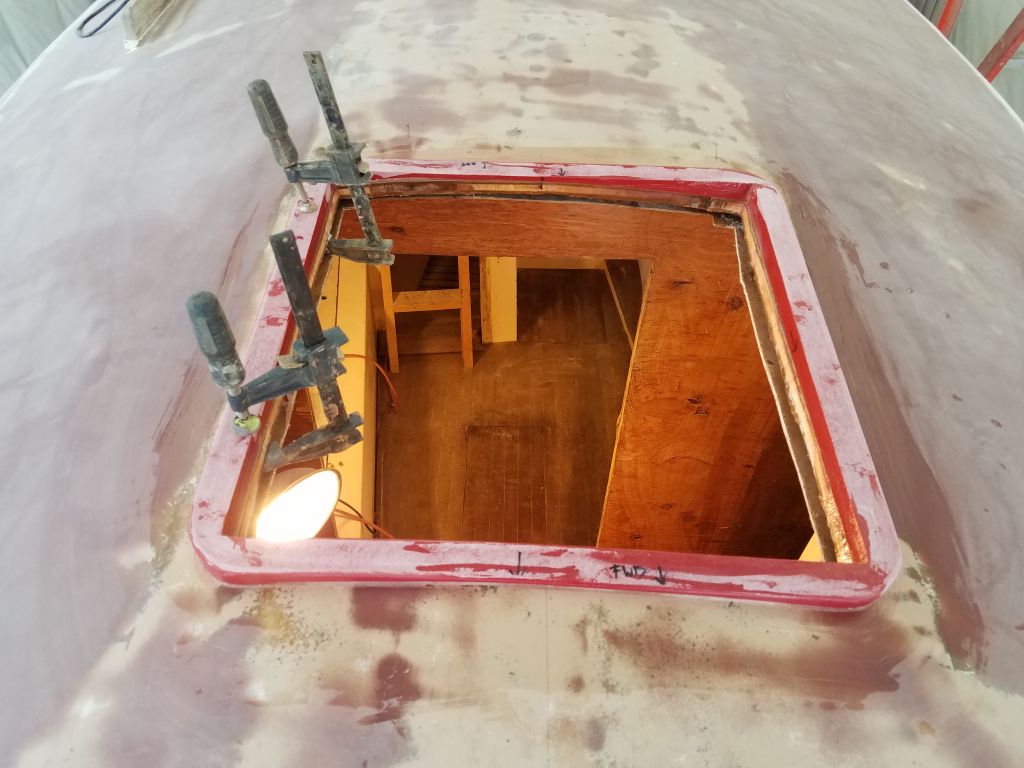
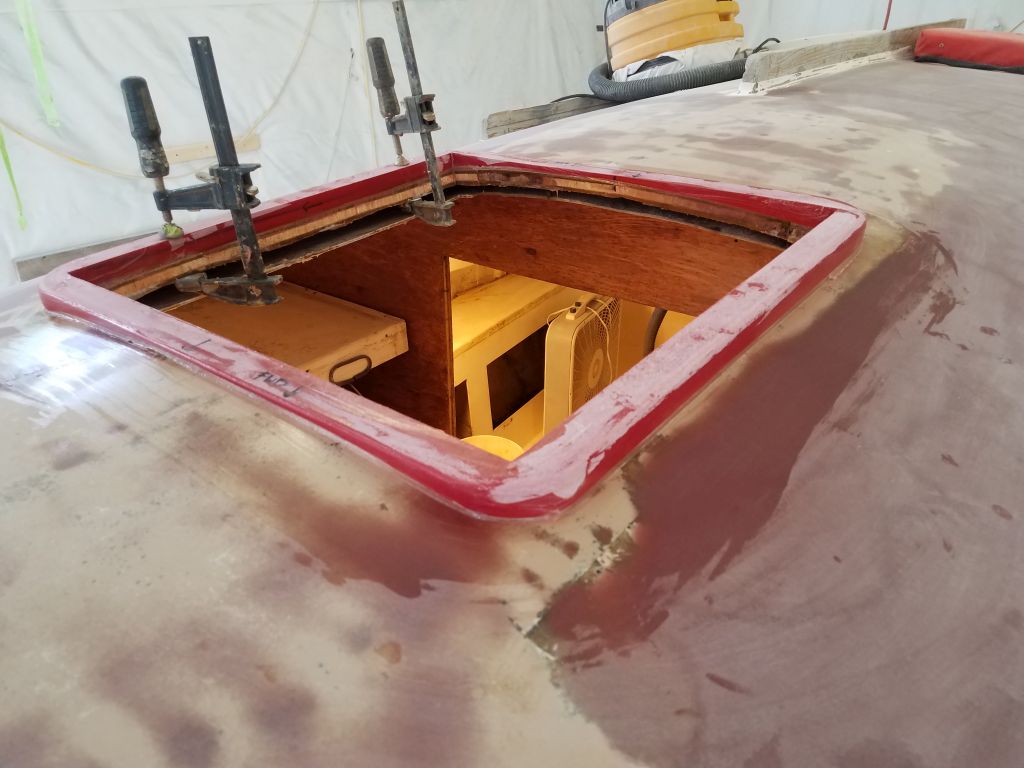
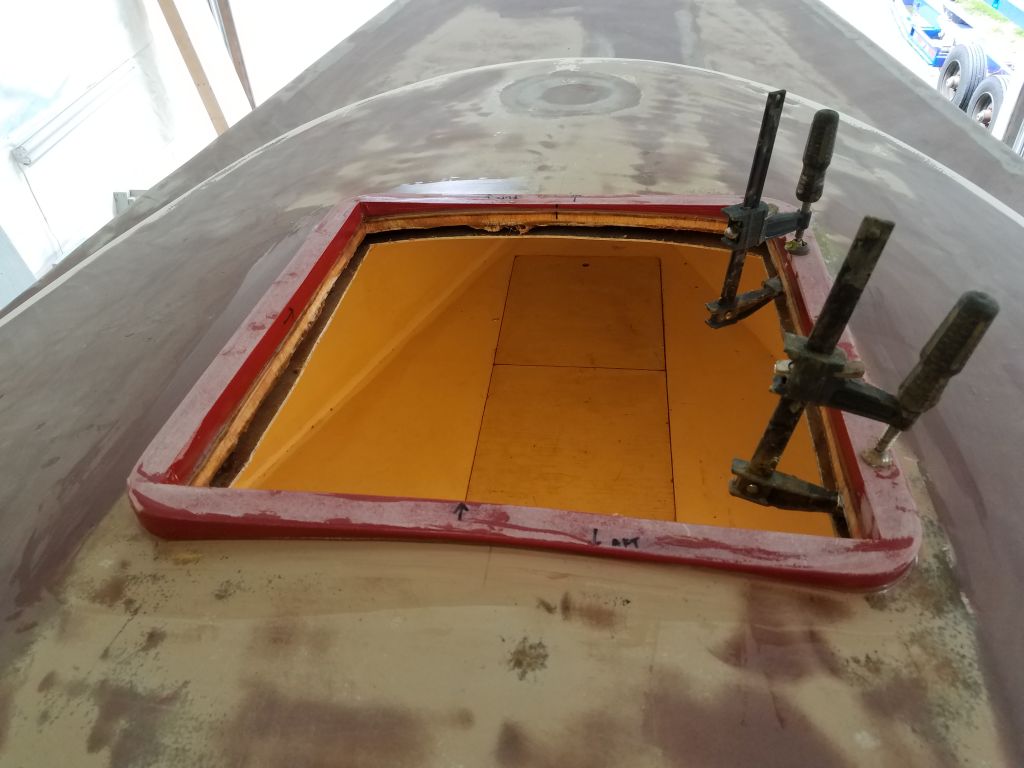
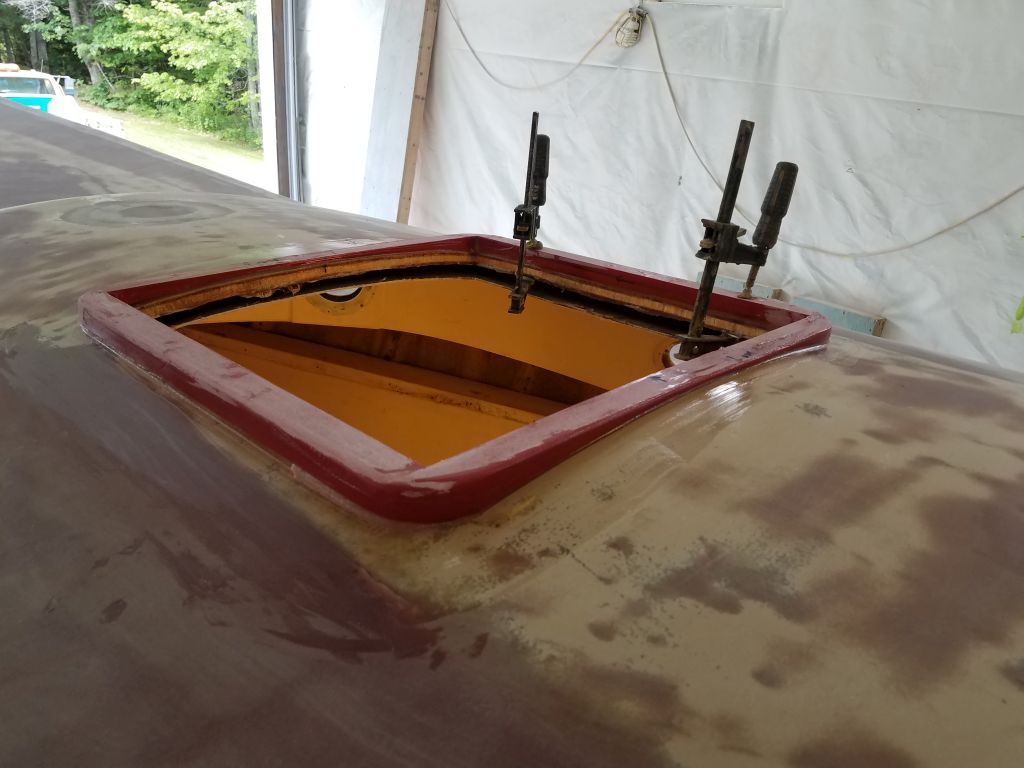
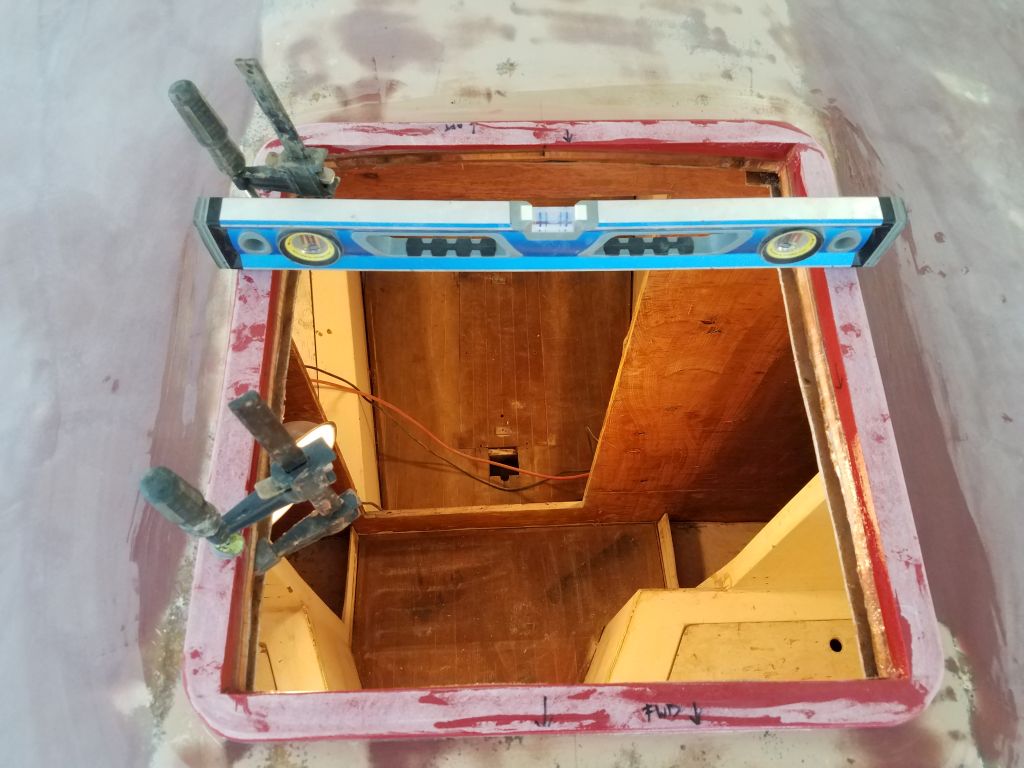
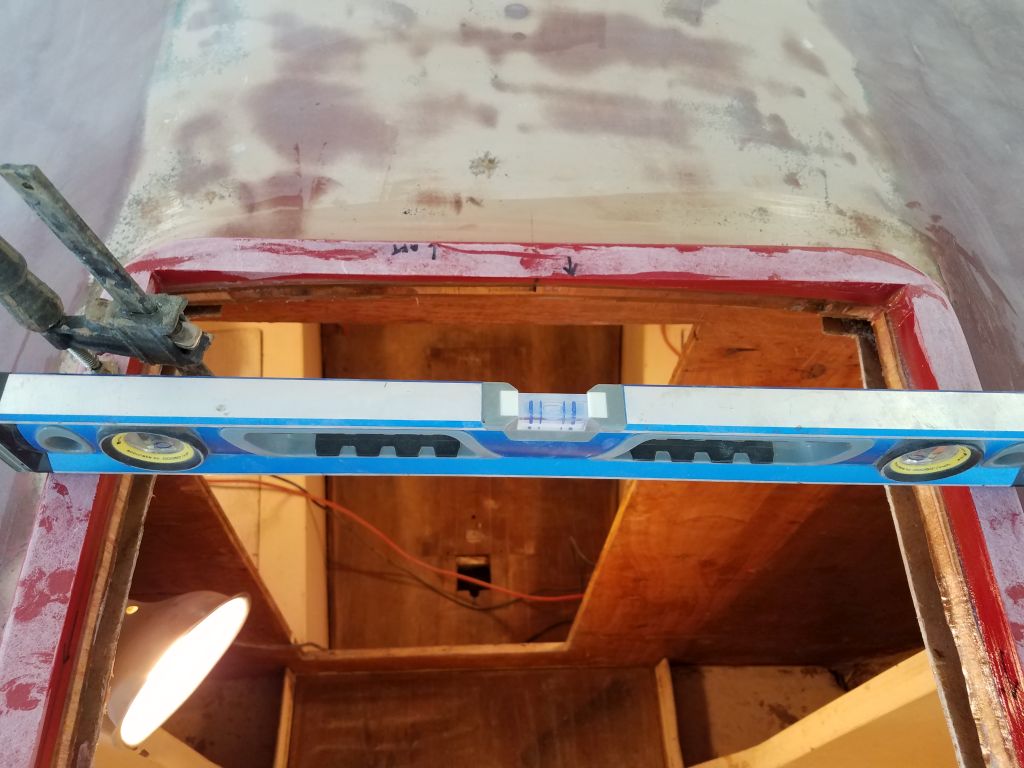
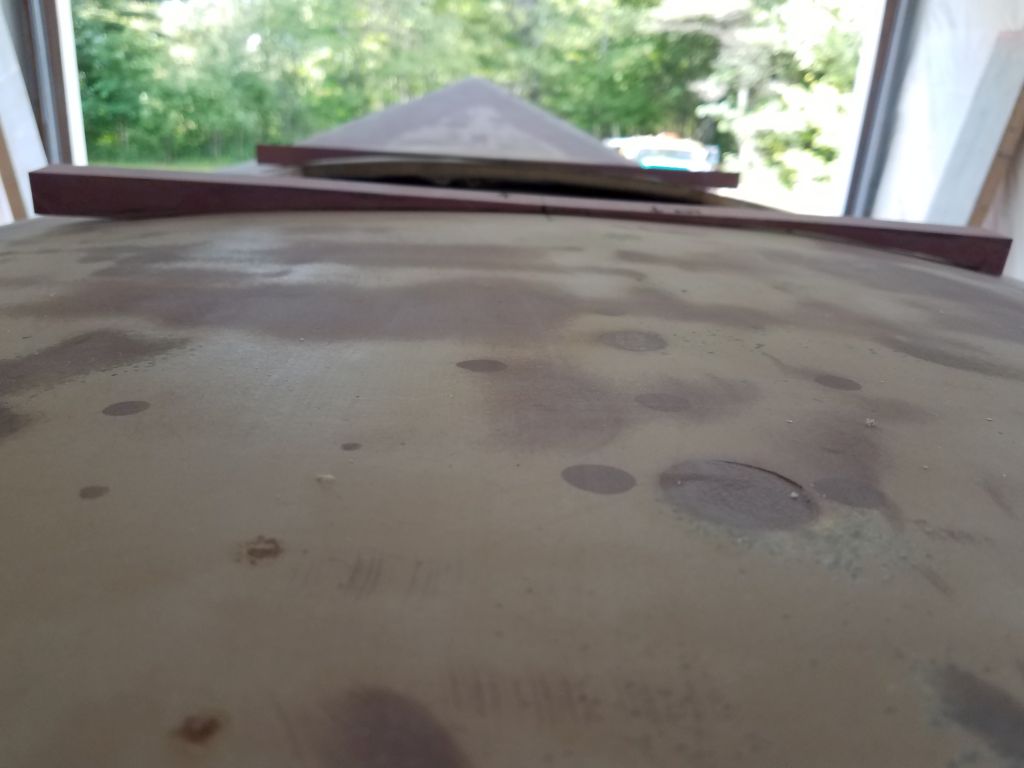
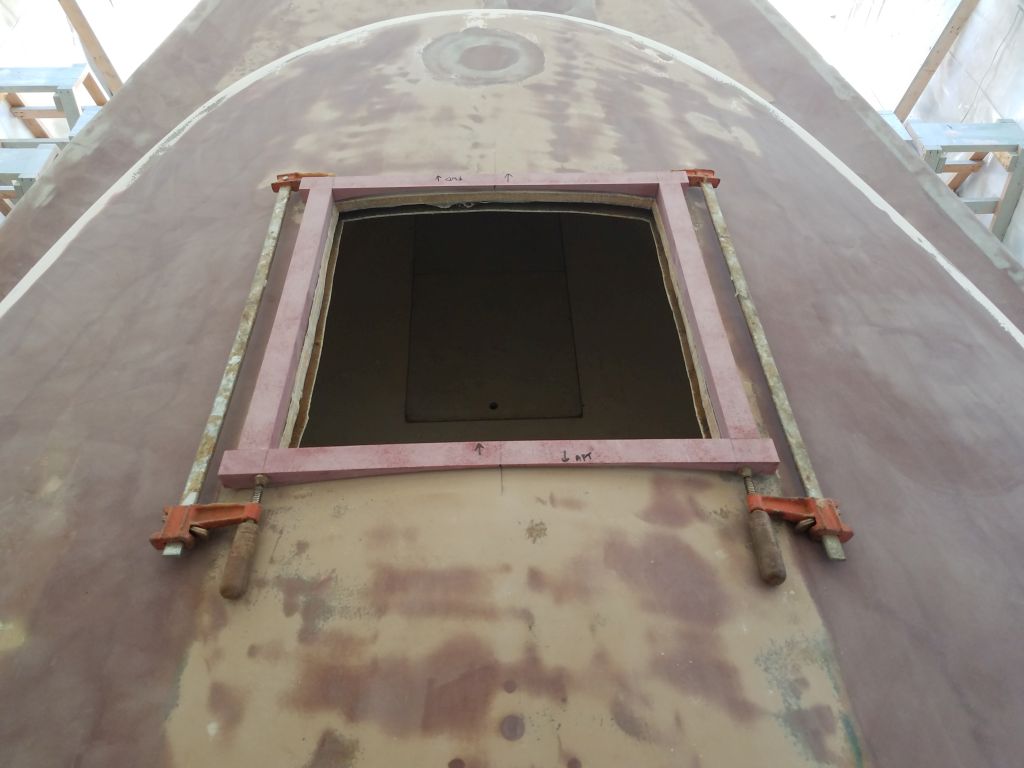
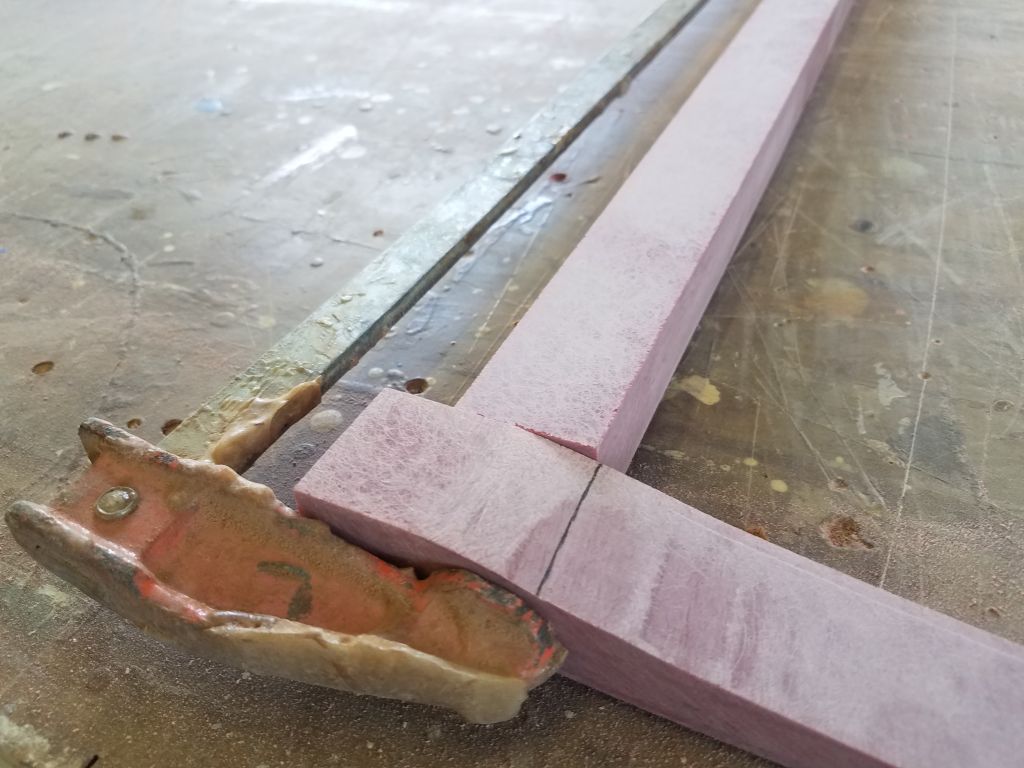
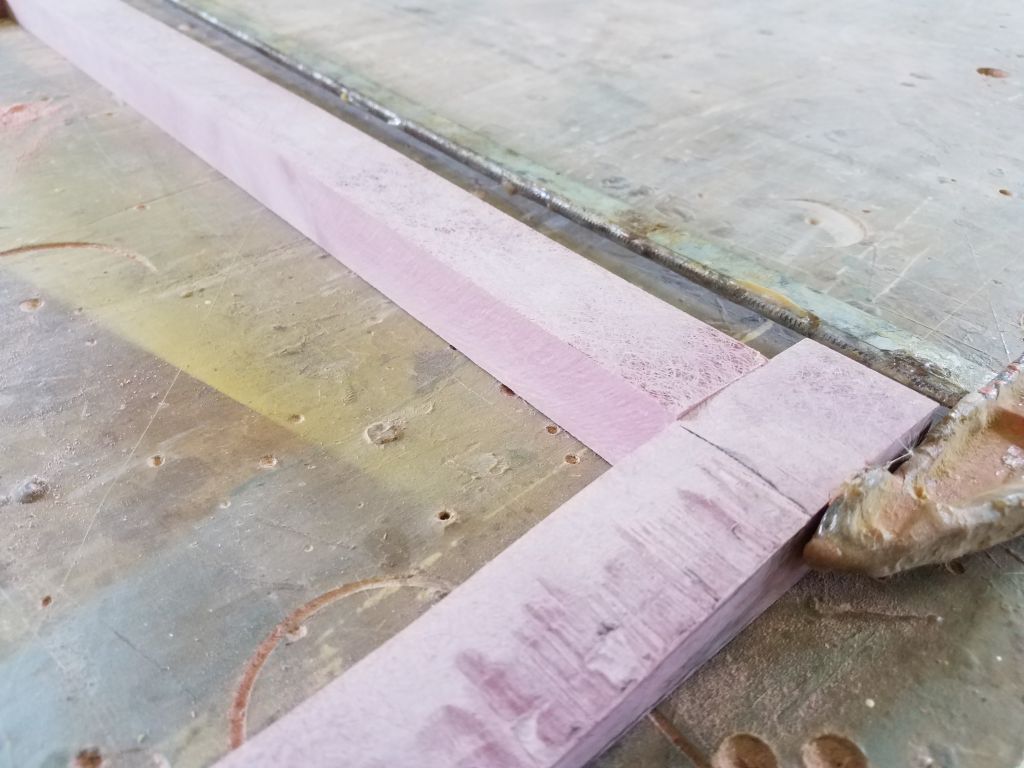
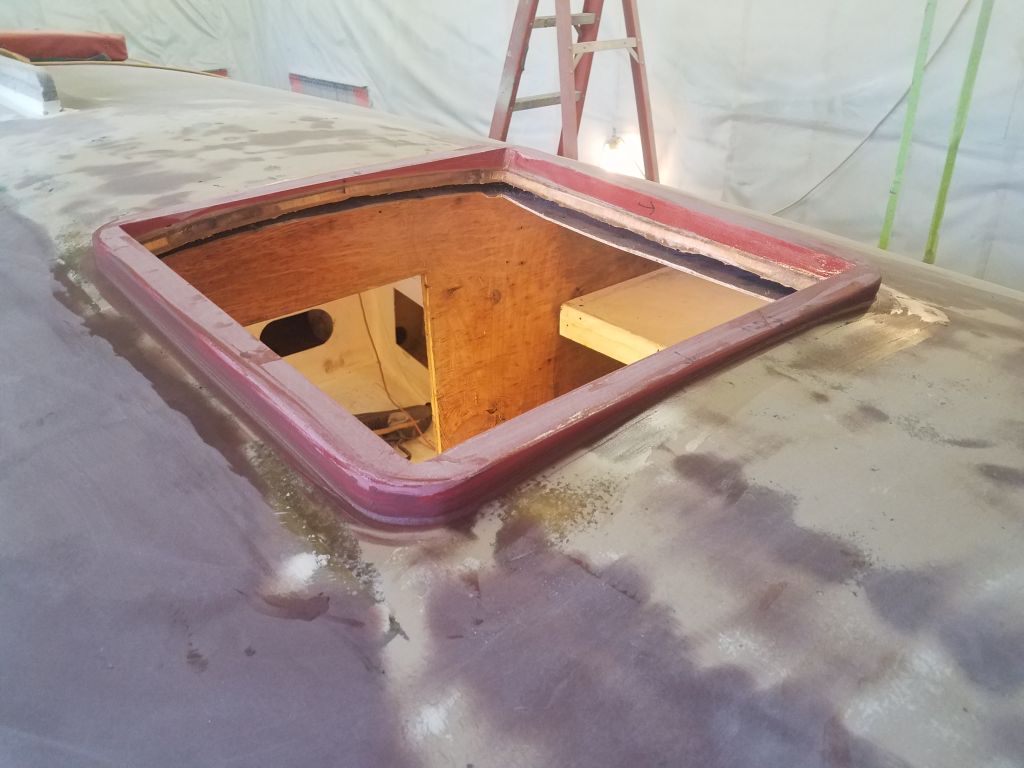
To round out the day, I built a coaming for the new lazarette hatch.  This raised coaming would prevent water from entering the opening, and support/align the new hatch to close the opening.  From 1/4″ thick prefabricated fiberglass, I milled 1-1/2″ wide strips to cover the exposed edges of the opening and continue above the deck surface far enough to do the job, without projecting so far as to make access to the hatch unnecessarily uncomfortable.  I dry-fit the new strips around the perimeter for a friction fit, secured temporarily to the exposed plywood core edge with screws.

With the coaming satisfactorily fit, I removed the strips and, after final preparations (including cleanup, solvent wash, and application of unthickened resin around the hatch edge to seal the exposed core), installed the strips in thickened epoxy adhesive, securing them again with the temporary screws and creating small fillets in the corners and around the outer edges of the strips where they met the existing deck.

Total time billed on this job today:  7.5 hours

0600 Weather Observation:  48°, clear.  Forecast for the day:   Sunny, 75°
Scupper 44

< Back to Scupper

Friday

Another day, another round of sanding on deck and on the through  hull patches.  The repairs in the cockpit were looking  pretty  good  after one coat of fairing compound, and the coachroof was getting close on the starboard side, and pretty good to port as well.

The new repair over the old solar  vent hole in the forward coachroof  was looking good, and I’d fair it in as I continued work on the adjacent areas.

The afternoon was rather disjointed, as my attention was sporadically required elsewhere for some unrelated work going on, but in several shorter sessions I managed to get through what I wanted to for the day, including a third coat of fairing compound on the coachroof.  This time, I focused on the known low spots left from last time, and fine-tuning the outer edges of the work area.

The old instrument and other holes in the cockpit were pretty close  after a single coat–in fact, the two smaller holes in the cockpit well required no additional work at this time–but I applied a second coat as  needed, along with some additional work on the port coaming repair and solar vent hole.  In addition, I skim-coated the molded nonskid areas on the cockpit seats and cockpit well, which areas I’d sanded during the morning’s sanding session to prepare for the finish  work now.

I’d also sanded the two cockpit locker lid hatches to prepare their original surfaces for skim-coating, which I did now.

The through hull patches looked good after a coat, and barely needed more attention, but I applied a second coat to all 12 patches regardless.

Finally, I skim-coated some remaining areas of the main deck, notably the foredeck and portions of the starboard deck, to help smooth the remnants of the old molded nonskid pattern and fill some additional small voids.

Total time billed on this job  today:  5.75 hours

0600  Weather Observation:  50°, clear.  Forecast for the day:  Sunny, low 60s

Scupper 43

< Back to Scupper

Thursday

Once more, by hand and machine as needed, I sanded the continuing work on the coachroof, bringing it incrementally closer to its final shape.

Meanwhile, I sanded the new fiberglass patches in the cockpit area.

Moving to the shop floor, I sanded all the new through hull patches, bringing the edges flush with the adjacent surfaces and ready for fairing.

After cleaning up, I applied a coat of fairing compound to the through hull patches.

On deck, I continued with another application of fairing compound on the coachroof and  on the new patches in the cockpit, plus some detail work in a few other areas here and there.

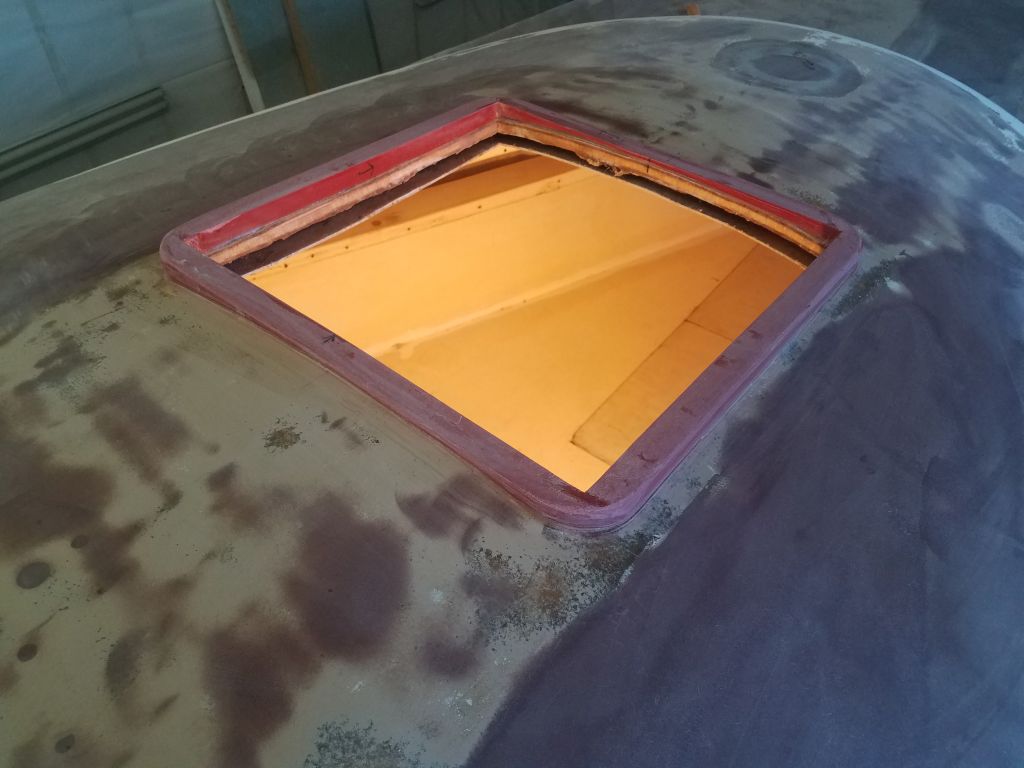
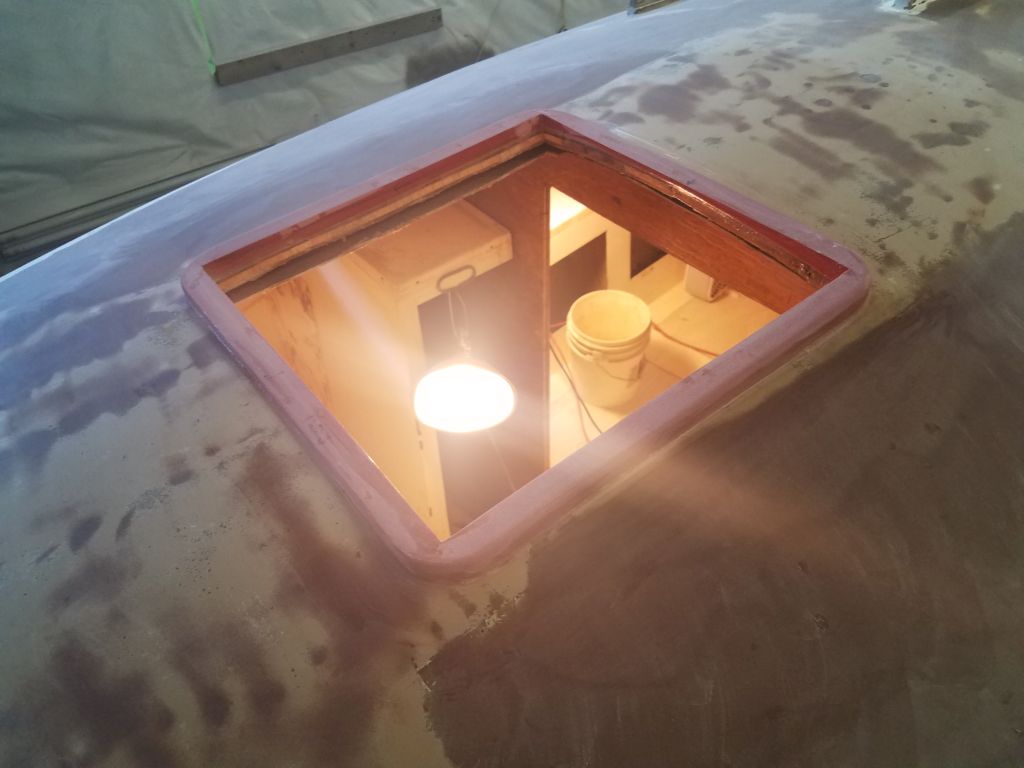
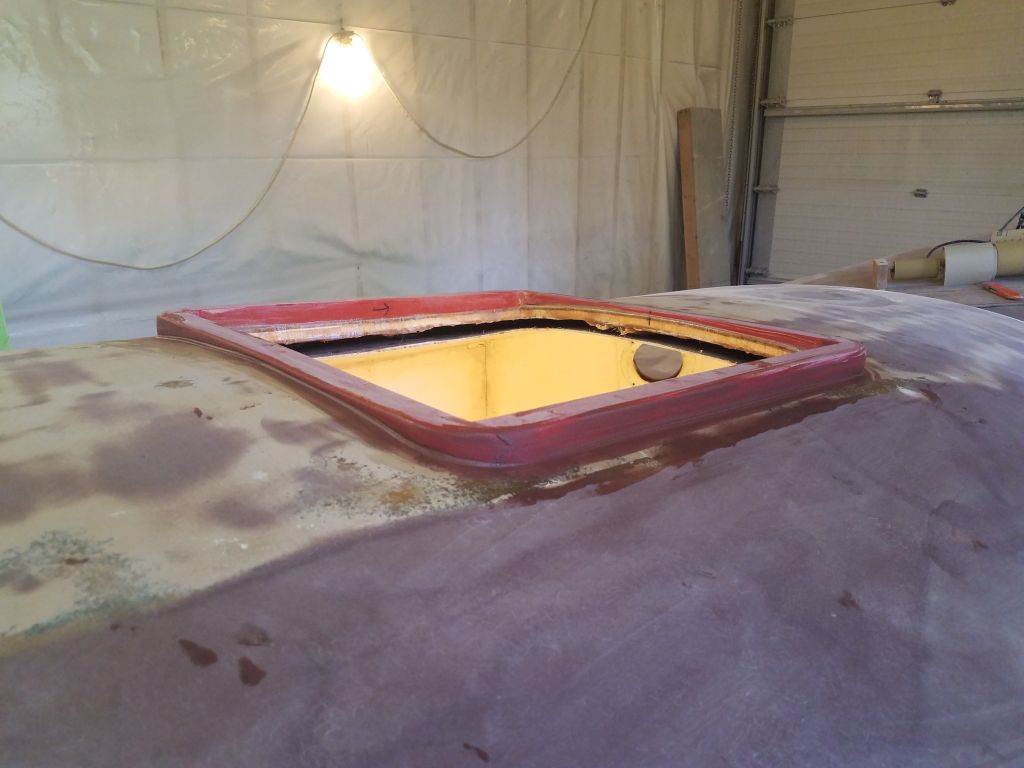
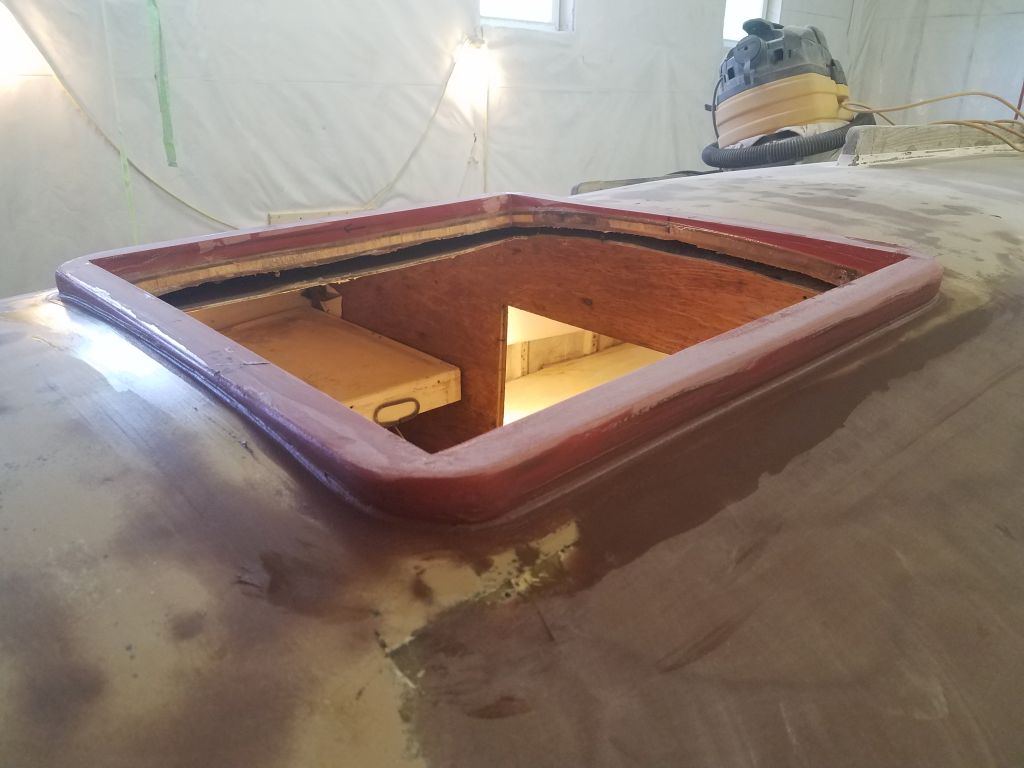
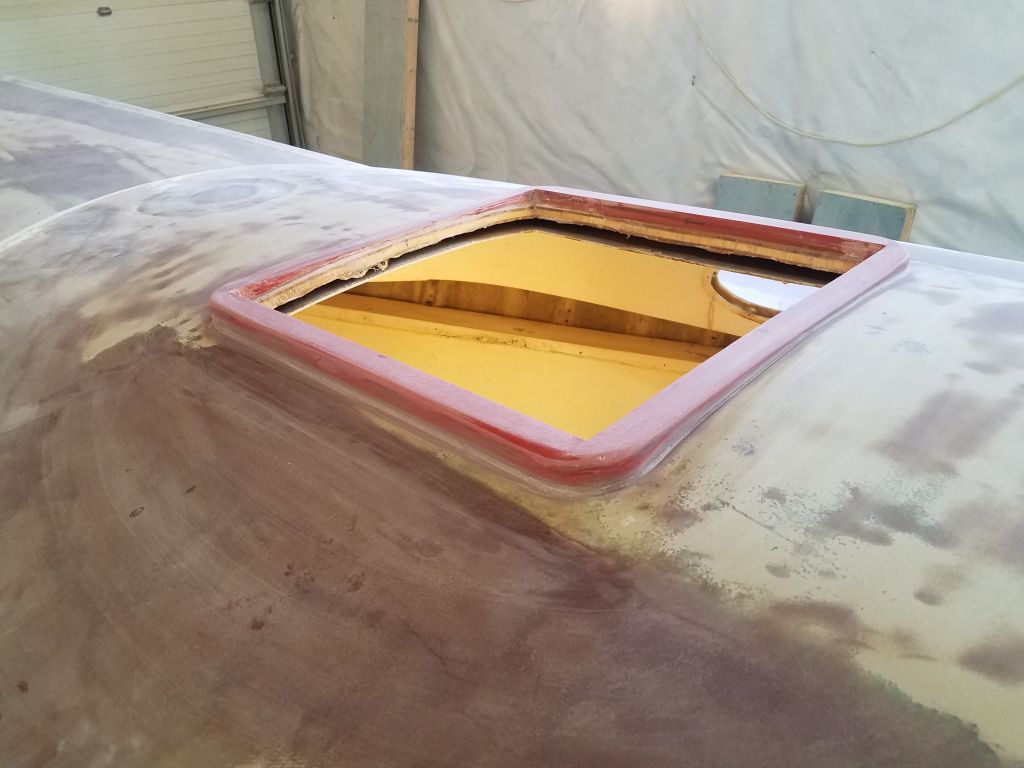
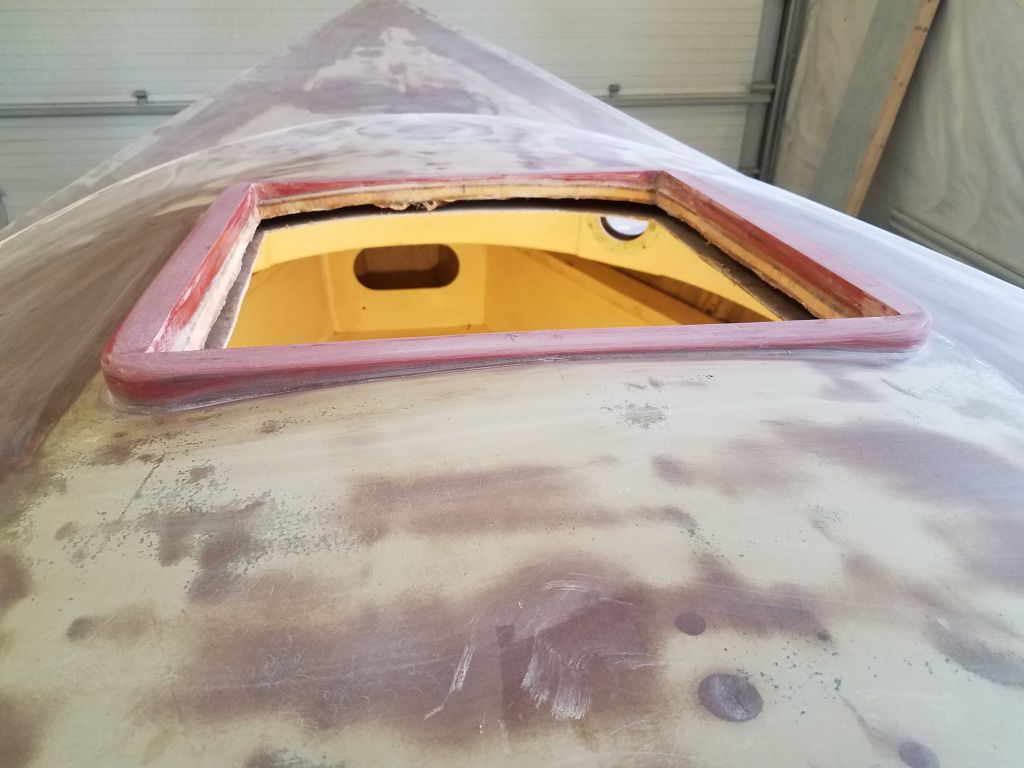
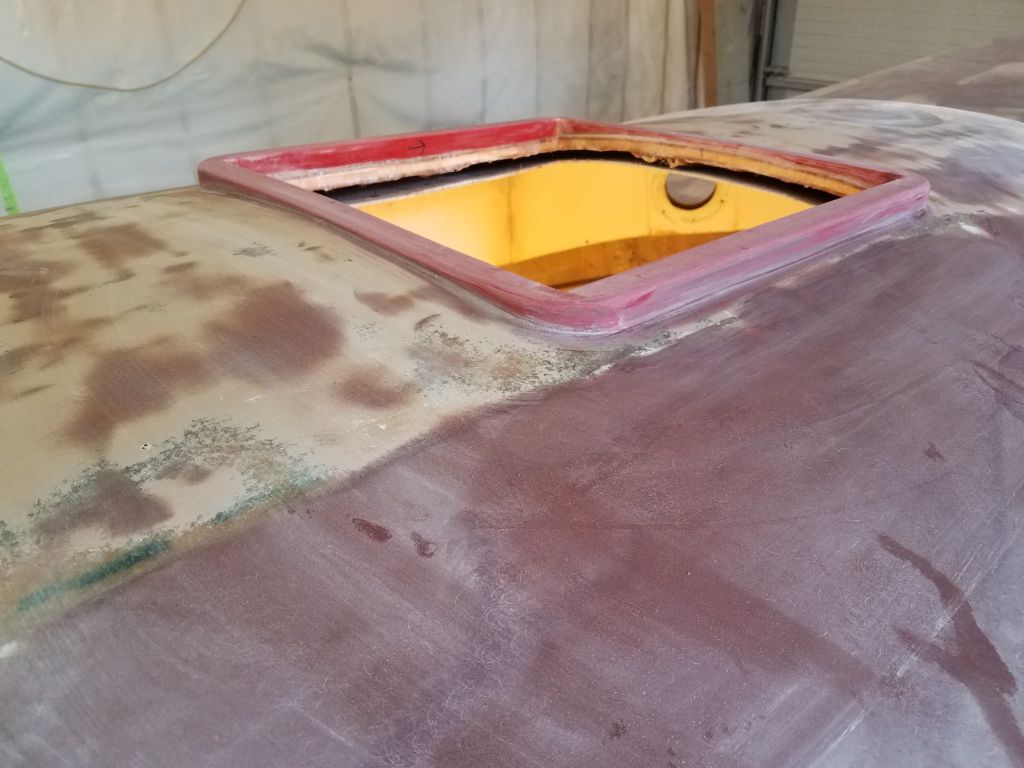
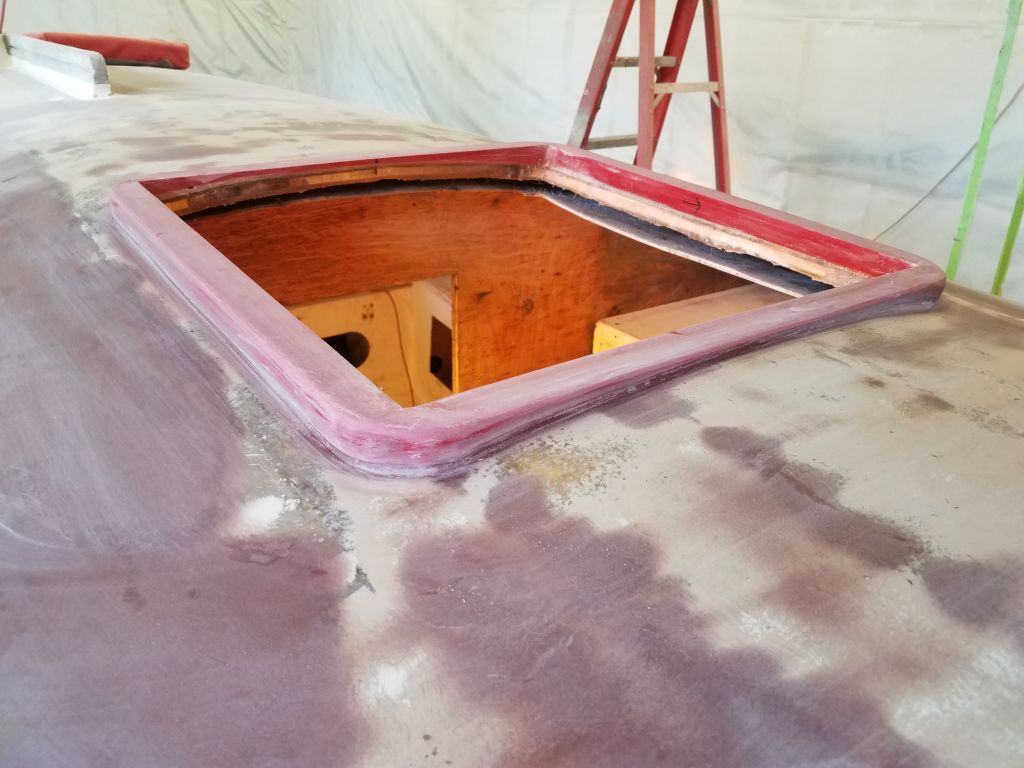
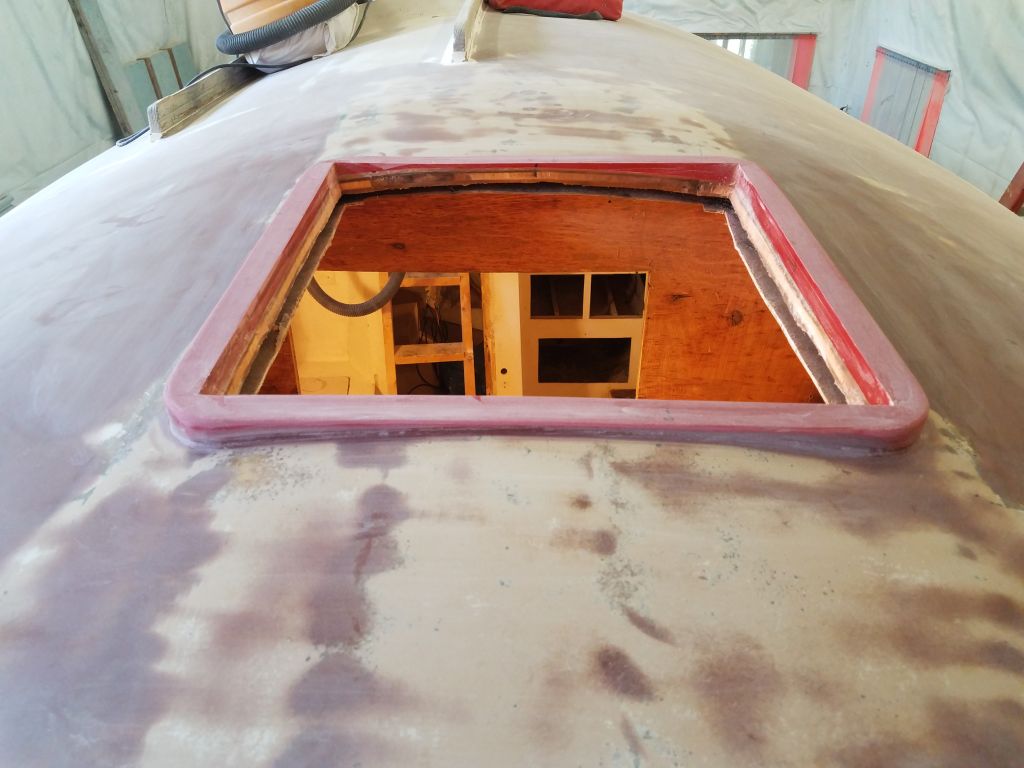
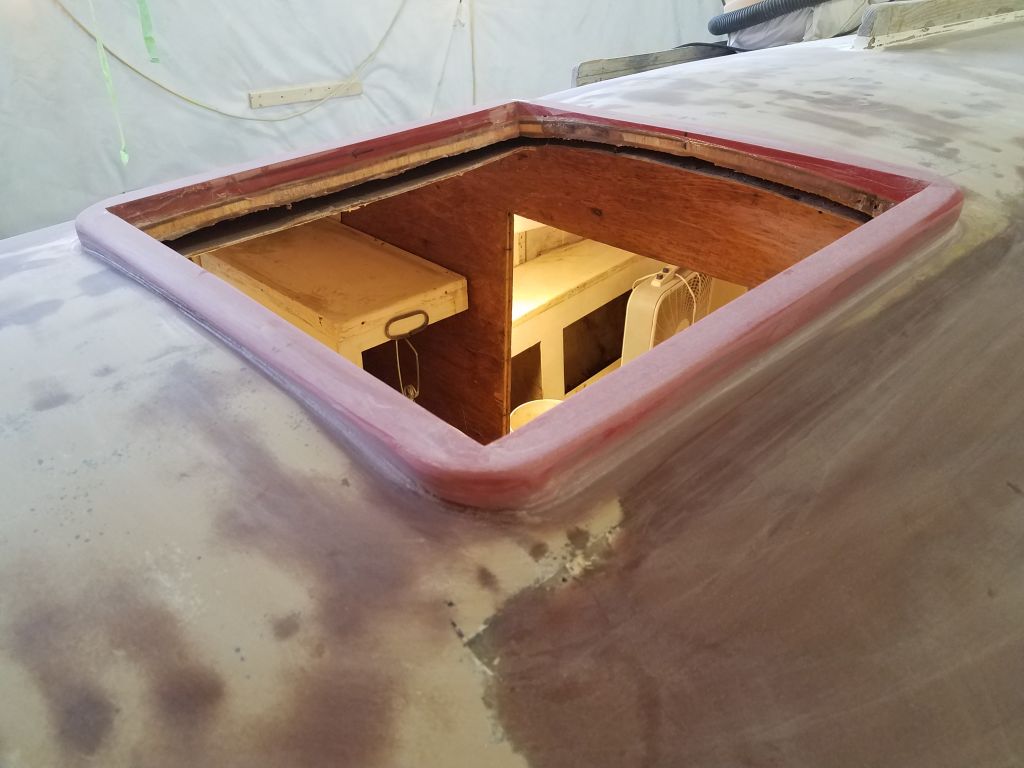
Later, I turned  to  the old hole leftover from a solar vent  in the coachroof.   Whether or not a  replacement  vent was in the plans for the future, we decided to patch the existing  hole and maintain flexibility for any and all  new installations later, and earlier I’d prepared the opening for patchwork by grinding around the existing hole in the usual way.  Now, I covered the inside of  the hole  and filled it with a structural epoxy plug before applying two layers of new fiberglass over the top, completing the patch.  Sometime later I’d address the inside of the opening.

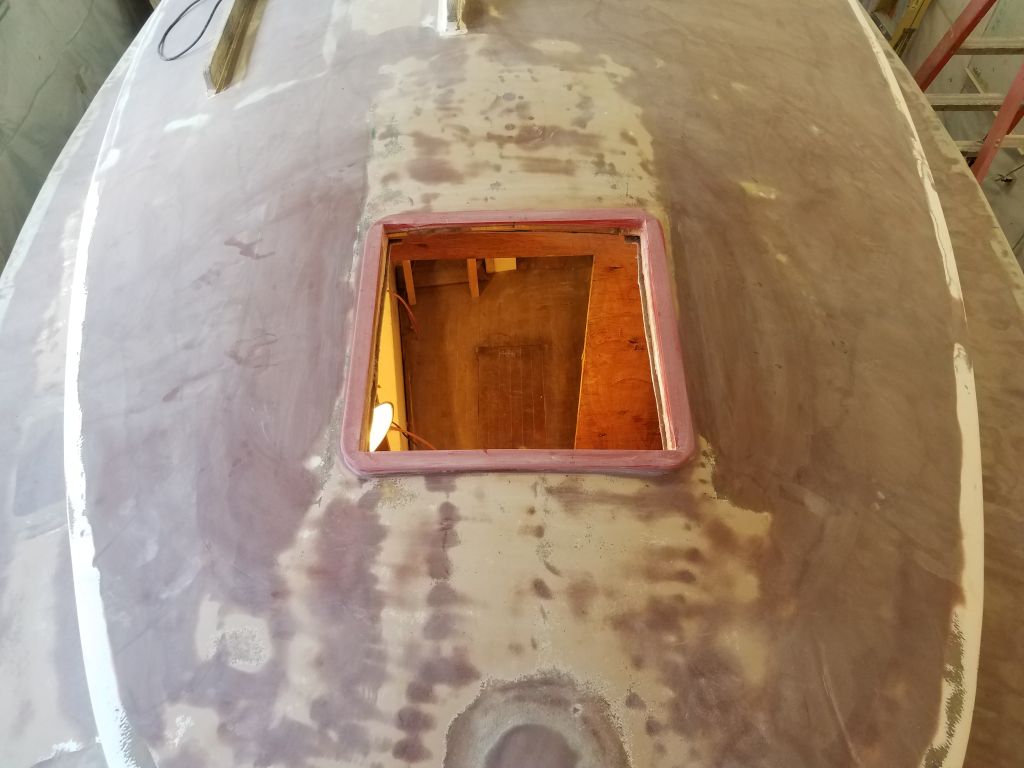
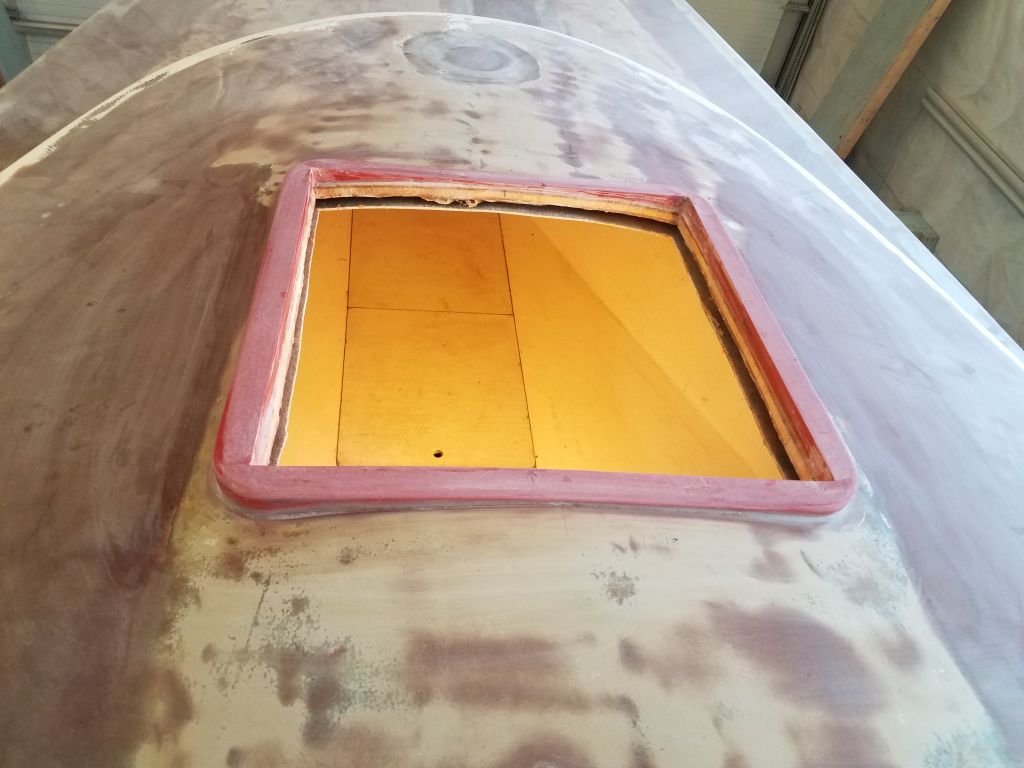
Finally, I decided to enlarge a bit the new cutout for the lazarette hatch.  When I first cut the opening, I’d kept it a conservative size, not yet sure how large I could or should make it, but access would be enhanced with a larger opening, and with plenty of room inside it made sense to increase the size for better ingress to  the space, as well as to  make room for a hatch lining and raised edge.  I enlarged the opening by 2″ on each side and made preparations for the next steps to continue work on the  hatch opening.

Total time billed on this job today:  7.25 hours

0600 Weather Observation:  50°, cloudy.  Forecast for the day:  Clearing, 72°

Scupper 42

< Back to Scupper

Wednesday

No one likes the long board, but the huge coachroof, which had started out substantially unfair as a remnant of some previous repair effort, simply required it in order to highlight the basic contour of the deck and the low spots that I needed to fill between the various highs that would ultimately form the basis for the new shape.  Fortunately, at least at this early stage I didn’t need to use the laborious tool for long:  just enough to scratch up the surface and show me where to focus on the next fairing coat.  Since most of the surface was actually low, I knew I’d be filling again, probably several more times, and now I just needed to knock off any rough spots and high areas to prepare for the next round, most of which I could do with normal sanding tools once I’d as sense of things from the hand scratching.

There were a few other small detail areas that had fairing compound requiring sanding at this point as well, including some fillets along the deck edges and cockpit repairs, plus the port coaming repair and port cockpit locker area.  There’d be more detail work ahead as I continued the increasingly minor and light fairing and overall surface preparation work on the decks now that most of the major repair work was complete,

The main bulkhead was sort of pinned in place at the top outside corners (most of the top edge wasn’t secured at all) with wooden blocks, which were throughbolted to the bulkhead and then secured through the coachroof with carriage bolts from above and barrel nuts from below.  These were in the way of the new fairing work–I’d just worked around them for the first coat–and needed to be removed, since they were not what I saw as a permanent solution to the bulkhead, so from belowdecks I removed the nuts (easily, fortunately) and then pried up the bolts from above, leaving holes that I reamed out and prepared for filling in my usual way.

After cleanup and final preparations, including filling the now-empty boltholes, I applied a second coat of fairing compound to the coachroof, troweling longitudinally this time, which was perpendicular to how I’d applied the first coat to help fill the trowel marks and other low spots left after the first application.  This was starting to look better and smoother, but there were still obvious low “swales” in the reconstructed laminate beneath, and I knew there’d be several more rounds of fairing before I could approach a reasonable shape on the coachroof.  With such a huge area, I didn’t even try (OK, I tried, but didn’t fret) to avoid ridges or trowel marks between application rows, but each application would be that much better and already the massive port side was looking an order of magnitude better than its original shape.    Rome wasn’t built in a day.

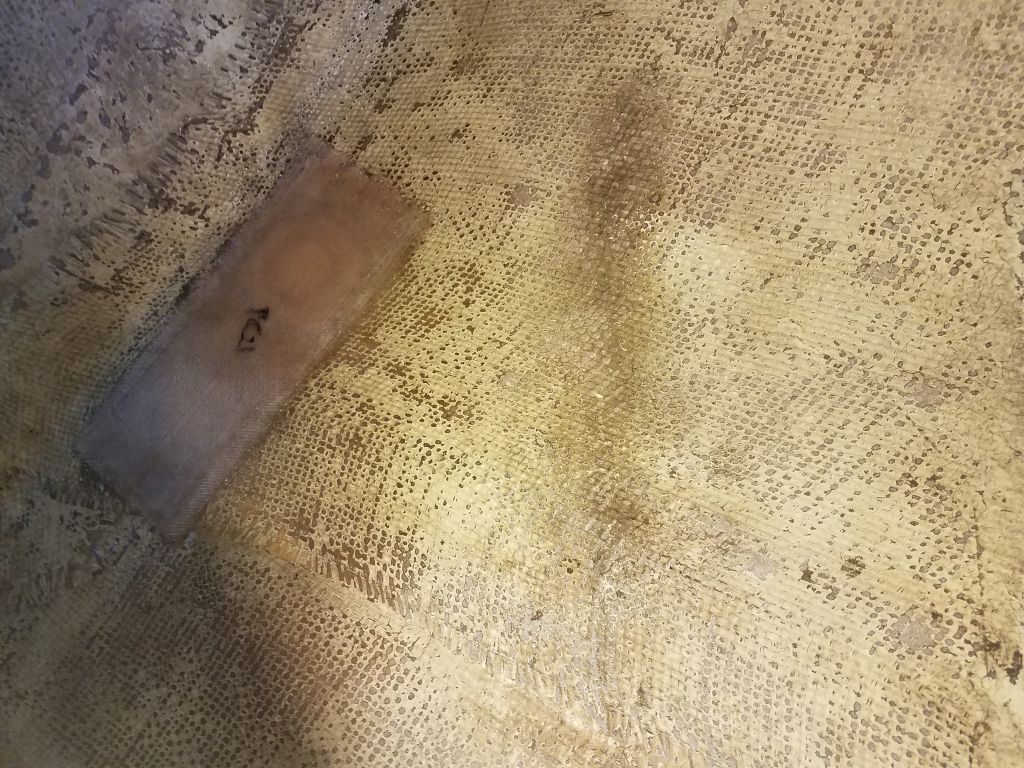
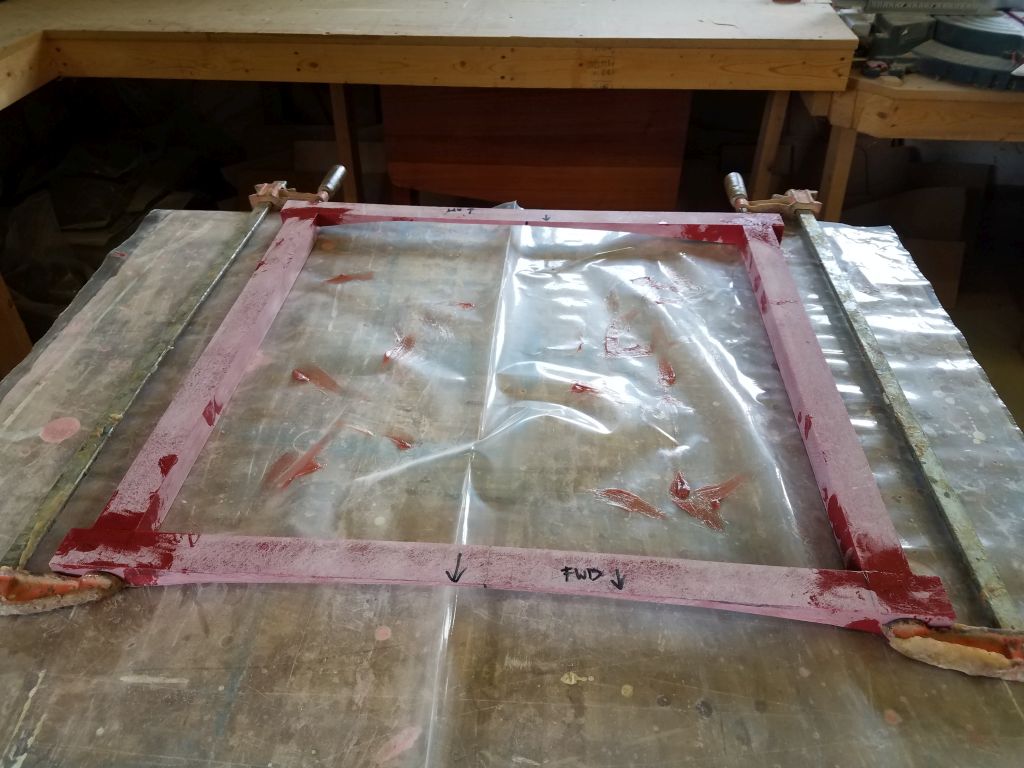
There were still several old hardware and instrument holes in the cockpit that required patching, most notably the myriad openings in the base of the bridgedeck.  With no direct access to the back side of this area, other than a narrow slot accessible from inside the engine room, I decided my best approach would be to apply a permanent prefabricated panel behind the holes, over which I could fiberglass the patches from the inside.  To this end, I’d ordered a sheet of 1/8″ thick fiberglass, which I sanded to prepare for bonding.   To the extent possible, I prepared and cleaned up the surface behind the instruments, then wedged the fiberglass panel in place from behind, holding it securely with some wooden wedges.

From outside, I applied a thickened structural epoxy mixture to smooth in the old cutout edges with the surrounding area, which also would ultimately well adhere the backing to the boat and new repair work.    While I let this cure for a time, I prepared two layers of fiberglass for the patch, cut to fit as needed, and later installed there new fiberglass in epoxy resin.  Meanwhile, in the cockpit well I installed new fiberglass over several existing holes that I’d previously repaired and filled with thickened epoxy during an earlier work session.

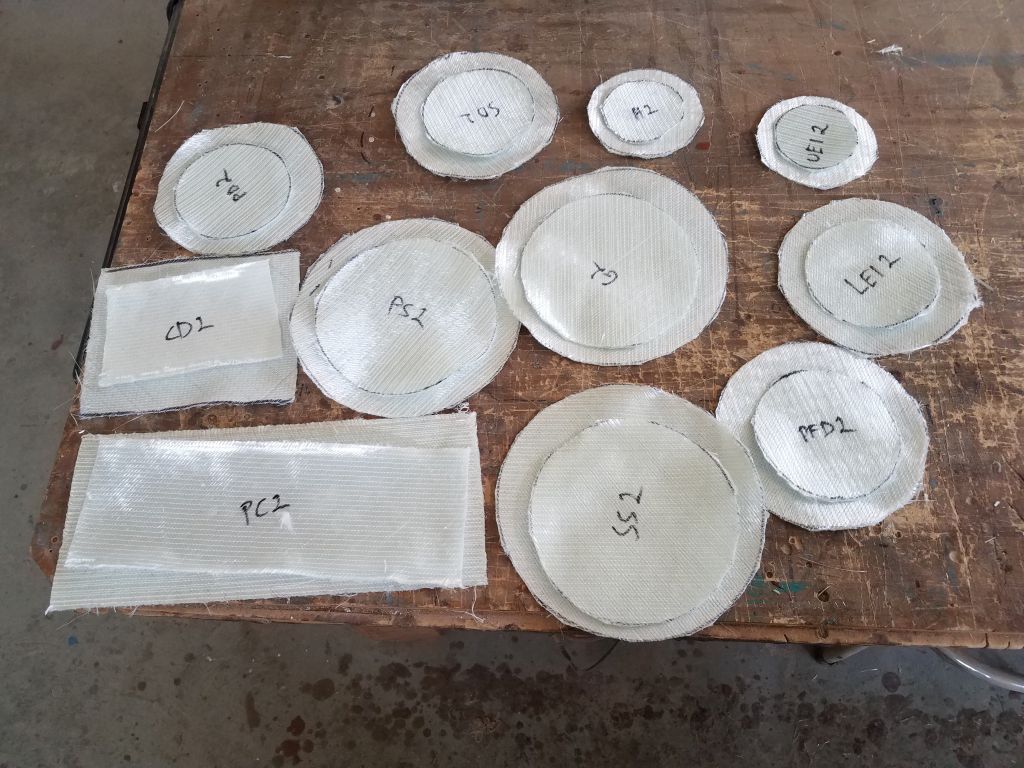
During the remainder of the day, I patterned and cut fiberglass for the 12 through hull patches required on the bottom and, in a few cases, on the topsides.

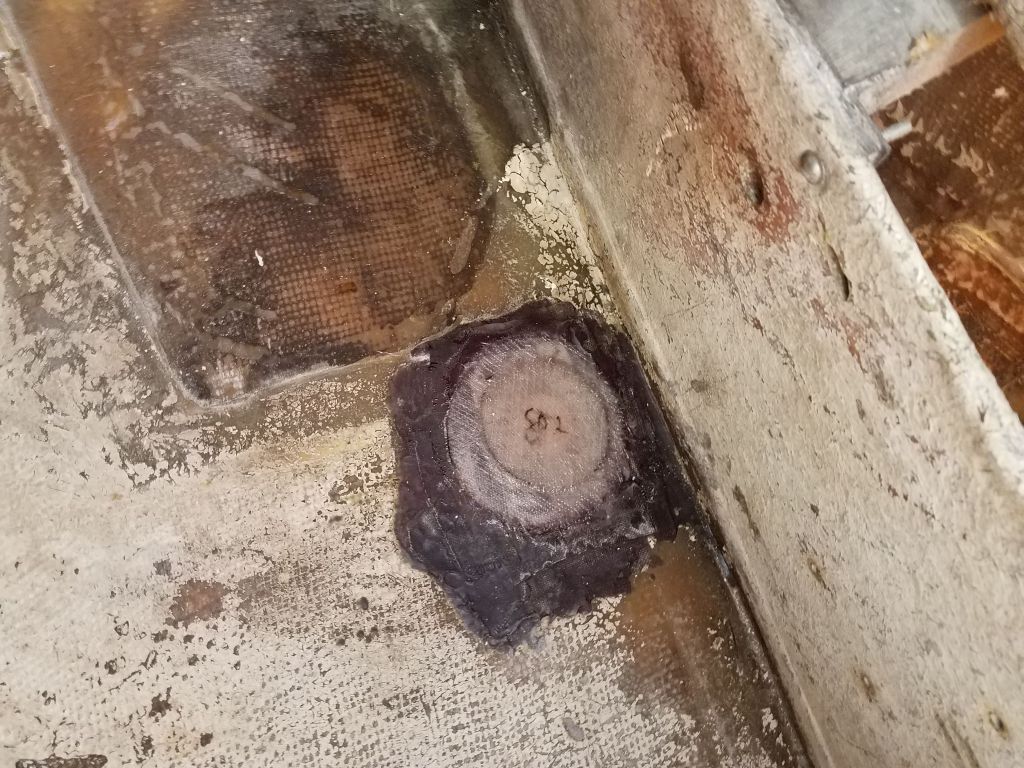
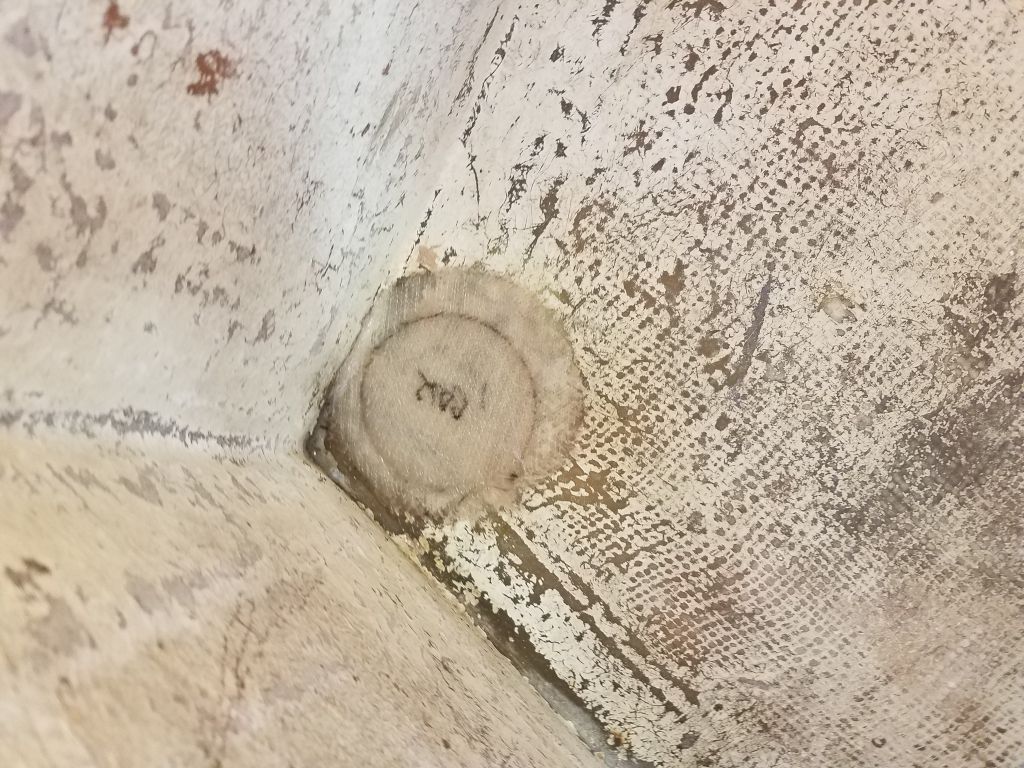
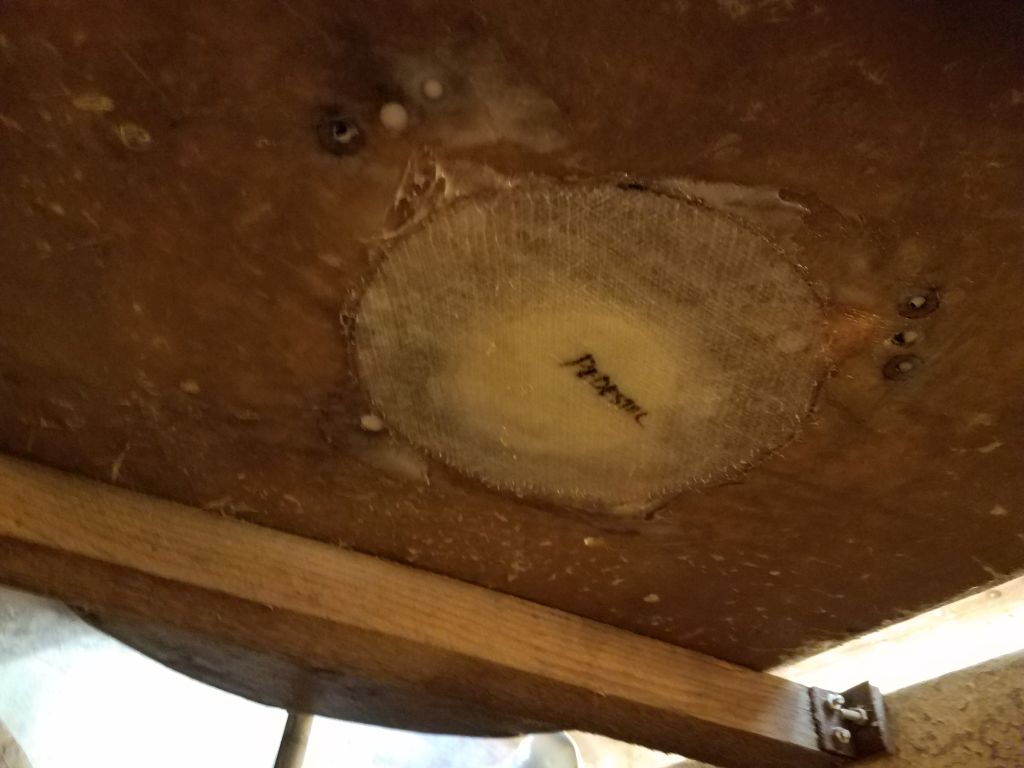
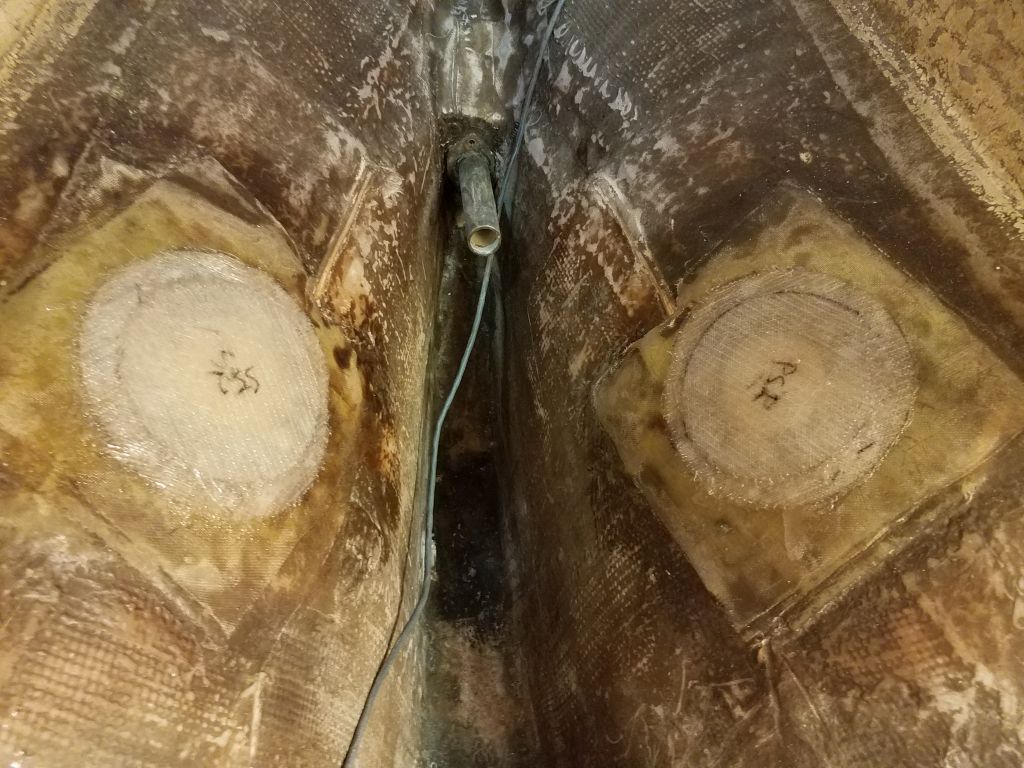
I’d long ago prepared all these old openings for the patch work by grinding out around the holes to accept the new fiberglass from outside, and in another work session I’d filled the round holes with my usual epoxy mixture from within, so all areas were ready for the new work after the usual solvent wash, epoxy application, and minor fine filling to better accept the fiberglass over the existing plugs.  With all the new fiberglass cut to shape, I wet out each patch and installed it in the usual way.

Total time billed on this job today:   8.25 hours

0600 Weather Observation:  45°, clear.  Forecast for the day:  Sunny, 50s

Scupper 41

< Back to Scupper

Thursday

After a day away from the shop working at a remote project, I got back to the deck and hull work with the usual round of sanding, this time mainly with a less aggressive finishing sander now that most of the fairing work was in its final stages.  There’d be additional, finer rounds of sanding soon ahead, but for the moment most deck areas were pretty much where they needed to be, other than some minor lows still requiring filling.

After sanding, some of the ground-out divots and gouges on the hull still required additional work, as many had received only one coat of fairing compound, but it was too awkward doing serious work on these areas with the staging at the higher height meant for deck work, so for the moment I planned to leave the hull mainly alone for more detailed attention as needed later on.

I removed the masking tape from the hull in way of the various through hulls I’d filled earlier, and as needed gave these areas a light sanding to prepare for the new fiberglass over the outside (and eventually inside).

After cleaning up the coachroof, I applied a first coat of epoxy fairing compound over the whole area, starting to even out the contours of the curved surface.  The first application was intended to fill the most obvious lows and bring some semblance of an overall contour to the area, but there’d be plenty of sanding and additional fairing to come.

The main bulkhead was pinned in place with some wooden blocks that were bolted through the cabin top with these barrel bolts.  I planned to remove these and secure the bulkhead in another way (tabbing), but for the moment I just left the fairing compound away from the bolt heads.

On the remainder of the deck, I focused mainly on little details, like cleaning up and re-filleting some of the corners in and around many of the areas I’d repaired earlier and between deck and cabin trunk/cockpit coaming, and continuing to fair in the large coaming repair on the port side and the repair to the port cockpit locker opening.

Total time billed on this job today:  5.25 hours

0600 Weather Observation:  42°, fog.  Forecast for the day:  Fog lifting, sun for most of the day, around 70°

Scupper 40

< Back to Scupper

Tuesday

First thing, I sanded all the deck areas as needed, removing excess fairing compound from the various areas currently underway.  Most of the fastener holes and small repairs would require some additional fairing work, as expected.

This time, in addition to cleaning up the decks once I’d finished sanding, I spent some time cleaning the bilges, interior, and related spaces, where I’d not really ventured in some time and which had become a Stygian mess.  With some of the upcoming work soon to require my reentry into the cabin and other spaces, it was too dirty for anything, and I had to make it at least remotely habitable by cleaning up the extensive dust, core debris, and other detritus that had accumulated over the past several weeks of intensive deck work.

After a solvent wash, I went around the decks and applied additional fairing compound as necessary, mainly focused on the cabin trunk and cockpit coamings with their myriad  small repairs, but I touched up a few areas on the main decks as they became evident.

It seemed like as good a time as any to apply a first coat of fairing compound to a number of small places I’d ground out on the hull during the early stages of the project.  I’d worked on some of the uppermost sections while I was rebuilding the hull/deck joint, and now I went around the rest of the lower sections of the hull to begin the repairs on the remaining divots.

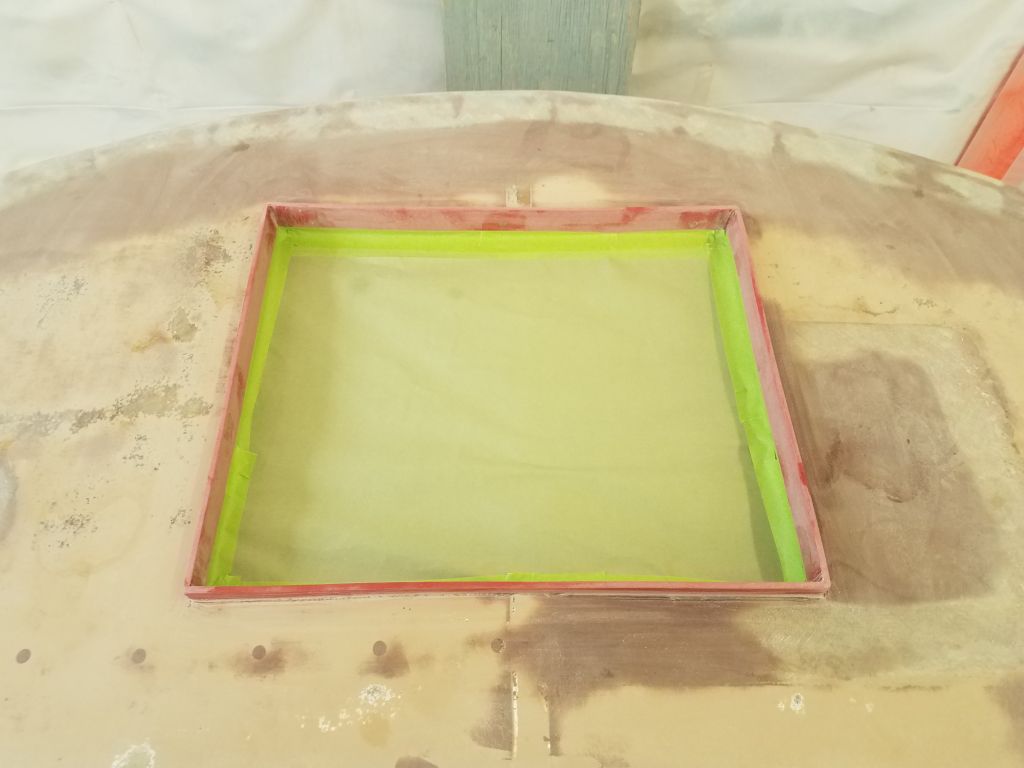
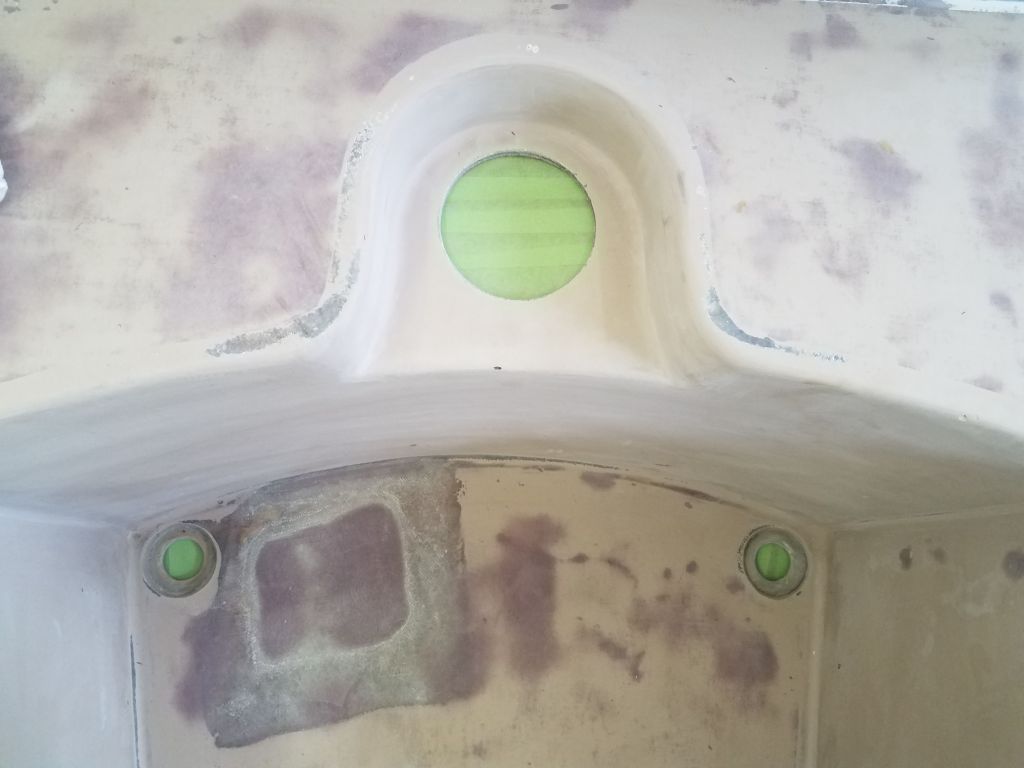
With a bit of time left in the day, I decided to get to work on the through hull openings, which I’d earlier ground out from outside the hull, ready to accept new fiberglass once I’d made some other preparations.  To start, I used a drum sander as needed to clean up the insides of the old holes and remove any remnants of sealant or other contaminants.  Then, I solvent-washed inside and out as needed, and masked over the openings from outside so I could fill the holes with a thickened structural epoxy mixture as a sort of plug over which I could later laminate the new layers of fiberglass, both outside and inside.

In the cockpit, I similarly filled some larger holes leftover from the bilge pump and other installations, after masking the openings from inside.

Finally, I prepared and installed new fiberglass over the port cockpit locker edge to repair and reinforce the damaged gelcoat and laminate there, and which I’d ground in preparation out earlier.

Total time billed on this job today:   7.5 hours

0600 Weather Observation:  30°, clear.  Forecast for the day:  Sunny, 70s

Older posts Newer posts